Wenxin Liu
About Me
I am a Year-1 PhD student on the Mathematics CDT with interests in Numerical Optimization. My supervisor is Prof. Bertram During.
I also very interested in Computational PDEs, Numerical linear algebra, and Wasserstein gradient flows.
Contact
Email: Wenxin.Liu.2@warwick.ac.uk
Experiences:
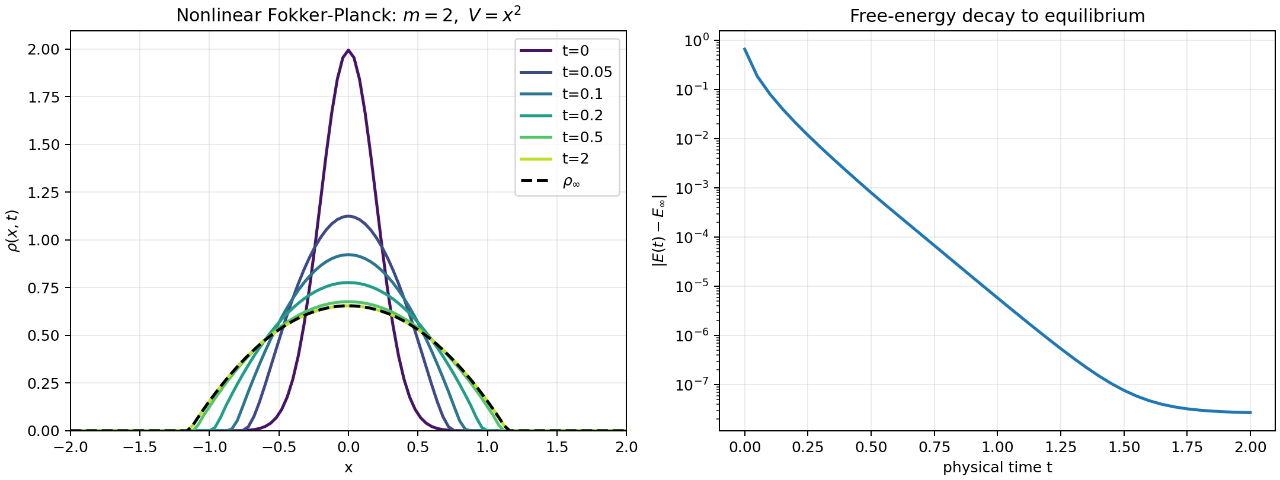
Master Project on Wasserstein Gradient Flows via Primal-Dual Splitting
Reproduced and implemented primal-dual dynamic JKO schemes for Wasserstein gradient flows, including porous-medium evolution and nonlinear Fokker–Planck dynamics. The implementation builds sparse continuity, no-flux, mass, and initial-condition operators, then solves the constrained kinetic-energy problem using pointwise proximal updates.
Optimal Transport Primal-Dual Method JKO Scheme Gradient Flows
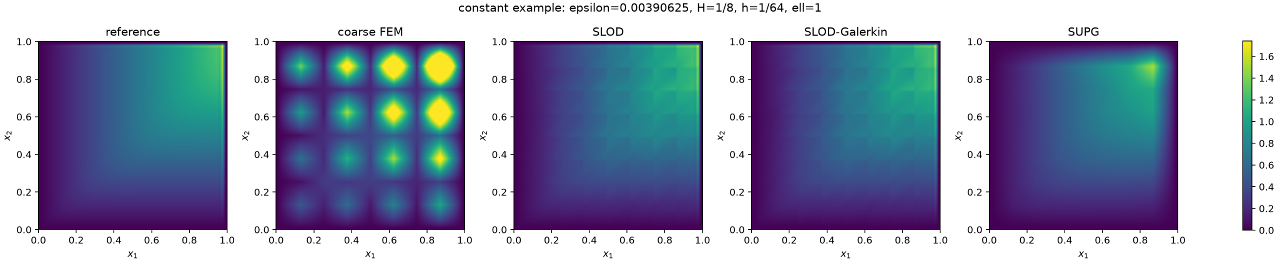
Multiscale PDE: Super-Localized Orthogonal Decomposition
Implemented a standalone two-dimensional reproduction of the Super-Localized Orthogonal Decomposition (SLOD) method for convection-dominated diffusion problems. The code builds Q1 finite element discretizations, local element-response bases, standard FEM and SUPG baselines, and SLOD/SLOD-Galerkin variants.
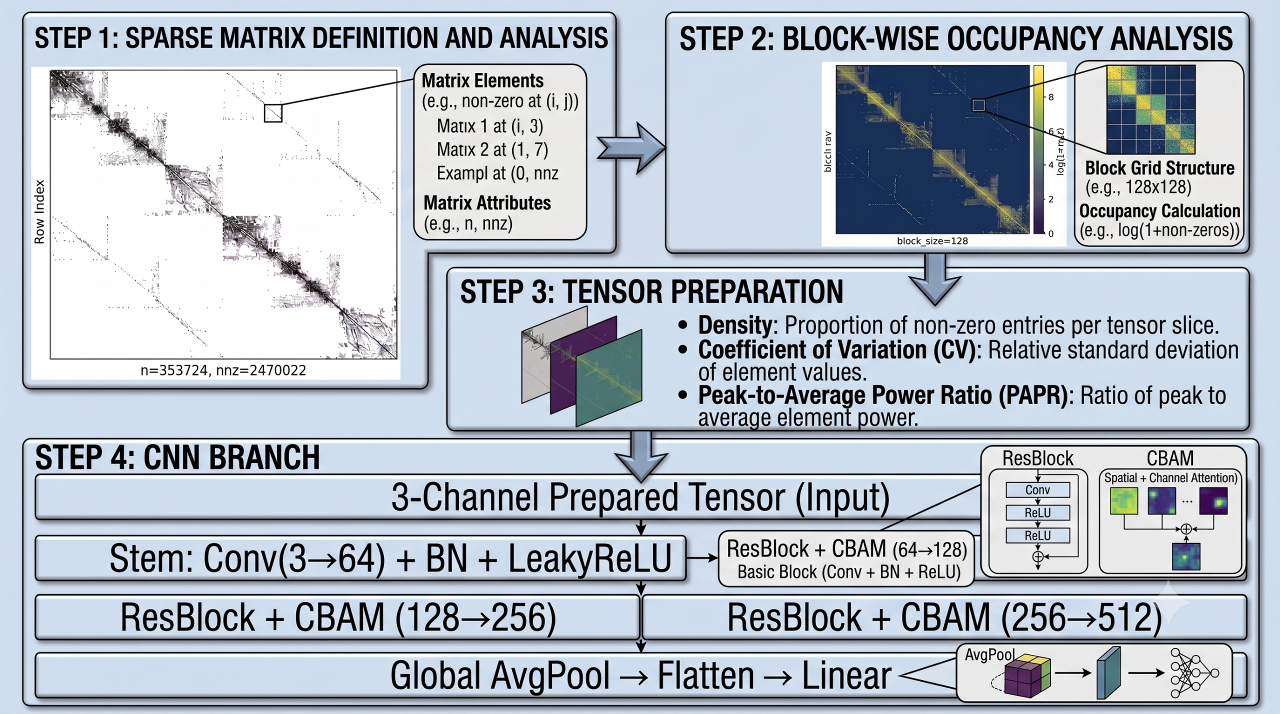
AISLS: AI-Accelerated Sparse Linear Solvers
Developed learning-based tools for accelerating large sparse linear systems from scientific computing workloads, combining solver/preconditioner selection, AMG parameter autotuning, and GNN-based initial-guess prediction.
Subprojects and results:
-
Solver/preconditioner selection: attention-fused CNN-MLP prediction over 26 solver combinations, reaching 80.3% accuracy and about 3.83× solve-time speed-up.
-
AMG parameter autotuning: learned AMG strong-connection threshold θ/eps selection, giving about 1.27× time speed-up and 20.97% iteration reduction against a default setting.
-
GNN initial guess: OpenFOAM pressure-Poisson tests achieved 1.67× average and 13.16× maximum iteration speed-up, plus 1.79× average and 19.51× maximum wall-time speed-up.
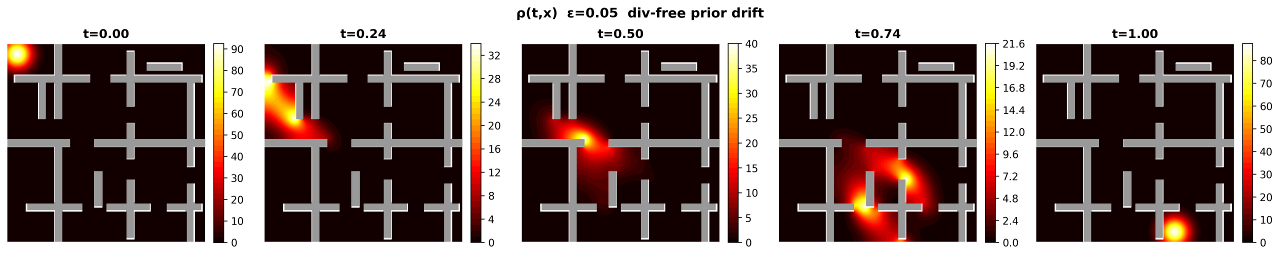
ECC 2026 : Generalized Schrödinger Bridge Computations
Developed finite element solvers for reflected Schrödinger bridge problems with obstacle geometry, nonlinear prior drift, and iterative forward-backward potential updates. This work supports ECC 2026 paper on PDE-constrained optimal trajectory planning under uncertainty.