
Warwick Economics alumnus awarded UK Finance Top Student Award 2026
Warwick Economics alumnus awarded UK Finance Top Student Award 2026
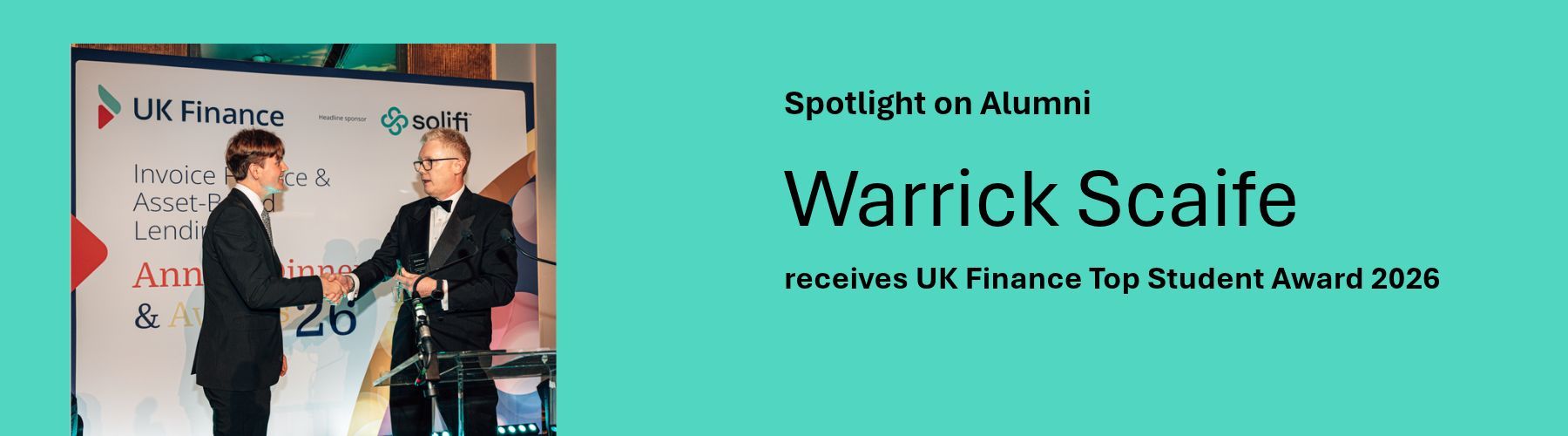
Wednesday 28 Oct 2026We were delighted to hear that Warrick Scaife (BSc Economics, 2024), a graduate of the Department of Economics, received the UK Finance Top Student Award 2026 at the UK Finance Annual Awards Dinner on 10 September. The award recognises the student who achieves the highest marks in UK Finance examinations during the preceding year.
Since graduating, Warrick has built experience across several areas of business and finance. After initially joining Amazon as a Business Analyst, he moved to Lloyds Banking Group in September 2025 to join its Business and Commercial Banking Graduate Scheme. Through rotations in Invoice Finance Sales, Financial Markets and, most recently, Mid Market Credit, he has gained experience spanning client relationships, financial markets and credit risk.
Warrick's connection with Warwick began long before he enrolled as an undergraduate. Having attended The Westwood Academy in Coventry, he participated in several of the University's outreach programmes, including mathematics days and English Literature workshops. He subsequently completed the Sutton Trust's Pathways to Banking and Finance programme, which helped pave the way for his undergraduate studies and later involvement as a Warwick Scholar.
We asked Warrick about his experience since graduating from Warwick and this is what he said:
Studying Economics at Warwick strengthened my analytical and critical-thinking skills, which are particularly valuable in credit risk, where you need to assess financial information, challenge assumptions and identify anything that doesn't quite add up. Modules such as EC226, alongside quantitative and programming work, helped me develop the ability to work confidently with data and interpret results effectively.
Beyond the technical skills, Warwick also encouraged a mindset of curiosity and persistence. Economics students are taught to look beyond the obvious answer, question their assumptions and work through complex problems. I have found that approach just as valuable in the workplace as the technical knowledge I gained during my degree.
How did studying economics at Warwick equip you with the analytical and professional foundations that helped you stand out at Lloyds Banking Group?
One of the most valuable skills I developed at Warwick was learning to question results rather than simply accept them. Modules such as EC346 encouraged me to challenge assumptions, consider alternative explanations and think critically about the conclusions drawn from data. These skills are particularly important when assessing business risks and making informed decisions.
My quantitative foundations were strengthened through EC226 and EC350 (Data Science), while EC333 and other industrial economics modules helped me understand financial markets and the economic forces that influence them. Together, these modules gave me a strong grounding in both analytical thinking and economic theory, allowing me to pick up new concepts quickly and apply them throughout my placements at Lloyds.
In what ways did Warwick’s academic environment shape your ambition for the finance sector?
Before coming to Warwick, I knew I wanted to pursue a career in finance, but studying Economics there helped raise my ambitions and gave me a clearer idea of what I wanted to achieve. From the first term, I was surrounded by people who were motivated, curious and willing to challenge themselves. Conversations with peers often centred on career aspirations and the steps we could take to achieve them.
Being part of that environment encouraged me to think more ambitiously about my own future. It also showed me the value of being proactive, seeking out opportunities and learning from the people around me.
Were there particular modules, projects, or mentors at Warwick that had a lasting impact on your professional direction?
EC333 was a particular highlight, especially the topics covering options and derivatives. These sparked my interest in financial markets and contributed to my decision to return to that area during my second placement at Lloyds.
Another meaningful experience was the Secondary Maths Teaching module, which connected closely with my involvement in Warwick in Africa and reinforced how much I enjoy education and widening participation. The experience had a lasting impact on me, both personally and in how I think about creating opportunities for others.
I was also fortunate to have a mentor at Lloyds who had studied at Warwick. Their ambition, drive and support played an important role in helping me settle into my summer internship in 2023, after my second year. Having someone who understood both the university experience and the transition into banking was incredibly valuable.
Tell us about your work within Widening Participation (Warwick Scholars) as a mentor and how this has shaped your career choices.
Widening participation has been one of the most rewarding parts of my time at Warwick. Through the Warwick Scholars programme, I mentored students as they navigated university life and thought about their future careers, including an Economics student who has since gone on to work at Citi.
I also supported students through Pathways to Banking and Finance and worked across seven widening participation summer schools. These experiences gave me the opportunity to help students access opportunities that might otherwise have felt out of reach.
Having benefited from widening participation initiatives myself, I understand the difference that encouragement, guidance and access to the right opportunities can make. These experiences have reinforced my belief that talent exists everywhere, but opportunity does not always follow. Helping to bridge that gap is something I hope to continue throughout my career.
Were you involved in the work of student societies at Warwick? How important was it for building your confidence and for job hunting?
In my second year, I helped organise Warwick Economics Society tours to Bristol and Barcelona. I really enjoyed the experience, particularly the planning and coordination involved in bringing everything together.
Organising these trips helped me develop my communication, teamwork and organisational skills, as well as giving me practical examples to draw on during interviews. It also gave me the confidence to take responsibility for projects beyond my academic work and showed me the value of getting involved in university life outside the lecture theatre.
Looking back, what skills and knowledge developed at Warwick have proved most valuable in your career so far?
Above all, Warwick Economics helped develop my ambition, drive and willingness to challenge myself. The Department fostered a culture of academic excellence that encouraged me to aim high, work consistently towards my goals and keep looking for ways to improve.
The technical knowledge I gained has been valuable, but the mindset I developed alongside it has been just as important. Being willing to persevere when something is difficult, question what I don't understand and keep learning has helped me make the most of the opportunities I've had since graduating.
My graduate scheme at Lloyds has given me the opportunity to experience several different areas of commercial banking, each offering a different perspective on how banks support businesses.
My first rotation was in Invoice Finance Sales, where I worked with small and medium-sized businesses and gained exposure to client relationships and funding solutions. Working in this area helped me develop my commercial awareness and understand how businesses manage their cash flow, access finance and support their growth.
My second rotation was in Financial Markets, which connected closely with my Economics degree. I gained experience in analysing market developments, interpreting economic data and supporting client communications around risks such as foreign exchange and interest rates. It was particularly interesting to see how economic developments translate into practical decisions for businesses managing financial uncertainty.
I am now in Mid Market Credit, where my work focuses on assessing the creditworthiness of medium-sized businesses and supporting lending decisions. This involves detailed financial analysis, evaluating risks and challenging assumptions to build a clear picture of a business's financial position and prospects.
Each rotation has helped me develop a different set of skills, and together they have given me a broader understanding of commercial banking, from understanding a client's needs to assessing the risks involved in providing finance.
How do you see the banking and finance sector evolving, and what excites you most about being part of that change?
Automation and artificial intelligence are already changing how banks operate, creating opportunities to streamline processes, improve efficiency and make better use of data.
What excites me most is the potential for these developments to give people more time to focus on the parts of banking where human judgement and relationships matter most. Understanding a client's business, navigating complex decisions and providing advice that reflects their long-term objectives are all areas where people can add significant value.
As someone at the beginning of my career, I find it exciting to be entering an industry that is evolving so quickly. I want to keep developing my technical knowledge while learning how to use new tools effectively, so that I can help clients navigate uncertainty and make informed financial decisions.
The UK Finance examinations were an important part of my professional development at Lloyds, helping me build my technical knowledge while balancing study alongside a demanding full-time role.
Preparing for the exams required discipline, consistency and careful time management. Completing them was rewarding in itself, as it gave me the opportunity to consolidate what I had learnt and demonstrate my understanding of the material. The experience also reinforced the importance of maintaining a commitment to learning alongside the day-to-day demands of work.
What does receiving the UK Finance Top Student Award mean to you?
Receiving the UK Finance Top Student Award is a milestone I am incredibly proud of, both personally and professionally. It recognises the work I put into studying alongside my role at Lloyds and is a great reflection of the effort that went into preparing for the examinations.
It is particularly rewarding to have that work recognised so early in my career. The award has given me confidence in what I can achieve through consistent effort, while motivating me to keep learning and building on that foundation. I am grateful to everyone who has supported me along the way.
What aspects of your Warwick experience do you feel most directly contributed to your success in receiving the UK Finance Top Student Award?
I think Warwick helped me develop the discipline and perseverance that contributed to this achievement. My degree was demanding, particularly in my second year, and taught me how to manage a heavy workload, stay focused under pressure and keep working towards a goal even when things became challenging.
Those habits have carried over into my professional life. Balancing work and study required a similar level of organisation and commitment, and I drew on the same approach I had developed at university: breaking down a challenging task, putting in consistent effort and taking responsibility for the outcome.
My advice would be to start exploring opportunities early, be intentional about what you apply for and focus on roles that genuinely interest you. It is worth taking the time to understand the different areas of banking and finance, as the industry offers a much wider range of careers than you might initially expect.
At the same time, don't be discouraged if you don't secure your ideal role straight after university. There are many routes into the industry, and careers rarely follow a single, predictable timeline. Focus on building your skills, making the most of the opportunities available to you and staying open to possibilities you might not have considered before.
Most importantly, don't underestimate the value of experiences outside your degree. Getting involved in societies, mentoring others or taking on additional responsibilities can help you develop skills that are just as valuable in the workplace as your academic knowledge.
If you could share one lesson you’ve learned since graduating, what would it be?
One of the biggest lessons I've learnt is that your career is only one part of your life. It is easy to become caught up in targets, achievements and the next opportunity, particularly when you are surrounded by ambitious people.
While having goals and working hard towards them is important, I think it is equally important to invest in your relationships, interests and personal development outside work. Becoming a well-rounded person, rather than focusing solely on career progression, will ultimately make for a more fulfilling life.
What message would you share with prospective students considering Warwick Economics?
I loved my time studying Economics at Warwick, and I would choose it again without hesitation. The Department offers an excellent combination of academic rigour, opportunities to explore your interests and a community of people who encourage you to challenge yourself.
My advice would be to make the most of everything Warwick has to offer, both inside and outside the classroom. Take on opportunities that interest you, try things you haven't done before and make the most of the people you meet along the way. You don't need to have everything figured out when you arrive. If you approach your time at Warwick with curiosity and an open mind, it can be an incredibly rewarding experience.
We are grateful to Warrick for reflecting on his journey and are delighted to celebrate his achievements. We wish him every success for the future.