
Beyond Words
Communicating with loved ones living with dementia when words are not enough – tips from partners and relatives, professional staff and academics.
Download our booklet (A6 size).
What's in this booklet
- Non-verbal communication and why it is important
- Practical suggestions and examples
- People's first hand experiences of caring for someone with dementia
- Some Dos and Don'ts
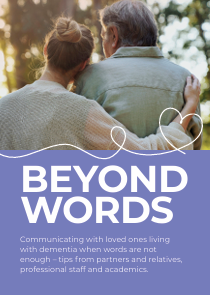
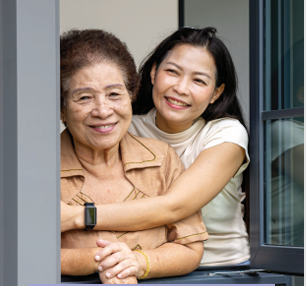
‘Beyond Words’ – when we say we love someone beyond words, it is often the look in our eyes, the tone of our voice, even our gestures, that express our love.
This booklet is about communicating with the person you care for when words are hard to find.
For information about dementia more generally, please see the page of Resources on the booklet website.
Booklet Index:
We all want to stay in touch with our loved ones if and when they find talking too difficult – or we find their words don’t make much sense any more. Some cultures rely more on touch than others, but we all use non-verbal ways to communicate. This booklet offers some simple techniques to help you communicate with them in this stage of life.
Our ideas and stories are relevant for any stage of the illness the person has reached, though particularly for when their illness has become advanced. But it may be helpful for you to try out some of the techniques while the person is still happy to engage in ordinary conversation.
‘There is a story here of growth in the midst of decline, my mother changing – and I with and in relation to her.’
Elinor Fuchs, writer
‘My mission was to make clear to people that there was a considerable level of intelligence at work behind the incoherence.’
Philip

Scene One
[In the photograph] my left hand is clasping Cath’s. . . . We are laughing. Cath’s eyes are closed, with, I guess, the intensity of the feeling.
It is a shared joke – one of many – but since she uses little language it may be something we have both noticed and looked at.
Or it may have been that one of us has thought of something and merriment has spilled over onto the other.
As always there is a complicity that goes beyond words.
John Killick
Adapting to the changes
We often talk about what our loved one can no longer do or has forgotten – it becomes a list of losses. The losses are as much ours as those of the person with dementia. They are tied up with what we used to do together, how we used to be with each other in public and in private.
What we often miss most is the kind of conversations we used to have, the lively gossip, the serious discussions, the jokes and that sense of a shared life full of meaning and memories. How can we conserve what is still positive and possible in our relationship with our loved one who is ill?
Our whole world of other relationships changes too when our focus is on the person with dementia; it may become difficult to spend relaxed time with family and friends, for example. But these relationships often become even deeper over time as they share our journey.
‘Dementia is a progressive condition so communication with the person changes and you have to adapt.’
Professional care worker
‘I am a words person – it’s particularly hard to suspend one’s instinctive search for clarity in a conversation.’
Helen
‘For most people, this set of circumstances – caring for someone with dementia – happens only once. So there is no easy way to draw on your past experience, nor a chance to learn and reflect on everything you need to as you go along. That’s why listening to, and sharing with, other people is so important.’
Geoff & Janet
Looks, Touch, Tone of Voice
Our society places a high value on verbal fluency.
But this is not the only – nor the first – way in which we communicate with each other. Think about the ways, from when we were very young, we learnt how to:
- tune into how the other person is feeling – and “tuning in” reminds us that music is a powerful way to connect
- go with the flow, be in the zone
- enjoy creating mutual attentiveness, for example by playing ‘catch’ with nonsense words
- improvise and play: for example, with finger games, ‘sing-songing’, peek-a-boo, blowing bubbles with a tub and wand, making pictures, moulding clay or play-dough, playing simple musical instruments, creating tiny surprises
So you could try any of these:
- make up word games, in which language has no purpose except enjoyable exchange and where meaning is created in the moment, as if by magical accident
- mirror the other person’s body language – dance with your hands
- mime what you want or what you want the other person to do
- create little rituals of greeting and farewell: like a particular way of saying hello, or a handshake, a playful goodbye wave
- put some music on and move together in time to the rhythm
- use coloured pencils to make some simple drawings together
- look together at books with lots of pictures / photographs
- rub hand cream onto the person’s hands – and let them do that for you if they want to
- use facial expressions, gestures and tone of voice to communicate – ‘it’s not what you say, it’s the way that you say it’
- embrace the absurd…
As adults, we do most of these things intuitively – they have become second nature in our daily interactions.
Now, with the person who may be finding words more difficult – whether speaking their own words or understanding yours – you can consciously develop your capacity to convey the value of their presence, in your life.
Play is a way of reaching and nurturing the authentic, creative dimension of a person’s personality – all the more important when that person has few external goals in their life.
‘The memory of words he had loved long ago still delicately chimed’
Nicci Gerrard, writer
‘We tried not to base our expectations of our next meeting with our sister-in-law on yesterday’s experience with her, whether it was good or difficult – today could be totally different.’
Geoff & Janet
‘I talk as if we are having a conversation about common interests. He listens, sometimes looking puzzled, at other times seeming to be interested; now and then he will smile if I say something funny.’
Gabriel
‘Laughter is both the medium and the goal of such games – a merriment that the other can catch without ever knowing its cause.’
John Killick, writer
‘Holding his hand, an arm round the shoulder for a cuddle calms him better than talking. Just try to keep the person happy.’
Jan

Scene Two
Almost daily on the telephone we have our weird little chats, our excursions into zero-degree speech, speech without intention or result.
“Hello, Mother,” I begin. And mother lobs back enthusiastically.
“Hello, my mother, duther, wrubber, brother, dear, dear, lovely, dovey --”
[Then her mother says:] “There was a lot of starting at the beginning.”
Starting at the beginning? “Oh, this is marvellous!” I chuckle. Mother always laughs when she hears a laugh, and we hang up laughing.
Elinor Fuchs
‘My husband brightens up whenever I take him for a walk outdoors – he mimics the bird calls, their trills and swooping shrieks.’
Lesley
‘Sometimes I get irritable and raise my voice – then I can see I’ve upset my husband, so I say “I need a hug” and we have a big hug, which puts us back on an even keel.'
Christine
Just like you, the person with dementia has a set of remembered phrases, gestures and facial expressions that are recognisably their own, their distinct way of talking, walking, eating, and the kind of shape they make in the world.
Just like you, they will pick up quickly on non-verbal cues, like your frown or your smile or the irritation or enjoyment in your voice. These forms of emotional and physical expression may in time become the only way the person with dementia can sustain a relationship with you.
And such ways of connecting make the communication between the two of you more equal, more open to shared pleasure, which is its own purpose.
We can think of these activities as a performance, an improvisation that celebrates what humans can do, with and without language, to stay in touch with each other. Words may still form part of the interaction, but more for their music than their meaning.
It is all about co-creating the ‘we-here-now’, for this moment as long as it lasts. Shared communication and activity – with words or without – should not be about ‘getting something done’. It is not a transaction, it does not have to get somewhere.
Scene Three
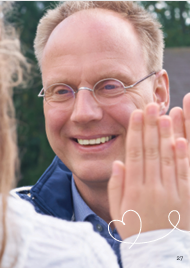
I try clapping her hands inside mine, and she picks up on the game. Or it becomes a game because she picks up on it. She keeps perfect time, and mostly gets the pattern just right.
Clap! Cross right.
Clap! Cross left.
Clap! Clap Clap!
Mother is eighty-four with advanced dementia, I am in my fifties and we are playing patty-cake. We are doing childhood all over again. For all I know we are doing it for the first time. We are having such a good time.
Elinor Fuchs
‘I have learned to try and connect emotionally with my dad rather than purely cognitively. This involves keeping eye contact, being patient and smiling, to see the person inside, rather than the disease.’
Ashley
‘I would sometimes touch his hand, for reassurance, for being alongside even when the words were failing us both; over time, we resorted more and more to simple eye contact and physical touch – giving up on the struggle to do it with words.’
Philip
‘Conversation in those living with dementia can be seen as the purest use of the body in speech. Lil’s language is a sensory production, in every sense; it is embodied, full of sound, pace and energy of delivery. Her language is, as it is identified in her daughter’s memoir, a “shimmy”, a dance.’
Liz Barry, researcher
‘My brother used to tell jokes at the family dinner table which stuck in my memory, and some of the jokes I now tell him are his own from those days.’
M
Some Dos and Don'ts
These may be especially useful if you're visiting or haven't seen the person for a while.
Do:
- Greet the person with a smile, and make friendly eye contact – show you’re pleased to see them
- Take a while just to sit and let them get used to your presence; give them your full attention
- Listen, without judgement, to the shape as well as the content of what they are saying; and be patient – it may be easier to understand their facial expression and tone of voice than their words
- Use a soft voice and speak clearly
- Match your tone of voice and facial expression to what you’re saying
- Take a moment to breathe if you feel irritation coming into your voice
- Be forgiving of yourself: communication doesn't have to be perfect and it's natural to feel sad, angry or inadequate some of the time
- Keep your side of the conversation light-hearted and straightforward
- Remember that life can be very tiring for someone who has dementia
- Let the person take the lead on interactions; and be open to surprises about what they can do or remember that you assumed no longer possible
- Use the comfort of touch - just holding hands - to reassure or console
- Buy a sensory or fidget toy (search for ‘sensory products for dementia’) and show them ways to play with it
- Make yourself more informed about dementia, for example by reading books and articles and/or taking a short training course – in person or online
Don'ts (or try not to):
- Lean over them too closely or invade their personal space
- Stare at them OR refuse to meet their gaze
- Overload their brains with information or a noisy environment
- Talk about the person in the third person as if they weren’t there
- Offer too many choices between different options
- Rush the person to do something, or make a decision, or finish what they are saying
- Make the person try to remember a particular person or an occasion from the past
- Correct them or make them feel inadequate (ask yourself: ‘does this really matter?’)
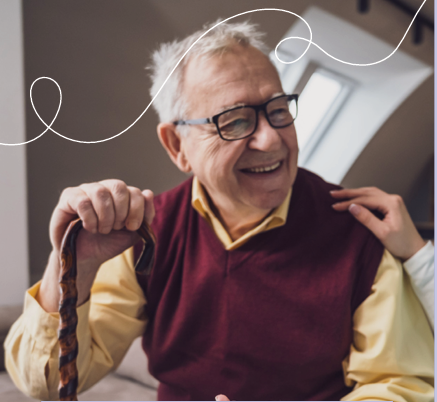
‘It is too easy just to brush over him to fill the silence with others starting to talk again – so I keep the rest of the family around him quiet while he is trying to assemble his thoughts to talk.’
Sue M
‘I use pictures and objects when I’m trying to explain something or asking them a question.’
Professional care worker
‘What a great thing live music is, handling instruments or dancing!’’
Sue G
Some questions for you
Here are the questions we asked people when we began writing the booklet; how might you answer them?
Thinking about the person with dementia with whom you have (or had) a close relationship:
1. What do you think you personally do (or did) particularly well in communicating with them?
2. What would you most like to have known about good communication skills when you first started to look after or visit them?
3. How has (or did) that communication process changed over time?
4. What – if anything – do (or did) you dislike about the way other people try to communicate with the person?
5. What advice could you give to other carers and family members about good communication?
6. What advice, if any, would you like to give to professional staff about appropriate communication?
‘I have made photobooks of past happy memories and my husband really enjoys them with others and on his own.’
Jan (also mentioned by many other carers)
‘I see my mother not only as a ‘patient’ and ‘sick’, but as an artist, spinning the poetry of a private world.’
Elinor Fuchs, writer
‘Find out what you can about the person’s interests when they were young and mirror it back to them, but without asking them difficult questions about it.’
Gabriel
‘I’m trying to find the borders between not humouring him, not giving up on the possibility that we can make sense of any confused conversation and, on the other hand, not pulling him up on stuff he’s forgotten.’
Helen
Scene Four
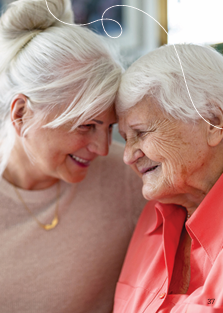
Elinor Fuchs is playing a language game with her mother Lil around the alliteration of her new care home, ‘Chevy Chase House’. They improvise a routine.
Lil: “Is it very . . . hah-hah?” She winks, twinkling across her failure of language.
“It certainly is.” I reply.
Lil: “You mean it’s a little [snapping her fingers] zu-zu?”
I consider the monthly bill: “Absolutely”.
Lil starts to cha-cha and do the shimmy, saying, “So then it’s hunh-hunh?”
I hold the door for her and she shimmies out. We are laughing so hard we are crying.
We are very grateful to the following people and organisations who have helped us in various ways with putting this booklet together:
- Individual respondents to our questionnaire, all of whom have experience of caring for someone with dementia
- Senior Leadership Team, staff and visitors, The Close Care Home, Burcot, Oxfordshire
- Dementia Oxfordshire and the Experts by Experience Group, both services provided by Age UK Oxfordshire
- Dementia UK
- Eleanor Care Group
- Moving Music and Sound Resource
- Older Adult Mental Health Social Work team, Oxfordshire
- Oxfordshire County Council Adult Social Care
- The University of Warwick
The ‘Scenes’ are taken from John Killick and Kate Allan, Communication and the Care of People with Dementia, Open University Press (Scene 1), and Elinor Fuchs, Making an Exit, Plunkett Lake Press (Scenes 2, 3 and 4).
Feedback
So we would love to know what you think of this booklet.
We would be really grateful if you could scan this QR code or go to https://warwick.co1.qualtrics.com/jfe/form/SV_4Iow6aMgFaVHdC6 and answer a couple of quick questions (anonymously) about the booklet so that we know what is useful. This will help us continue our efforts to improve the lives of those living with dementia and those caring for them.

If you would be willing to provide a more detailed response, please email us at arts.impact@warwick.ac.uk and we will send you some questions. As part of our gratitude for this detailed feedback we will provide an e-gift voucher.
We are especially grateful to the University of Warwick for funding Professor Barry’s research work in this field, as well as for the design and printing of the booklet.
Compiled by Lesley Saunders and Liz Barry.
“I think the booklet is wonderful. In fact, I would love copies to show the wider operational team and executive members” – Marie McCourt, Care Homes & LD Operations Director, Eleanor Care Group
“I really liked the way the booklet flows, with examples from lived experience and quotes from individuals expressing the reality of communicating with people with dementia. The Dos and Don’ts are clear and succinct” – Diane Drain, Academy Lead Admiral Nurse, Dementia UK
“The approach you describe — centring playful improvisation, gestures, expressions, and non-verbal connection — feels humane, practical, and exactly the kind of resource informal carers and visitors need” – Sijo Mathew, Team Manager, OAMHSW Team
“Overall, we thought it was excellent and the way you’ve used your own experience to help others in this way is truly admirable” – Isabel Rockingham, Head of Joint Commissioning, Age Well, Oxfordshire Health, Education and Social Care Joint Commissioning Team
“Congratulations to the people putting this together – it is such a challenge! The more information there is for people coping with dementia the better” – Anna, Sound Resource charity