
News & Events

Impact Prize for forensic doctoral researcher
Danni Norman has been awarded the Faculty of Science, Engineering and Medicine PhD Thesis Impact Prize for her thesis entitled "Factors Modulating Memory-based Deception Detection in Concealed Information Tests".
New Publication: "Seen this scene? Scene recognition in the reaction-time Concealed Information Test"
 Dr Danni Norman (WMG) and colleagues, Dr Daniel Gunnell, Aleksandra Mrowiec, and Professor Derrick Watson (Psychology) have published a new paper investigating whether the Concealed Information Test (RT-CIT) can determine whether suspects recognise crime-related scenes.
You can download a freely available version of the paper via Warwick's research repository.
Here is a general summary:
Detecting a suspect’s recognition of a crime scene (e.g. a burgled room or a location visited for criminal activity) can be of great value during criminal investigations. Although it is established that the reaction-time Concealed Information Test (RT-CIT) can determine whether a suspect recognizes crime related objects, no research has tested whether this capability extends to the recognition of scenes. In Experiment 1, participants were given an autobiographic scene-based RT-CIT. In Experiment 2, participants watched a mock crime video before completing an RT-CIT which included both scenes and objects. In Experiment 3, participants completed an autobiographic scene-based RT-CIT, with half instructed to perform a physical countermeasure. Overall, the findings showed that an equivalent RT-CIT effect can be found with both scene and object stimuli and that RT-CITs may not be susceptible to physical countermeasure strategies thereby increasing its real-world applicability.
Seminar: "Serious Organised Crime: Answering the Home Office’s call for evidence"
 The Cambridge Centre for Science and Policy are holding a free virtual seminar entitled "Serious Organised Crime: Answering the Home Office’s call for evidence". The seminar will take place on Zoom at 11am on Thurs 25th June.
You can find out more and register here.
New Publication: Patrolling the “Thin Blue Line” in a World in Motion: An Exploration of the Crime Migration Nexus in UK Policing’
 Dr Ana Aliverti (Law) has published a new paper that examines the role of police in patrolling the UK's borders.
You can download a freely available version of the paper via Warwick's research repository.
Here is a general summary:
This paper examines the contemporary role of the police in patrolling the nation’s territorial and social borders. The police play an important role in framing ideas and perceptions of order and disorder. By selecting when and against whom to apply coercion, the police not only constitute crime and criminals. They shape the boundaries of civility and patrol the margins of citizenship. Such role has been revitalized lately as they are tasked with immigration enforcement functions. Drawing on an empirical examination of immigration-police cooperation in England, I explore how police and immigration officers define the remits of their job and work alongside in everyday policing. I argue that the reliance on immigration enforcement by the police evinces the limitations of modern policing to decipher the new geographies of crime and disorder, and their difficulties in offering a reassuring response to public anxieties and ultimately in producing social order.
New Publication: Judging Juries: The "Common Sense” Conundrums of Prosecuting Violence against Women
 Professor Vanessa Munro (Law) has published a new chapter that reviews findings on jurors' approach to decision-making in rape cases.
You can download a freely available version of the paper via Warwick's research repository.
Here is a general summary:
The jury plays a pivotal role within many criminal justice systems. It has often been lauded for its unique ability to ensure the involvement of, and accountability to, members of the public in the application of criminal laws to citizens. At the same time, however, what goes on in the jury room has remained remarkably opaque. We know little about the nature and content of jury deliberations, about how legal tests are understood and applied therein, and about what persuasive strategies are most effective in securing a verdict. Over the past two decades, I — together with colleagues — have conducted several studies, using trial simulations, designed to explore jurors’ approach to decisionmaking in rape cases. In this article, I reflect on the key findings from that work and situate them in the context of ongoing international dialogue about both how to respond to the “justice gap” in rape cases, and what to do about juries.
New Publication: Quality Standards for Digital Forensics: Learning from Experience in England & Wales
 Professor Tim Watson (WMG) and colleagues, Dr Gillian Tilly (Forensic Science Regulator), Neil Cohen (Defence Science and Technology Laboratory), Gareth Davies (United Kingdom Accreditation Service, and Prof Roy Isbell (University of South Wales), have published a paper that examines the quality standards for digital forensics in England and Wales.
You can view the paper hereLink opens in a new window.
Here is a general summary:
The Forensic Science Regulator has the role of setting quality standards for forensic science in the Criminal Justice System (CJS) in England and Wales. The current requirement is for organisations carrying out digital forensics to gain accreditation to the international standard ISO/IEC 17025 and the Forensic Science Regulator's Codes of Practice and Conduct. The aim of this requirement is to embed a systematic approach to quality, including understanding methods, validating software and systems, understanding risks, ensuring that all involved in the crime scene to court process have the skills and competence they need and the appropriate equipment and environment for the work, and providing ongoing assurance of quality through audit and proficiency tests. However, the challenge of implementing the standards in digital forensics should not be underestimated, particularly in an environment where there is insufficient capacity to meet a growing demand for services in an area of increasing complexity and fragmented delivery. It is therefore timely to review available data to determine the extent to which accreditation to ISO/IEC 17025 is addressing quality issues in digital forensics and consider what changes and resources could be made available to assist with implementation of quality systems.
New Publication: Using Virtual Reality to Enhance Deception Detection in Police Investigations
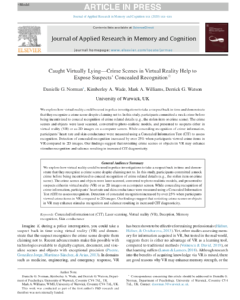 PhD student, Danni Norman (Psychology), and her co-supervisors, Dr Kim Wade, Prof Derrick Watson (Psychology) and Prof Mark Williams (WMG), have published a new paper that explores how virtual reality might be used in police investigations to enhance the efficacy of the Concealed Information Test.
You can download a freely available version of the paper via Warwick's research repository.
Here is a general summary:
We explore how virtual reality could be used in police investigations to take a suspect back in time and demon- strate that they recognize a crime scene despite claiming not to. In this study, participants committed a mock crime before being incentivized to conceal recognition of crime related details (e.g., the stolen item or crime scene). The crime scenes and objects were laser scanned, converted to photo-realistic models, and presented to suspects either in virtual reality (VR) or as 2D images on a computer screen. While concealing recognition of crime information, participants’ heart rate and skin conductance were measured using a Concealed Information Test (CIT) to assess recognition. Detection of concealed recognition increased by over 25% when participants viewed crime items in VR compared to 2D images. Our findings suggest that revisiting crime scenes or objects in VR may enhance stimulus recognition and salience resulting in increased CIT diagnosticity.
National Custody Forum 2019

On the 15th and 16th May 2019, COPR hosted the National Custody Forum at the Warwick Business School. This event was attended by police officers and researchers from across the UK.
New Publication: Empirical Approaches to Criminal Procedure

COPR Director Jackie HodgsonLink opens in a new window has a new chapter on Empirical Approaches to Criminal Procedure in The Oxford Handbook of Criminal ProcessLink opens in a new window.
The recently published chapter was written in collaboration with Yu MouLink opens in a new window at the University of London, and focuses on criminal justice in its sociopolitical culture, routine criminal justice practices and the relationship between law and policy.
You can find out more and access the chapter hereLink opens in a new window.
Kim Wade is now Co-Director of COPR
Kim WadeLink opens in a new window has recently been appointed the role of Co-Director of COPR. She will take over from Neil StewartLink opens in a new window, who will continue to be an active COPR member and researcher at Warwick Business SchoolLink opens in a new window.
Kim (pictured left) will join Co-Director Jackie HodgsonLink opens in a new window (below right), who continues to work hard to keep COPR moving forward.

Kim's research focuses on memory distortions,and the implications of memory research for legal professionals, including work on eyewitness testimony, the best methods for constructing and adminsitering lineups, and the use of fabricated evidence. As well as being an active researcher, she also works as the Associate Editor at the Legal and Criminological PsychologyLink opens in a new window journal, and as the Executive Director of the Society for Applied Research in Memory and CognitionLink opens in a new window. No doubt she will also do a fantastic job as Co-Director of COPR!
You can find out more about Kim's work on her home pageLink opens in a new window, and also on her websiteLink opens in a new window.