
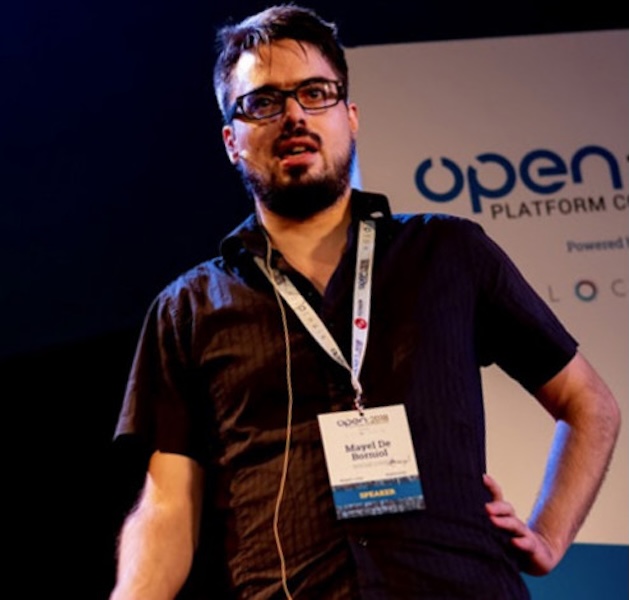
Mayel de Borniol
Bio
Mayel de Borniol is a developer, activist, and co-maintainer of BonfireLink opens in a new window, a not-for-profit, open-source framework for building federated social apps. Bonfire 1.0 launched at the end of 2025, after several years of co-design pilots and experimentation, and now supports a growing constellation of communities.
Rather than a one-size-fits-all platform, Bonfire is built from modular extensions that communities can assemble into their own apps, determining their own governance, moderation practices, and user experience. Among these is the Open Science NetworkLink opens in a new window, an emerging "flavour" of Bonfire tailored for academics and research communities, with features like ORCID integration and one-click archiving of discussions to Zenodo with a DOI.
Through Bonfire, they have collaborated with pioneering communities across the Fediverse and beyond, including Princeton HCI, Knowledge Commons, UCL, IFTAS, and the Social Web Foundation, to co-design features that range from federated groups and consent-based moderation to mutual aid networks and community archives.
Mayel's work sits at the intersection of software development, community governance, and participatory design, grounded in the belief that the people using a platform should also be the ones shaping and governing it. Their approach is shaped by sociocratic governance, peer production and coordination, and a long-standing interest in technology as commons. They are interested in how digital infrastructure is also social infrastructure, and growing tools that don't just connect people but support genuine participation, care, and collective power.
Outside Bonfire, they have contributed to projects across the cooperative and open source ecosystems, and regularly collaborate with grassroots organisations exploring alternatives to extractive platforms.
Participatory Design: A Living Lab for the Federated Research Commons
This fellowship will take shape as a living lab at Warwick, running a Bonfire instance as a site for participatory co-design of digital research infrastructure.
We will explore how communities can collaboratively shape, use, and govern their own digital spaces, by engaging a deliberately diverse mix of participants (academics, students, librarians, data stewards, and research software engineers) to foster interdisciplinary input and avoid replicating the narrow design assumptions baked into most platforms.
Methodological experimentation is at the heart of the project: we're not just piloting a platform, we're piloting the process: testing new models of participatory co-design, collaborative governance, and digital workflows, and learning publicly about what works and where the friction lies.
The work directly engages the Centre for Interdisciplinary Methodologies' themes of Democratising Information and Participation and Making Methods Matter, while contributing to Bonfire's broader mission of building federated infrastructure that genuinely serves the needs of communities.
Outputs will include a functioning Bonfire server that can persist as an ongoing digital commons for Warwick, a documented and transferable co-design methodology, openly licensed guides and resources, and practical insights into building inclusive academic platforms. Because Bonfire is free and open-source software built on open federation standards, everything produced here belongs to the commons and can benefit other open platforms.
Crucially, the Warwick instance will not be a walled garden: thanks to the ActivityPub protocol, it will federate with other academic institutions and communities, including Open Science Network and Bonfire instances, but also the broader Fediverse, with interoperability even extending to other open protocols like AT (Bluesky/Eurosky/Blacksky) or Matrix. This makes Warwick's digital space a node in a living network rather than a standalone forum.
Project details:
https://bonfirenetworks.orgLink opens in a new window
https://openscience.network/Link opens in a new window
Mailing address:
University of Warwick
Centre of Interdisciplinary Modules