
Calendar
Mother Tongue Other Tongue Poetry Competition
.jpg)
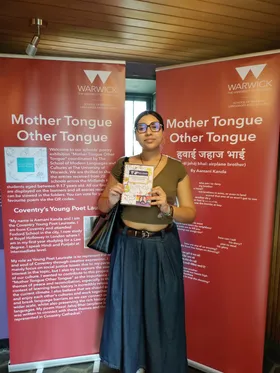
Staff from the School of Modern Languages and Cultures ran a series of events to mark the university’s 60th birthday and the 80th anniversary since the end of World War Two. Our theme of “Language Learners as Peacemakers” linked perfectly to our collaboration with Coventry Cathedral whose motto of peace and reconciliation drives all of their community engagement. We were delighted to produce a booklet of family friendly visitor activities and a tree of peace on this theme for visitors to the Cathedral during the summer holidays, and work with Coventry’s Young Poet Laureate Aamani Kanda from whom we commissioned a special poem “airplane brother” which introduced our schools poetry competition “Mother Tongue Other Tongue” exhibited with all our finalists across primary and secondary schools in the Chapterhouse. Finally, we hosted 2 evening talks delivered by two of our SMLC academics on their research on the Second World War and hosted a school’s event for 60 Year 9 pupils from Coventry schools in October. The students were able to reflect on the themes of peace and reconciliation through language learning with a series of language-based tasks and a creative challenge to propose and design a new piece of artwork to mark the link between Dresden and Coventry”
The competition was open to all students in KS2, KS3, KS4, and KS5.
The aim of the Mother Tongue Other Tongue competition was to celebrate languages, culture, and language learning—giving school students the opportunity to practise and improve their foreign language skills (in any language they were learning in school) and/or to appreciate and celebrate their heritage through poetry.
The regional competition was led by Routes into Languages West Midlands at the University of Warwick.
The competition:
Mother Tongue entries consisted of two parts. The first part was a poem—either an original piece written by the student, a creative work, or a poem or song that was “remembered” (for example, something in the student’s first language recalled from memory or passed down by a relative). This could be in any language except English. The second part was a short explanation in English describing the inspiration behind the piece, its origin, or its personal significance. If the poem was original, this section also included a translation. The explanation (no more than half a page) formed the basis for judging.
Other Tongue entries were original poems written in a language that was not the student’s first language. Entries were welcomed in French, Spanish, German, Italian, or Mandarin.
As the 2025 themes were more focused, students could alternatively submit a prose reflection in English exploring what peace and reconciliation meant to them—ideally based on an intercultural experience. This could be submitted instead of a Mother Tongue or Other Tongue entry.
All entries had to focus on the key themes for 2025: learning to live with difference, celebrating diversity, and peace and reconciliation.
There was one winner selected from each category in each of the four key stages. Each winner received a certificate and an online shopping voucher. As many entries as possible were exhibited in Coventry Cathedral during the school summer holidays.