
News from the Warwick Venice Centre
Warwick Venice Centre hosts workshop on Modern Trends in Parametrized Complexity
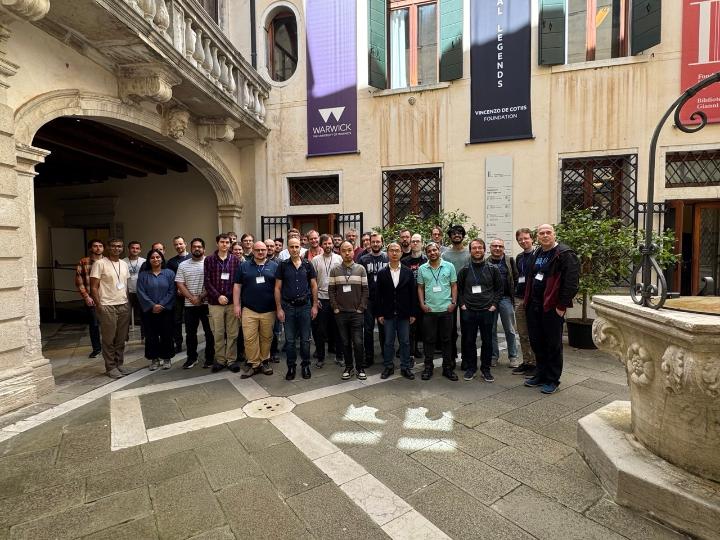
Between the 20th and 23rd of April WVC was pleased to welcome the “Workshop on Modern Trends in Parameterized Complexity” of 2026, organised by Ramanujan Sridharan, Associate Professor in Computer Science at Warwick, hosting 35 participants from 14 countries, thus bringing together an internationally diverse community. The MTPC is a workshop which brings together leading researchers and early-career scientists for a 3.5-day programme in Palazzo Giustinian Lolin in Venice.
Opening with a welcome reception on the evening of Monday 20th April, the workshop also had three lunches and a dinner on the final evening, providing additional opportunities for informal interaction alongside the in-depth tutorials, high-quality lectures and the contributed talks.
The entire programme encompassed a broad range of topics within parametrized complexity and related algorithmic areas. The tutorials given by Tuukka Korhonen (BARC, University of Copenhagen) and Jie Xue (New York University Shanghai) were designed to introduce participants, particularly early-career researchers, to active lines of research in the field.
The intensive programme also featured eight invited talks. The speakers were Robert Ganian (TU Wien), Iyad Kanj (DePaul University, Chicago), George Osipov (Royal Holloway, University of London), Benjamin Bergougnoux (Aix-Marseille University), Karthik C. S. (Rutgers University), Alexander Kulikov (JetBrains Research), Michael Lampis (LAMSADE, Université Paris Dauphine), and Jie Xue (New York University Shanghai).
Also included were 11 contributed talks of 20 minutes each, selected to represent a range of research directions. Contributors included both established researchers and early-career participants (PhD students, postdocs), providing an opportunity for the wider community to present recent or ongoing work.
On the Monday evening there was also an open problem session providing a structured yet informal setting for questions, discussing conjectures, and identifying directions for future work. In addition, there was informal discussion time, all with the goal of facilitating the exchange of ideas and initiation of new collaborations.
The workshop was an extremely positive experience, and having facilitated new discussions and collaborations, has the potential to have a substantial impact on the field.