
News from the Warwick Venice Centre
"Lying Abroad: Henry Wotton and the Invention of Diplomacy" with Professor Em. Carol Chillington Rutter, University of Warwick.
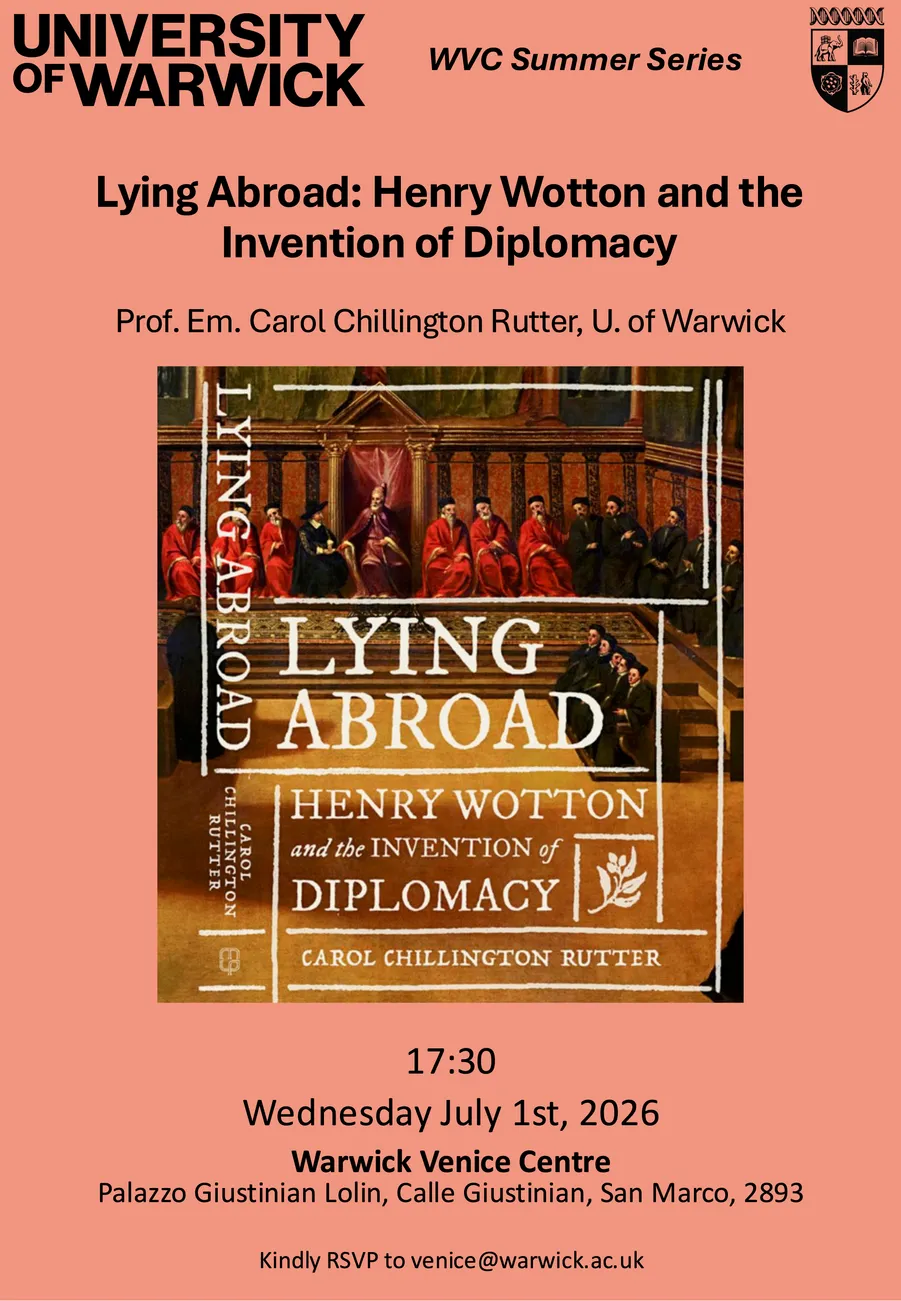
The third instalment of Warwick Venice Centre's Summer Series is the presentation of Lying Abroad: Henry Wotton and the Invention of Diplomacy with Professor Em. Carol Chillington Rutter (University of Warwick). The event will be in English with questions and discussion in English and Italian. Spaces are limited. Please RSVP to venice@warwick.ac.uk.
By the time King James VI/I sent him ambassador to Venice in 1604, Henry Wotton had already exhausted several lives: student, traveller, soldier, secretary, scoundrel, spy. Wotton's assignment in La Serenissima? To restore Anglo-Venetian relations, lapsed for fifty years. Lying abroad: Henry Wotton and the invention of diplomacy recounts Wotton's backstory, how the mind of the future ambassador was formed by school, travel, and employment with that 'star of England', the earl of Essex. Then, deep-diving into the Archivio di Stato here it Venice, it watches Wotton build his embassy from the ground up. When the gunpowder plot explodes in London and the Interdict Crisis threatens Venetian sovereignty, Wotton reacts by inventing diplomacy that changes the course of European history.
About the Author:
Carol Chillington Rutter is an award-winning author, university teacher and occasional broadcaster. Emerita Professor of Shakespeare and Performance Studies at the University of Warwick, her books include Clamorous Voices: Shakespeare's Women Today; Enter the Body: Women and Representation on Shakespeare's Stage; Shakespeare and Child's Play: Performing Lost Boys on Stage and Screen; and Antony and Cleopatra in Performance. She holds a Warwick award for teaching excellence and is a National Teaching Fellow. In Lying abroad: Henry Wotton and invention of diplomacy she writes the sometimes hair-raising, always theatrical biography of the young man King James VI/I sent ambassador to Venice to restore Anglo-Venetian relations in 1604 -- just as he, in London, was settling down to watch a new play by William Shakespeare titled Othello, the Moor of Venice.