Assessment Methods

Assessment Methods
Our Philosophy
We treat assessment as a space for empowering students.
Our assessment is a space to experiment, explore, and actively define and shape your learning journey based on your interests, aspirations and talents.
On your module, you will be guided through an Assessment programme that will empower you to critically navigate the landscape of disciplinesLink opens in a new window (and beyond), embrace uncertainty, develop your agency, and create an exciting multi-/inter-/transdisciplinary contribution to knowledge.
Assessment on our module may look different to what you are used to, and we recognise that assessment agency thrives on clear guidance and support. We actively supports students with embedded assessment literacy activities throughout the run of the module, tailored supervision, integrated pre-assessment opportunities including how to write an inter- and trans- disciplinary abstractLink opens in a new window, and much more.
We believe, passionately, that the value of your assessed work should be celebrated well beyond the module. As an Education Academy student, you are invited to share your work in our Assessment ExhibitionLink opens in a new window, and we will open the doors to a host of sector-leading research opportunities, including ICURLink opens in a new window, BCURLink opens in a new window, and ReinventionLink opens in a new window.
It is hard to overstate how meaningful this work is for our students and how a student-led assessment programme – one that is empowering, authentic, and humanised – can produce the most remarkable, thought-provoking projectsLink opens in a new window from students of all disciplinary backgrounds at Warwick.

Painting from 'Holistic Education' by Maddie White
Assessment in our modules is geared towards real world impact.
Research is integral to the assessment experience. Our modules empower students to take charge of their learning through independent, inter- and trans- disciplinary research. By exploring diverse perspectives, you will develop original ideas for your assessments and contribute to a vibrant, student-led research culture. This experience not only enriches your academic journey and broadens your outlook but also equips you to tackle global challenges—while adding valuable skills to your CV.
We actively embed research into our curriculumLink opens in a new window by connecting your assessed work with our prestigious, world-leading research platforms, including: ReinventionLink opens in a new window, the Journal of Undergraduate Research; ICURLink opens in a new window, the International Conference of Undergraduate Research; and BCURLink opens in a new window, the British Conference for Undergraduate Research.
We support you in developing your research interests through flexible assessments like the Student Devised Assessment (SDA) and workshops on academic writing, ethics, and research communication. A key element of this process is learning to craft an accessible inter-/ trans- disciplinary abstract that synthesises your research for a wider audience, opening pathways to academic publishing and presentation.
We offer multidisciplinary modules that explore entrepreneurship and innovation, providing you with practical experiences and opportunities to work with local and national entrepreneurs, start-ups, and organisations. You will develop transferable enterprise skills, such as problem-solving, teamwork, and communication, and are encouraged to create your own business ventures and social enterprises.
We embed enterprise pedagogies across our modules and collaborate with Warwick EnterpriseLink opens in a new window to support students in testing their entrepreneurial ideas.
We are continually innovating, and we invite students and staff to get involved in our diverse curricular and extracurricular activities.
Curious to see what assessment on our modules looks like? See our Assessment ExhibitionLink opens in a new window

'The Pandemic and Eudaimonism' by N. Kodam
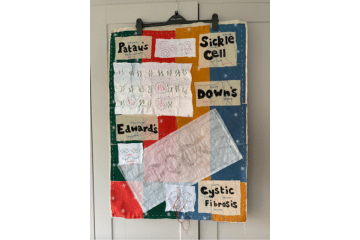
'Living in the Silver Lining' by Sophie Shaw

'Tree' by Liu Shuhan
We are experts in student-led assessment. But don’t take our word for it!
Hear from our students directly:
From IL212/IL312
Genetics: Science & Society
'This is the first time I’ve been given complete freedom over what topic I wished to pursue but also the format in which I wished this to be assessed on… I became immersed in a topic I found really interesting and I was allowed to present this in a far more creative and interactive way than an essay would allow.'
From IL215/IL315
Serious Tabletop Game Design and Development
'This is genuinely the most fun and innovative module I have ever taken, it makes learning fun and there is always support given when needed. Being able to create a physical end game to your module work feels very satisfying.'
From IL217/IL317
Public Engagement
'The openness and interactive nature of the module; the atmosphere was a very safe space, allowing me to feel comfortable to voice opinions, thoughts and personal experiences. The assignment was not a formal academic essay and allowed us to communicate more naturally.'
From IL221/IL321
Your Idea, Your Research
'[I enjoyed] the encouragement from professors to pursue my own project [and] felt like there was space for any and all ideas. [I enjoyed] being required to review abstracts based on given criteria – closest thing I have experienced so far to being put in the shoes of a staff member's potential dilemmas when marking.'
From IL205/IL305
Global Connections
'I have felt so supported in the assessments and class work. I love the freedom it brings in options for assessment, and it has been so lovely getting to know other students from different disciplines.'
From other modules
IL216/IL316 Change: 'I love the flexibility the course gives, a liberating educational experience.'
IL202/IL302 Navigating Psychopathology: '[I enjoyed] formulating own research question and developing the scope of the module essay.'
IL209/IL309 1 'The uncharacterised structure for assignments... allowed me to explore my own thoughts on a topic.'

'Notice how you feel' by Shivani Patel
'Bodies of Water' by Jan Hocevar et al
'The Compassion Club' by Rebecca Smith
An example of our student-led assessment
The SDA offers students the chance to display their critical engagement with the themes and theories of the module and to take a considered approach as to how they might practically apply what they have learned in a medium of their choosing.
It gives space and the opportunity to test ideas and to be creative!
The SDA’s form is down to the student. They consider what issues and theories they want to address and then pick whatever form they feel best expresses them. The SDA can take any form they wish (a story, workshop, presentation, blog, comic, painting, video, essay, dance, website, poem, song, learning resource, collage, diary...anything!) and it displays their personal experiences of and thoughts about the module’s topics, questions, and stimuli in the best way possible. They have to clearly demonstrate and critically engage with theory and give an explanation of their choice of medium. To help with this, they write an accompanying explanation or give an accompanying presentation to their piece together with a detailed bibliography.
Additional Resources
If you are interested in learning more about non-standard learning and alternative assessment methods, and specifically how this comes to life on UG module, listen to Dr Heather Meyer’s podcast on the Student Innovation at Warwick podcast series. She speaks about the benefits of non-standard assessment methods, why student research skills acquired through these alternative methods are essential for lifelong learning and employability, and how they promote and foster innovation.