
News
Ninth Conference on the Future of Adversarial and Inquisitorial Systems
Jackie Hodgson, CJC Director, and CJC members Divya Sukumar and Sharda Ramdewor will take part in the Ninth Conference on the Future of Adversarial and Inquisitorial Systems. The theme of this year's conference is: 'Rights and Remedies in Criminal Procedure: Examining the Nature of the Relationship'. The Conference cycle on the Future of Adversarial and Inquisitorial Systems is a collaboration between the University of Warwick (UK), the University of North Carolina (USA), the University of Bologna-Ravenna (Italy) and the University of Basel (Switzerland).
Sharda and Divya will both present their research during the pre-conference for young scholars. Sharda will talk about 'Using Body Worn Video as evidence to combat disproportionate stop and searches/frisks' and Divya will present a paper entitled ' Strategic Disclosure of Evidence in Police Interviews: Implications for Suspects and their Lawyers'.
Jackie will act as a moderator for the pre-conference for young scholars and take part in the main conference. She will sit on a panel on 'Comparative Approaches to Rights and Remedies in a Time of Austerity'. In this panel, the different approaches of adversarial and inquisitorial procedural traditions to the guaranteeing of rights, and how the rise of managerialism and reduced budgets has impacted these guarantees in theory and in practice will be considered.
A. Rights are protected in different ways. In a party-based adversarial procedural model, (positive) fair trial rights are an integral part of equality of arms for the defense. Inquisitorially rooted models have relied historically on the more neutral ideology of judicial officers responsible for investigation and prosecution, and this has created tensions with the recent strengthening of positive rights through EU directives (such as those implementing the so-called roadmap) and ECtHR decisions such as Salduz v Turkey. Some jurisdictions, such as France, regard the imposition of the right to counsel at the first stages of the investigation as rooted in the Anglo-Saxon tradition and so inappropriate for French criminal justice.
B. The constant push for cheaper and speedier processes of criminal justice undercuts the protection of rights in both procedural models – from the resourcing of legal aid; to the time available to prepare the defense; to the ability of public prosecutors to oversee case preparation and the disposal of cases through alternatives to trial.
New Publication! Wrongs and Crimes
The Criminalization series arose from an interdisciplinary investigation into criminalization, focussing on the principles that might guide decisions about what kinds of conduct should be criminalized, and the forms that criminalization should take. Developing a normative theory of criminalization, the series tackles the key questions at the heart of the issue: what principles and goals should guide legislators in deciding what to criminalize? How should criminal wrongs be classified and differentiated? How should law enforcement officials apply the law's specifications of offences?
In the sixth volume in the series, Victor Tadros offers a philosophical investigation of the relationship between moral wrongdoing and criminalization. Considering they justification of punishment, the nature of harm, the importance of autonomy, inchoate wrongdoing, the role of consent, and the role of the state, the book provides an account of the nature of moral wrong doing, the sources of wrong doing, why wrong doing is the central target of the criminal law, and the ways in which criminalization of non-wrongful conduct might be permissible.
A flyer with a voucher valid until 17 March 2017 is available.
New Publication on Criminal Justice Adjudication and Mass Migration
Ana Aliverti has edited a special issue for the New Criminal Law Review on 'Criminal Justice Adjudication in an Age of Migration'.
The articles are united by a shared set of questions about the salience of citizenship in contemporary criminal justice policies and practices. As such, they offer important empirical and theoretical evidence of the shifting global terrain. In particular, the articles in this collection address three distinct, yet interconnected, matters: migration control and state sovereignty, fairness and equality, and politics and policy.
Ana is presenting the articles in more details in a blog post for Border Criminologies.
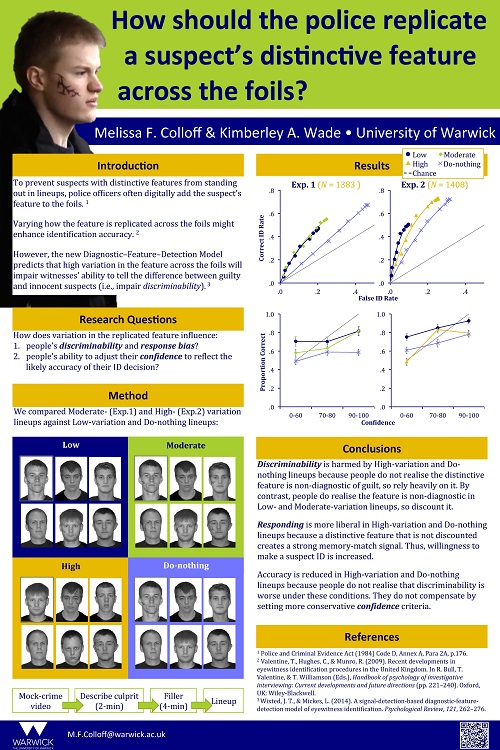
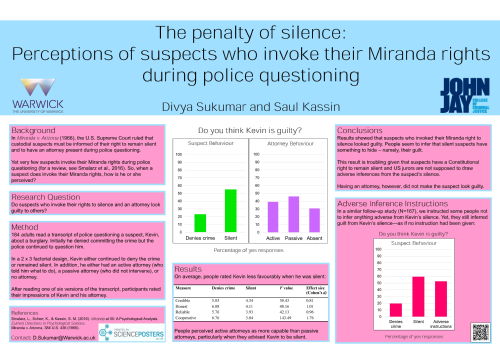
Melissa Coloff and Divya Sukumar win poster competition

Congratulations to Melissa Coloff and Divya Sukumar who presented research posters at the biennial conference of the Society for Applied Memory in Research and Cognition (SARMAC) in Sydney in January (http://www.sarmac.org/sarmac-xii-2017/). Their posters were chosen by the SARMAC student caucus as the best student posters and they were each awarded $100 as prize money.
Here are the winning posters:
New Publication! Justice and the Slaughter Bench
In this follow-up to Law and the Beautiful Soul, Alan Norrie addresses the split between legal and ethical judgment. Shaped by history, law’s formalism both eschew and requires ethics.
The first essays consider legal form in its practical aspect, and the ethical problems encountered (‘law’s architectonic’). The later essays look at the complex underlying relation between law and ethic (‘law’s constellation’). In Hegel’s philosophy, legal and ethical judgment are brought together in a rational totality. Here, the synthesis remains unachieved, the dialectic systematically ‘broken’.
These essays cover such issues as criminal law’s ‘general part’, homicide reform, self-defence, euthanasia and war guilt. They interrogate legal problems, consider law’s method and its place in the social whole. The analysis of law’s historicity, its formalism and its relation to ethics contributes importantly to central questions in law, legal theory and criminal justice.