
News
CJC members to present their research at SARMAC XII
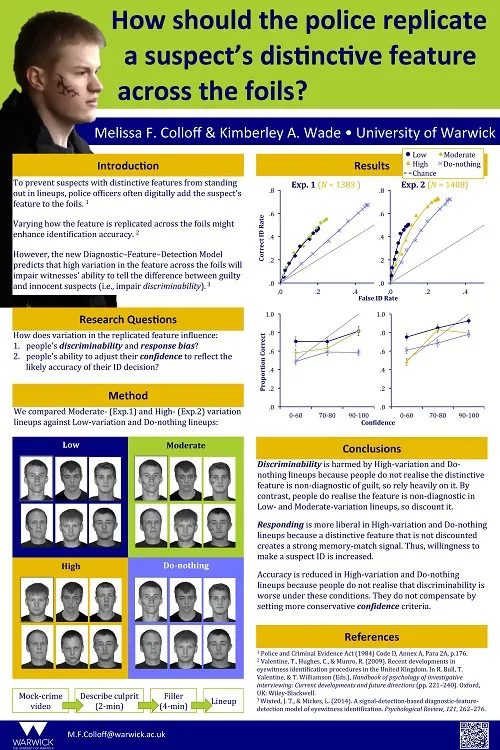
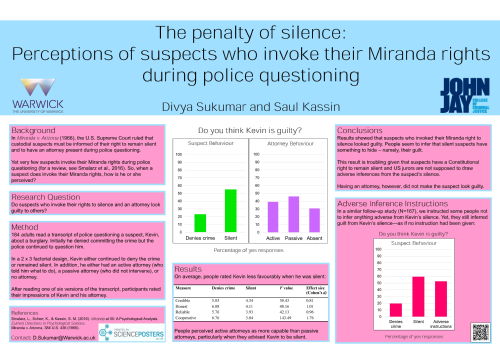
Colleagues from the Psychology department will present their research at the biennial conference of the Society for Applied Memory in Research and Cognition in Sydney in January 2017 (http://www.sarmac.org/sarmac-xii-2017/). Here are the posters they will be presenting:
Kim Wade's study on false memories
In a study on false memories, Dr Kimberley Wade in the Department of Psychology demonstrates that if we are told about a completely fictitious event from our lives, and repeatedly imagine that event occurring, almost half of us would accept that it did.
Over 400 participants in ‘memory implantation’ studies had fictitious autobiographical events suggested to them - and it was found that around 50% of the participants believed, to some degree, that they had experienced those events.
The study has been reported in the international press: http://www.upi.com/Science_News/2016/12/08/Convincing-people-of-fake-memories-is-surprisingly-easy/5141481147837/
New Publication! Access to Justice and Legal Aid
Prof Jackie Hodgson and Asher Flynn from Monash have a new edited collection on 'Access to Justice and Legal Aid: Comparative Perspectives on Unmet Legal Need' published by Hart.
This book considers how access to justice is affected by restrictions to legal aid budgets and increasingly prescriptive service guidelines.
As common law jurisdictions, England and Wales, and Australia, share similar ideals, policies and practices, but they differ in aspects of their legal and political culture, in the nature of the communities they serve and in their approaches to providing access to justice. These jurisdictions thus provide us with different perspectives on what constitutes justice and how we might seek to overcome the burgeoning crisis in unmet legal need.
The book fills an important gap in existing scholarship as the first to bring together new empirical and theoretical knowledge examining different responses to legal aid crises both in the domestic and comparative contexts, across criminal, civil and family law. It achieves this by examining the broader social, political, legal, health and welfare impacts of legal aid cuts and prescriptive service guidelines. Across both jurisdictions, this work suggests that it is the most vulnerable groups who lose out in the way that law is now done in the 21st century.
The book is essential reading for all those interested in access to justice and legal aid.
A. Chamberlen on the current prison crisis
CJC member Anastasia Chamberlen wrote a short piece for The Conversation on prisoner wellbeing last week. Anastasia's article is entitled 'The real prison crisis is the damage the system does to its prisoners' and refers to her own ongoing research with women prisoners.
It will also be published in the Inside Time newspaper (prisoners’ national newspaper) in January.
New Publication! Prosecution in France
Prof Jackie Hodgson & Laurène Soubise have published an article on 'Prosecution in France' in Oxford Handbooks Online.
Their essay examines the increasingly ambivalent role and status of the French prosecutor, the procureur. As a judicial officer (magistrat), she is required to act in and to uphold the public interest, but her hierarchical accountability to the executive and her role in the formation and implementation of local criminal justice policy threaten her independence, notably in the eyes of her fellow magistrats. The dominance of the executive, both politically and through the imposition of managerialist imperatives, is felt in the ever-expanding role of the procureur, especially in the local sphere. While the limited forms of legal and structural accountability in place leave the prosecutor with broad discretion, this is diminished through the drive to standardization resulting from the delegation of work to fulfill the demands of dealing with greater numbers of cases more quickly, with fewer resources.