
Connected Learning Community FATE: Fairness, Accountability and Transparency in Data Processing
This Connected Learning Community (CLC) addresses key issues related to the fairness, accountability and transparency (FATE) of digital technologies, and their social dimensions. The FATE community brings together scientists and scholars in Computer Science, Law, Science & Technology Studies and Visualisation. It is co-ordinated by Prof. Carlos Castillo (Universitat Pompreu Fabra, lead), Prof. Gloria Gonzalez Fuster (VU Brussels), Prof. Dimitris Kotzinos (CY Cergy Paris Universite) and Prof. Noortje Marres (University of Warwick).
Our Activities
Joint Learning Activity
Every year, the CLC organises a joint learning activity focused on Performing Data Access Requests (DARs). Students across four universities work in small groups to perform data access requests for a chosen set of online services and then analyse and visualise the results. The activity combines synchronous and asynchronous elements, and concludes with a remote plenary session where students in different universities present and discuss their project results. The overall objective of the learning activity is to facilitate practice-based, interdisciplinary learning, using the right of data access to collaboratively explore how online services and platforms configure relations between users, data, industry, state, and society.
This FATE activity has been offered yearly since 2022 across four undergraduate and graduate modules in Law ("Privacy and Data Protection" at Vrije Universiteit Brussels), Computer Science ("Data Processing and Automated Decision-Making at Universitat Pompeu Fabra; "Transparency and Fairness in Big Data and AI" at CY Cergy Paris University), and Data Visualisation ("Visualisation in Science, Culture and Public PoliticsLink opens in a new window" at the University of Warwick).
This FATE activity has been offered yearly since 2022 across four undergraduate and graduate modules in Law ("Privacy and Data Protection" at Vrije Universiteit Brussels), Computer Science ("Data Processing and Automated Decision-Making at Universitat Pompeu Fabra; "Transparency and Fairness in Big Data and AI" at CY Cergy Paris University), and Data Visualisation ("Visualisation in Science, Culture and Public PoliticsLink opens in a new window" at the University of Warwick).
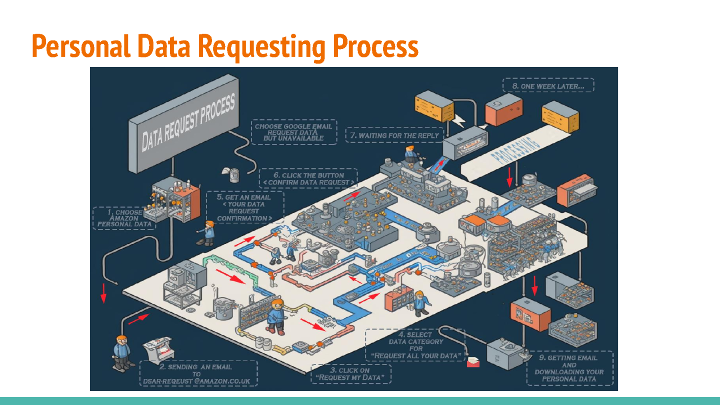
Visualisation by Caius Liu, XiaoYu Guo, Yujia Xu, Jiaying Chen, Jiaming Wang (University of Warwick, 2024)
'Accessing Data with the Data Act' Workshop at UPF
On 7-8 May 2026, the international workshop 'Accessing Data with the Data Act' took place at the beautiful Poblenou campus of the Universitat Pompeu FabraLink opens in a new window in Barcelona.
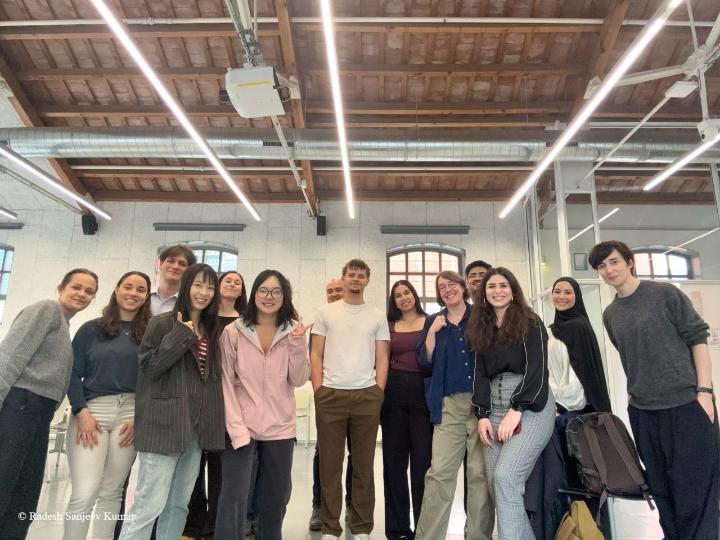
During this interdisciplinary event, participants with diverse backgrounds in law, computer science, data visualisation and social studies of technology came together to learn about the EU's Data Act and to explore how it can be deployed to investigate and intervene in digital societies.
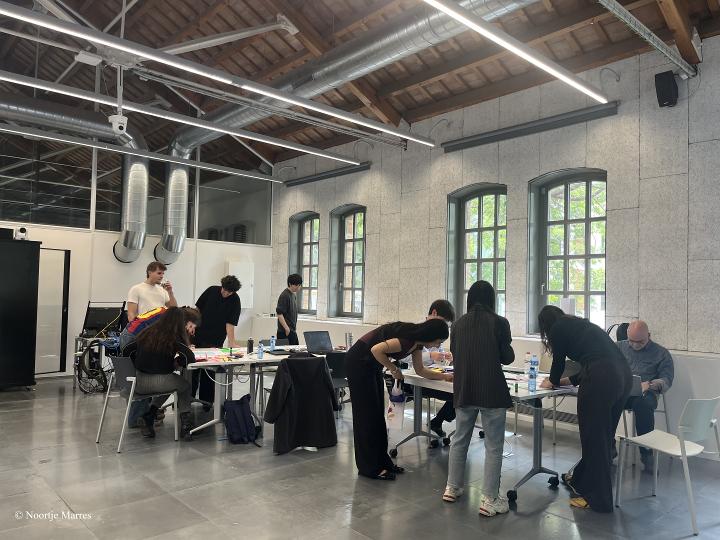
The workshop brought together 17 postgraduate students, researchers and academics of 4 different universities: the University of Warwick (United Kingdom), Vrije Universiteit Brussel (Belgium), CY Cergy-Paris University (France) and Universitat Pompeu Fabra (Spain). It was co-organised by the Eutopia learning community called FATE (for Fairness, Accountability and Transparency in Data Processing), which under the leadership of prof. Carlos Castillo (UPF) has delivered shared learning activities since 2021.
Combining talks with practice-based assignments and student presentations, the workshop started with an introduction to the Data Act by prof Gloria Gonzalez Fuster (VUB). Next, students analysed industry statements about the Data Act in small groups, finding that these statements tended to foreground technical aspects of accessing product data, rather than accountability, transparency, and data rights.
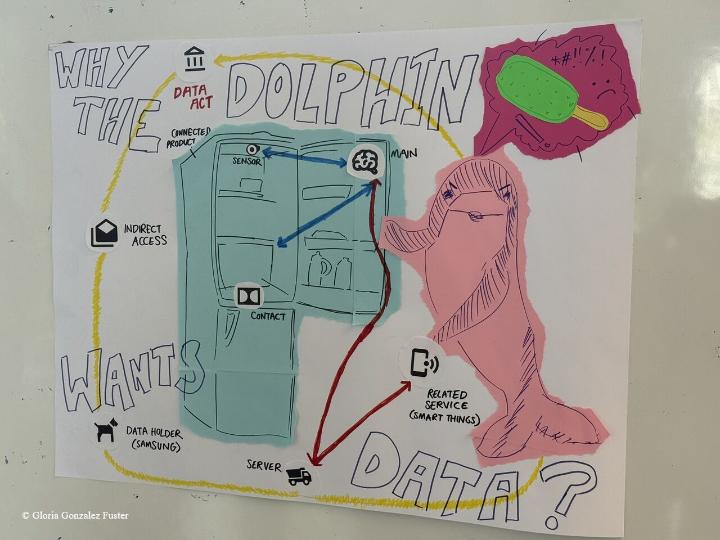
The second half of the workshop was dedicated to the exploration of networked data accessed through the Data Act, as well as the GPPR. Students created visual diagrams of data relations, mapping out how everyday technologies like a fridge and social media enroll people into complex data relations with infrastructures, companies, environments and the state.
By creating various engaging diagrams, students demonstrated how connected products and platforms give rise to new power asymmetries in everyday settings like the home and the street, but also create opportunities for knowledge and intervention by citizens and organisations. Devising diagrams proved an effective way of opening up these complex issues for shared discussion and exploration, drawing us into technical, abstract and sometimes fraught questions and issues through puzzling mysteries such as whether a particular smart fridge was or was not responsible for the melting of one participant's ice cream.