
Celebrating our people: Prof. Don Pollacco
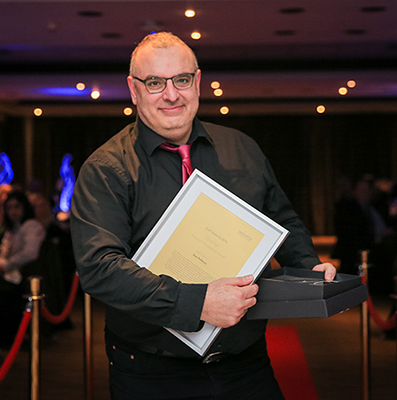 The Staff Awards are a great opportunity to show appreciation of the hard work that goes on day to day, here at Warwick! Find out more about our award winners and nominees in our series of interviews, highlighting their roles and acheivements.
Don Pollacco, Professor of Astronomy, Physics
Tell us a bit about your role:
I’m like any other academic staff member at Warwick – I teach and do research. I am a member of the Department of Physics having joined the University in 2012, moving from the Queens University of Belfast at the age of 51 years.
I run projects at both BSc and MPhys level, supervisor PhD students (currently 3), support 4 PDRA’s. I strongly believe in research informed teaching. I research into exoplanets – the study of other solar systems. I led the pioneering WASP project that is still the leading ground based exoplanet discovery project. I am also the Science lead on the ESA PLATO space mission (to be launched in 2024).
For my WASP and general exoplanet work my key collaborations involve colleagues at Warwick, Cambridge, Marseille and Geneva. While for PLATO I manage a team of around 500 mainly European scientists.
You won the Research Excellence Award for your work on answering ‘Do other Earths exist?’ Tell us more about this project:
This is effectively the culmination of a project that started in 2000 ie 16 years ago. At that time I started a project, with a few friends, called the Wide Angle Search for Planets or WASP. The idea was to find stars with large planets whose orbits caused them to cross the line of sight and hence causing a small periodic dip in star brightness, lasting just a few hours, as the star light was partially blocked out.
While most people gave our chances of success as less than 10%, WASP turned out to be the most successful ground based survey. To find the small number of large planets with favourable orbits involves monitoring the brightness of millions of stars. in 2003 when the survey commenced, the data rate was impressive with the database growing by more records than that held in the UK telephone directory every night! Hidden amongst this data were our planet signals. WASP has now found nearly 200 transiting planets most of which are amongst the best/most accurately characterised planets known.
The WASP project has won several accolades including the Royal Astronomical Societies Team Award (2010) and the CNN/Times Top Ten Scientific Discoveries in Science (2008).
The Award highlights how you have gone above and beyond your role, what have been the key challenges of this project?
I don't actually believe I have gone above and beyond my role. Sometimes its necessary to take a potentially career defining risk. For me both WASP and PLATO were gambles (when I joined Warwick in 2012 my business plan put the likelihood of a PLATO selection success as 5-10%). Yes I’ve put tremendous levels of (obsessive) work into these projects and to be successful that has been necessary. However, either one could have gone badly wrong.
Ironically, as I read over this I seen to be a risk taker but I’m really pretty cautious.
The Staff Awards are a great chance for the University to improve and learn from staff initiatives over the year. If you could change one thing at the University, what would it be?
The problem with any space project is that its always going to be high risk but potentially high reward. Space missions are expensive and so few will ever be launched. I’ve heard stories of selected missions being de-selected several times before eventually being launched (not within the ESA programme, I hasten to add, where all selected missions have launched). During the early phases of a mission most work is unfunded and relies on academics donating effort. Later on a senior person in a mission would be more then 50% externally funded maybe for 10-15 year period. More likely the mission will be abandoned… This is all at odds with idea behind FEC and work load allocation models etc. So there is a conflict here that I don't know how to resolve.
What does winning a Staff Award mean to you?
I am truly honoured but baffled as I think I’m just doing my job. I guess I’m fortunate that my hobby is also my job, but I’m also aware that there just has to be a lot of luck in these projects being successful.I think the award is fantastic recognition for both Physics and the Astronomy Research Group, after all research is one of the main things we are employed to do. I noticed my students tweeting the news on social media so I know they are proud as well.
Overall it vindicates my family’s decision to move from Belfast. With 13 and 9-year old children this was anything but simple (both children are doing extremely well here). Academically for myself the move has been tremendously revitalising. While WASP has certainly produced many high cited, high impact publications, it is far too early for PLATO. Hence I believe this award demonstrates the University’s faith and vision in this subject.
A lot of staff and students took the time to nominate, if you had the chance what would you say to the people that nominated you for this award?
So I have become aware of the person who (I think) nominated me and I am extremely grateful and hope that I can continue to deliver success for our Department and Warwick.
We hope you enjoyed the Staff Awards evening. Any highlights from the night?
I was most happy for our departmental undergraduate secretary, Rashida Mohamed.
I couldn't have written the script for the evening better - a Star Wars theme with aliens and astronomy and an astrophysicist (working on planets and alien life) winning the research award!
Enjoyed reading about Don? Hear from some more award-winning colleagues…