
Fair Play Kenya
Fair Play Kenya was a two-day arts festival exploring the interrelated issues of climate crisis, land justice and conflict held at the National Theatre of Kenya, Nairobi in November 2025. The festival was co-created by partners including The Playhouse, Derry (Northern Ireland), Amani People’s Theatre and ZamaleoACT (Kenya) and the University of Warwick. As part of this work, a co-created Practice as Research project investigated these issues with groups of young people in Birmingham, Nairobi and Derry.
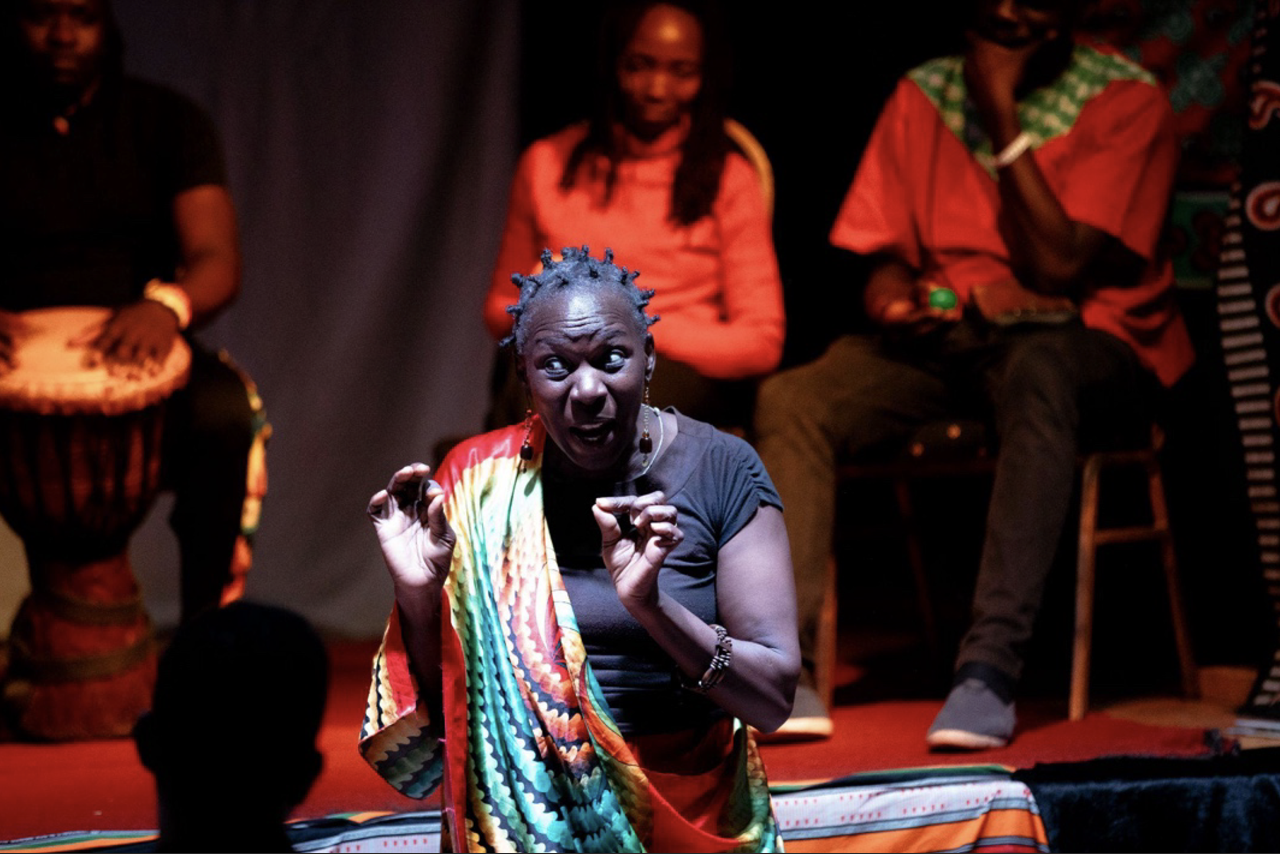
Image: Alumbe Hellen performs in Rhythms of the Land at the Fair Play Festival
The Fair Play Festival aimed to explore issues of climate crisis, land justice and conflict through a series of workshops, panel discussions and sharing of art and performance. A new co-created performance,Rhythms of the Land,was devised including collaborators from ZamaleoACT and John Namai - a Kenyan storyteller - and Sarah Murphy - a musician who worked with Kenyan artists to compose new music for the piece. The British Council supported this work as part of its Kenya 2025 season, which aimed to facilitate meaningful creative partnerships between Kenya and the UK and promote cross-cultural dialogue.
Transnational co-creation with young people
Alongside the festival and this new performance, Dr Bobby Smith (Theatre and Performance Studies) formed part of a transnational team of artists, researchers, facilitators and young people to develop a short practice as research project. Participants from Nairobi worked with John Namai and Maxwel Okuto from Amani People’s Theatre, while in Northern Ireland, young people engaged in workshops at The Playhouse led by Alice Malseed. In Birmingham, The GAP Arts Project joined from Birmingham, led by Ceri Townsend and Arron Gill. The project aimed to investigate how the core themes of the festival - land justice, climate crisis and conflict - related to these different groups of young people in their local contexts. It also aimed to test how artistic collaboration across geographical borders could foster dialogue and learning between contexts. To do so, a series of workshops were held online and led by Sarah Murphy with Bobby. Alongside Dr Rachel Turner-King (Education Studies), Bobby observed and reflected on these workshops to help think about new directions in transnational co-creation and collaboration.
Dialogue and exploration
In each location, artist-facilitators drew upon their expertise to guide sessions that creatively explored the core themes of the project. This supported the groups to investigate their local contexts and to begin to find out what these issues mean, for them.
In the first online workshop, which brought together the groups in each location, participants shared what they had discovered and become interested in through the creative workshops. In Nairobi, more was shared about the ways in which carbon credit deals were leading to Kenyans losing their land under unfair circumstances. For those in England and Northern Ireland, this was a shocking example that highlighted how seemingly innocuous global initiatives can have far-reaching, unknown and often hidden effects. Meanwhile, young people in Derry explained what they had found out regarding Lough Neagh. Located less than hour from Derry, mismanagement and pollution has had severe consequences on life in and around the lough. What began to emerge through these conversations is that while those in Kenya and Northern Ireland felt relatively connected to their landscapes, the post-industrial cityscape and planning decisions from the mid 20th century in Birmingham result in a city that seems particularly disconnected from nature.
These findings then shaped the local creative responses and exploration each group undertook. In Derry, participants continued to explore their connections to their local environment. A key point for discussion was the potential threat posed by gold mining to the Sperrin Mountains, while a desire to find out more about the impact of climate crisis on other parts of the world led the group to engage with the situation in Tuvalu. Here, the government is considering forms of ‘digital citizenship’ as land disappears into the sea. Meanwhile, in Birmingham, drama-based workshops invited young people to re-imagine the city, role-playing as planners to envisage and set out alternative visions for a greener city. The young people in Nairobi also participated in a workshop led by Bobby during his visit to their project. In this workshop, the group co-explored the contradictions and problems involved in issues of land justice and development: while some saw the land as a resource through which to increase economic growth, others were concerned by how this might continue to marginalise and exclude certain groups – particularly women. This also raised questions about the pursuit of growth and the harm this may cause.
Finally, the creative work and explorations formed part of a short film, which aimed to capture aspects of the process and share perspectives from participants.
Findings and new approaches
Alongside providing insights into the issues that most concern young people in these three distinct contexts, this short project has also offered insights into new approaches. In particular, the project demonstrates the potential of building transnational connections to share insights and experiences of globally-shared problems, while also illustrating the nuanced and varied ways in which these play out in diverse local contexts. Relatedly, Bobby is developing an article that theorises these approaches alongside the concepts of the polycrisis and the pluriverse in order to raise questions regarding how socially engaged arts projects are facilitated. Many of the collaborators involved also share an ambition to build on the findings fromFair Playand the potential for the arts to be part of a conversation that brings together the distinct, yet interconnected, issues of land justice, environment and conflict.