See the PhD Opportunities section to see if this project is currently open for applications via MIBTP.
Please Note: The main page lists projects via BBSRC Research Theme(s) quoted and then relevant Topic(s).
Communication, competition and resilience in structured bacterial communities
Secondary Supervisor(s): Dr Munehiro Asally
University of Registration: University of Warwick
BBSRC Research Themes:
Project Outline
How do bacterial communities communicate and reorganise to survive environmental stress? Biofilms are dense microbial communities with major consequences for health, agriculture and the environment, including chronic infections, antimicrobial resistance and biofouling. Despite strong spatial gradients in nutrients and oxygen, biofilms can display collective responses and reorganise under changing conditions via chemical, mechanical and electrical cell-cell communication.
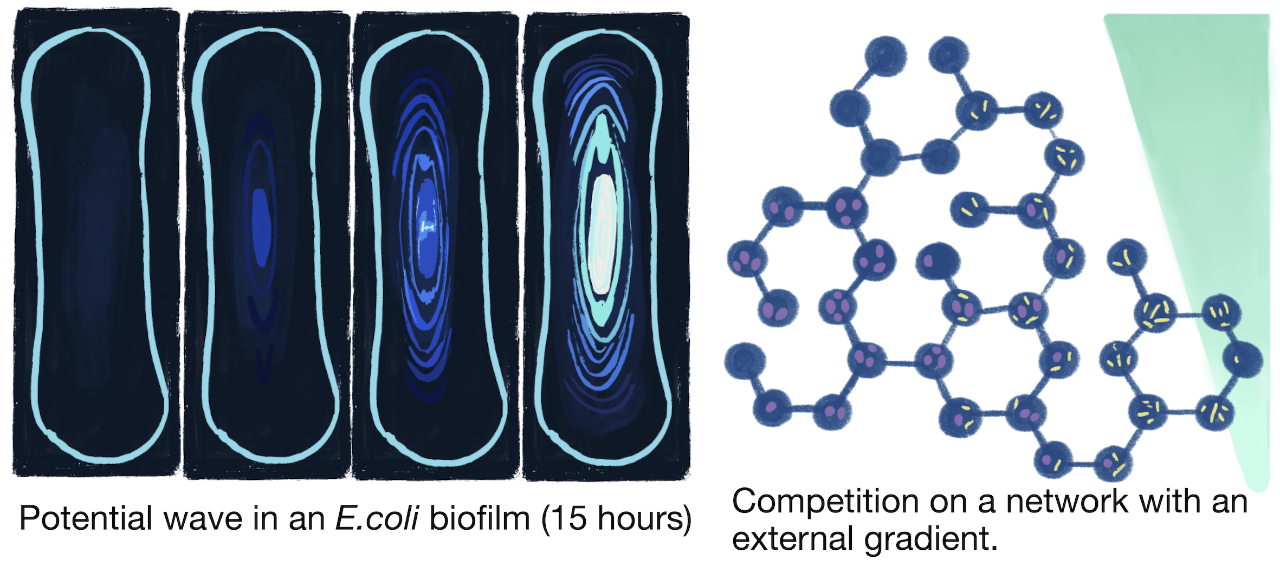
This project will develop mathematical models to understand the mechanisms and consequences of long-range communication in biofilms. Together with the Asally lab, we will study electrical waves observed in E. coli biofilms and investigate how nutrient or oxygen depletion affects membrane potential, extracellular ions and bacterial growth. The aim is to build minimal models to reproduce wave propagation, identify wave speeds, signalling ranges and thresholds, and generate predictions that can be tested experimentally.
Understanding how such signals propagate naturally leads to a second question: what do they change at the level of the microbial community? We will model how communication affects the response to perturbations such as nutrient depletion, hypoxia, antibiotics or invasion by a competing population, and whether it alters survival, spatial growth patterns, competition or recovery. We will consider the role of cellular behaviour, including cell division and motility, in these responses.
Finally, we will ask how these mechanisms change when microbial communities inhabit structured environments like soil. We will incorporate the local biofilm dynamics into network models of connected habitats, such as porous soils, where nutrients, oxygen, signals and cells move between local populations. By varying flow, moisture and connectivity, we will identify how communication, transport and environmental structure combine to determine persistence, recovery, invasion or collapse.