
Gibson Group News
Synthesis of glyconanoparticles without protecting groups, published in Bioconjugate Chemistry
Glycans (sugars) dictate a huge range of biological processes, from host-pathogen interactions to cell-cell communication. We have a large research 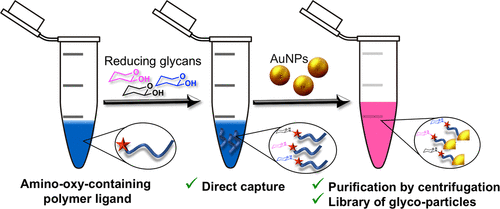
program into using nanomaterials to display glycans, mimicking how they are presented on cell surfaces. For example, we have used these in diagnostics (including our recent work on rapid COVID diagnostics). However a key challenge is actually getting the glycans on the nanoparticles as multiple protecting groups are often needed. In our latest paper, we installed amino-oxy groups at the end-group of polymers to allow capture of reducing glycans in aqueous solution, with the aim of simplifying our synthetic route with our long-term aim of fully-automating the process. We critically evaluated the efficiency of this reaction using 13-C enriched glucose, to enable the actual polymer, rather than model small molecules to be used. This show 25 % of the chains can capture a glycan, which was then immobilised onto gold nanoparticles. This approach is particularly suited to screening applications where small amounts of glycan are available, to identify hits.
Read the paper here
Protecting Group Free Synthesis of Glyconanoparticles Using Aminooxy-Terminated Polymer Ligands