
Advancing Sustainable Battery Manufacturing Through Innovation in Laser-based Material Processing
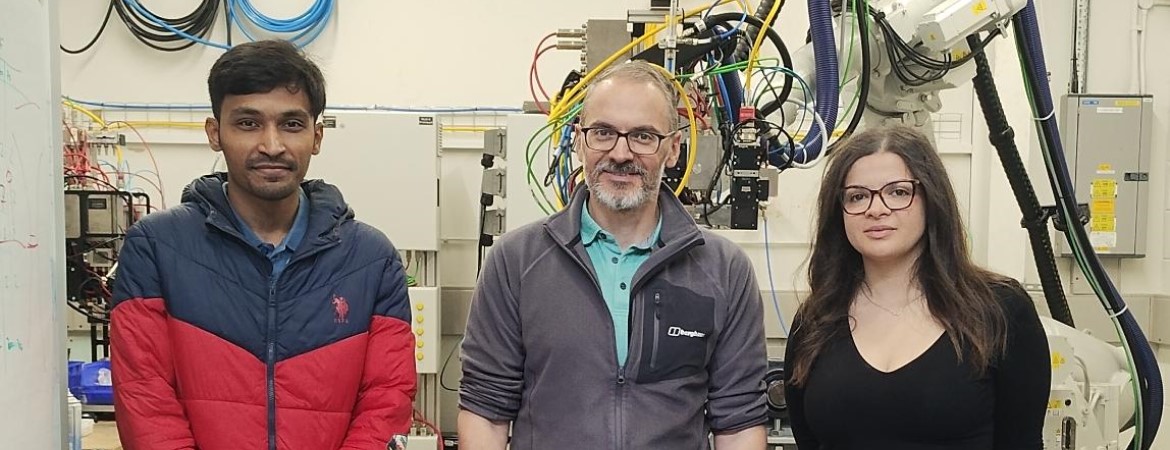
This joint research project between the University of Warwick and the Indian Institute of Technology Delhi brings together leading expertise in advanced manufacturing to address a critical challenge in electric vehicle production. Funded by Warwick’s International Partnership Fund, the project strengthens international collaboration while advancing research that supports more sustainable and efficient battery manufacturing.
The work is led by Prof Pasquale Franciosa from WMG at Warwick and Dr Abhishek DasLink opens in a new window from IIT Delhi, with contributions from specialists in laser welding, battery systems, and materials science at both institutions.

Electric vehicles produce no emissions during use, yet a significant proportion of their environmental impact occurs during manufacturing. Studies show that around 30% of an electric vehicle’s lifetime emissions come from production processes, making it essential to improve how components are made. Battery manufacturing is particularly important, as it relies heavily on laser material processing, including laser welding, to join electrodes, connectors, cells, and structural enclosures with high precision and reliability.
The project, titled “Lasers4UK-India: Exploring the Use of Blue Lasers and Dynamic Beam Lasers for Welding Challenging Materials in E‑Vehicle Battery Manufacturing”, focuses on improving how difficult materials are welded during battery production. Traditional laser welding typically uses infrared lasers, which are powerful but can struggle with highly reflective materials such as copper, a key component in battery connectors. These materials reflect much of the laser energy, often leading to defects such as cracking and inefficiencies in energy use.
Prof Pasquale Franciosa is Professor in Advanced Laser Welding Processes at WMG and Head of the Laser Beam Welding Group. His research centres on high power laser systems and beam shaping technologies that control how heat is delivered to materials. Dr Abhishek Das is Assistant Professor at IIT Delhi, with expertise in advanced material characterisation and laser to material interaction, particularly using visible blue lasers. Together, they are combining Warwick’s strengths in dynamic infrared laser beam shaping with IIT Delhi’s expertise in blue laser technology, an approach that neither institution could pursue alone.
Blue lasers operate at shorter wavelengths and are absorbed far more effectively by materials such as copper. This allows welding to be achieved with lower energy input, reducing defects and improving overall efficiency. At the same time, parallel advances at Warwick show that shaping the intensity profile of infrared lasers in real time can create rapid thermal cycling within the molten material. Known as dynamic beam shaping, this technique can improve weld quality by reducing harmful thermal gradients that cause cracking.
Despite their promise, both blue lasers and dynamic beam shaping are still emerging technologies with limited scientific evidence comparing their technical performance, energy efficiency, cost, and sustainability. This project fills that gap by systematically assessing both approaches through experimental welding trials conducted at IIT Delhi and WMG. The aim is to understand not only whether these technologies work, but how they can be used most effectively and responsibly in industrial settings.
The research is supported by a strong existing partnership between Warwick and IIT Delhi, including a memorandum of understanding signed in 2024 and earlier successful collaboration on doctoral supervision. The International Partnership Fund enables the teams to share facilities, knowledge, and people, including exchange visits and hands on training for students and early career researchers. This is particularly valuable given the high cost of specialist equipment, such as blue laser systems, which would otherwise be inaccessible to one partner institution alone.