
2026 European Day of Languages
European Day of Languages 2026: Multilingualism and Inclusion
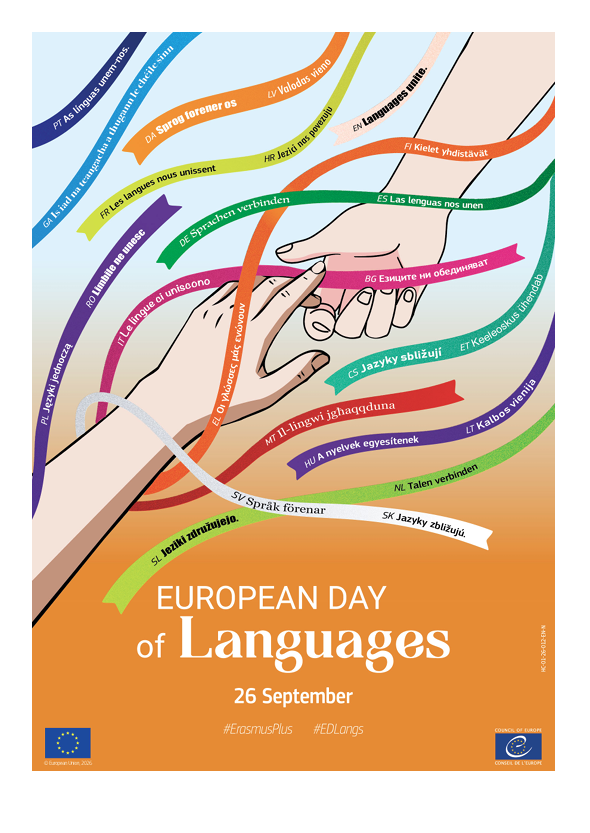
This year’s European Day of Languages theme, ‘Languages and Inclusion’, speaks directly to the challenges facing European societies and to the opportunities that Europe’s linguistic, cultural, geographical, political and social diversity provides for development and competitiveness. Multilingualism is not merely a characteristic of Europe; it is a foundational pillar of its identity, ethos, mission and values, as well as a resource for social, cultural and economic progress. These opportunities can only be realised if we recognise and legitimise Europe’s rich linguistic ecosystem and the full repertoires of its speakers.
Despite policymakers’ commitment to the multilingual ideal, the full potential of Europe’s multilingual ecosystem, to support personal wellbeing, societal progress, creative flourishing and economic growth, remains unrealised.
In 2022, the EUTOPIA "Multilingualism and Diversity' Connected CommunityLink opens in a new window published its Multilingual Policy for Sustainable Educational GrowthLink opens in a new window (Angouri, Climent-Ferrando and Milani, 2022). In this policy, we proposed “a dynamic, nuanced and politically informed definition of multilingualism according to which multilingualism denotes a diverse linguistic ecosystem in which speakers are empowered to use their repertoire”. This definition led us to advocate “a policy that takes a holistic multilingual ecosystem approach”. We also offered three recommendations for challenging what we described as a persistent multilingualism paradox: while multilingualism is associated with mobility, productivity and knowledge creation, our societies and institutions continue to operate according to a monolingual ideal.
This paradox is particularly visible in higher education. Although multilingualism has long been recognised as an asset by the European Commission, we often observe parallel monolingualisms: different languages coexist, but remain institutionally separated. In HE, languages are commonly outside the core curriculum -unless they are themselves the subject of learning. They are also frequently positioned in binaries: global and local, international and national, majority and minority... Yet languages do not compete with one another; competition is produced through the political and institutional asymmetries that assign them different status and value. These arrangements create fragmentation and limit opportunities for students and staff to draw on and connect their linguistic repertoires as part of their learning and overall university life.
The European University Initiative (EUI) has been an important instrument for advancing the multilingual ideal. Multilingual and innovative higher education has been central to the vision of what the Alliances can achieve. Students and staff across European University Alliances (EUAs) bring diverse linguistic repertoires, while the Alliances themselves hold significant academic expertise, experience and institutional capability that can be mobilised to develop more inclusive multilingual environments.
Most EUAs have rightly made multilingualism one of their priorities. Recent research captures the volume and range of the valuable activities Alliances are developing to promote multilingualism:
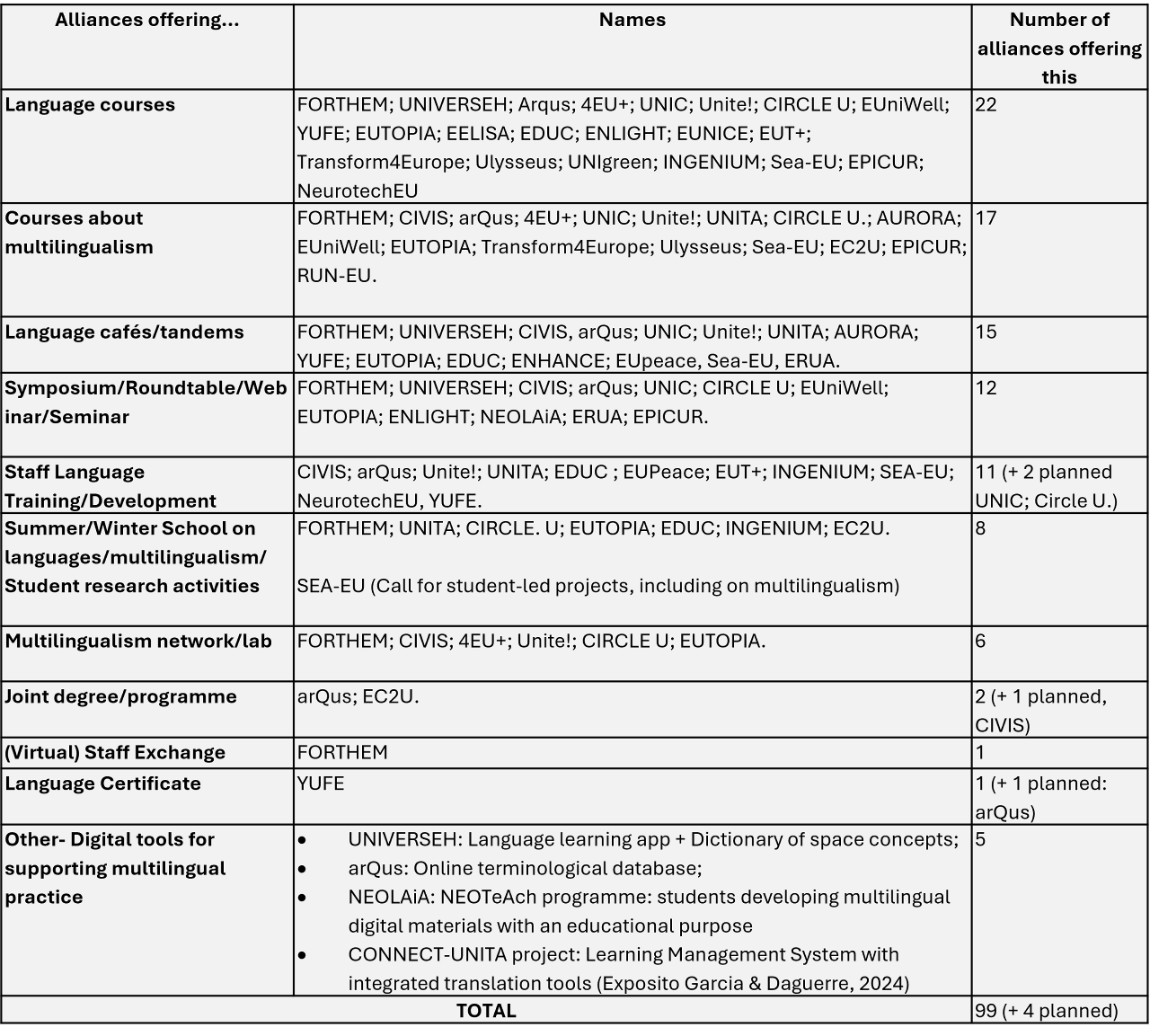
Source: Angouri, J., & Delmas, M. (2026). Multilingualism in higher education: (What) do European university alliances deliver? Journal of Multilingual and Multicultural Development, 47(6), 3578–3596. https://doi.org/10.1080/01434632.2025.2529947
However, emerging literature on EUAs also points to a disconnect between this commitment and its implementation. Many excellent initiatives remain peripheral to the educational experience of the majority of students. Without deeper integration into institutional structures and curricula, multilingualism risks remaining an aspiration rather than becoming a lived reality across our universities.
We strongly believe that embedding multilingualism requires the empowerment and legitimisation of learners’ and staff members’ linguistic profiles. It also requires curricula in which multilingualism is a core part of the learning experience, rather than an optional addition or an activity running alongside the curriculum. These conditions are essential if existing initiatives are to become sustainable and contribute to genuinely multilingual education.
Bringing multilingual pedagogies into students’ core learning is fundamental. It means creating equitable spaces in which learners can use their full linguistic repertoires to engage with knowledge, collaborate with others and develop their academic and professional identities. It also means recognising that multilingualism is not simply a skill to be acquired, but a critical part of who we are and a resource for how we think, learn and work together. In and through language we can connect perspectives, enable equitable participation and support the collaborative production of knowledge across linguistic and cultural boundaries.
So, today, on the 2026 European Day of Languages, we call on European University Alliances to draw on the expertise already present within their communities and to be ambitious, and brave, in moving from multilingual activities to multilingual educational structures. We call on policymakers to create the conditions that enable Alliances to move beyond structural and linguistic barriers. And we call on institutions to recognise multilingualism as critical to the future of our universities and societies: not as a peripheral value, but as a foundation for more inclusive universities and for the development of genuinely global citizens.
The multilingual ideal will only become a reality when Europe’s institutions do more than celebrate linguistic diversity. They must legitimise it, embed it and enable students, staff and non-academic partners to learn and collaborate in and through the full richness of their linguistic repertoires.