
Departmental news
Professor Emma MacPherson showcases research on BBC News
Emma MacPherson showed the BBC team around her lab, showcasing the development of her skin scanner machine.
Undergraduate of the year award with AON
The Warwick Statistics Department are very proud that one of our students, Oliver Crook, has won the Future Actuary Undergraduate of the Year Award with AON.
History of the Jews in Coventry event Thursday 23 May 2024
Dr Anna Hajkova, Co-Director of the Centre for Global Jewish Studies, has arranged a unique chance to see an otherwise closed Jewish Cemetery in Coventry and a small temporary exhibition on Coventry’s Jewish history currently shown in the Herbert Gallery.
More information about the event can be found on the Centre for Global Jewish Studies website hereLink opens in a new window.
Distinguished Africa Lecture on AI
Vice Chancellor Professor Stuart Croft will be hosting the annual Distinguished Africa Lecture in June. The lecture title is “Higher Education in Africa in the era of Artificial Intelligence”.
Details below:
• Monday 3 June 2024, 4:15pm
• University of Warwick, The Oculus, Room OC0.03, and online
• Guest speaker: Professor Tshilidzi Marwala, United Nations University Rector & UN Under-Secretary-General
• Title: Higher Education in Africa in the era of Artificial Intelligence
For more information and to register visit the website distinguishedafricalecture2024 (warwick.ac.uk)
Funding for joint Warwick-Aston Engineering Biology research paves the way for enhanced sustainable manufacturing and drug discovery
A team of academics from The University of Warwick and Aston University has secured a £1.8m grant to engineer microbial cell factories to produce membrane proteins which will support future drug screening and sustainable chemical production.
Dementia Action Week: WMG calls for volunteers for ground-breaking Alzheimer’s screening tests
Expert comment from Professor Alan Chalmers
For Dementia Action Week, WMG at the University of Warwick, together with Superlunary Labs, are doubling their efforts to develop a low-cost, non-intrusive method for the early screening of Alzheimer’s disease using a simple flavour test which can be undertaken as part of a regular health check-up by a nurse, at a pharmacy or community centre.
The test can help diagnose the beginnings of Alzheimer's years before symptoms of memory loss through a loss of taste or smell.
Scientists at WMG are looking to get data from at least 1000 people before aiming to roll the screening out nationwide, potentially as early as next year. If you want to take part in the trial, and can get to the University of Warwick campus, contact Alan.Chalmers@warwick.ac.uk to be part of the future of medicine.
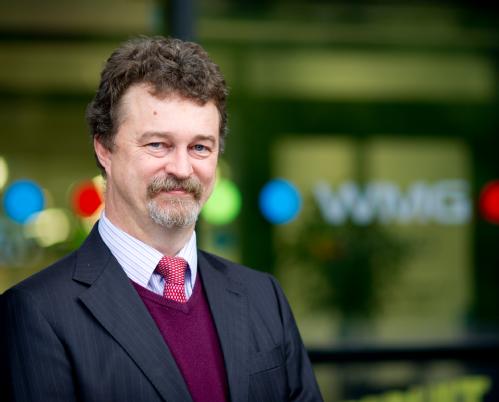 Professor Alan Chalmers commented: “Working with MPs and their constituency offices we will be collecting more data across the country to significantly enlarge our dataset of people’s flavour perception ability. This dataset, together with AI and MRI scans, will enable us to validate our screening method. Once validated we will be able to roll out the method widely, hopefully as early as next year.
"New drugs that slow disease progression down offer real hope to people living with Alzheimer’s Disease, but crucially the disease needs early diagnosis for these drugs to be most effective. One might have the disease many years before failing a memory test, the current means for diagnosing Alzheimer’s Disease.”
Professor Steven Brown joins EPSRC Advisory Team
Congratulations to Professor Steven Brown who has joined the Engineering and Physical Sciences Research Council (EPSRC) Physical Sciences Strategic Advisory Team.
Grafting Polymers to Graphene Oxide goes better Through Branching
The BonLab shows that grafting polymer chains to graphene oxide is easier when branching is employed.
Emeritus Professor Robin Okey posthumous book award
Emeritus Professor Robin OkeyLink opens in a new window (1942-2023) has been awarded Jesus College's Francis Jones Prize for the best book on Welsh history published in 2023. This was Robin's last book before his passing in December 2023.
Extracts from the notification sent by Thomas Charles-Edwards, Jesus Professor of Celtic (Emeritus):
'The committee has decided that the prize for 2023 should be awarded to Robin Okey for his book, Towards Modern Nationhood: Wales and Slovenia, c. 1750–1918. That he died shortly after it was published makes no difference: the book deserves the prize..... The prize is £1,000...... Quite apart from the prize itself, we very much hope that the family (and his former colleagues) will be pleased that Robin’s last book has been honoured in this way.'
Interdisciplinary Biomedical Research Building awarded RIBA West Midlands Building of the Year
Our Interdisciplinary Biomedical Research Building, which we share with the School of Life Sciences, has been awarded the West Midlands Building of the Year award from the Royal Institute of British Architects.