
Departmental news
Science labs opened to support students from Aylesford School
Aylesford Sixth Form Science students welcomed to complete practical exams and gain hands-on experience in our labs following classroom closures. More at tinyurl.com/mr4d4hpr
Life-changing technology will be rolled out to people with type 1 diabetes
Thousands of people with type 1 diabetes could be offered wearable technology to help them manage their condition thanks to guidance based on research conducted by WMS.
“Unclear” whether opioids are effective at treating cancer pain
The world’s largest review on opioid medicines for cancer pain, which included WMS researchers, has found it is unclear whether some commonly used opioid medicines are better than a placebo and suggests that non-opioid medicines, including aspirin, may be as effective as opioids.
Assistant Professor in Ottoman History opportunity
The Department of History seeks to appoint an Assistant Professor in Ottoman History on a full-time and indefinite basis from 1 September 2024.
This is an exciting opportunity to be part of one of the largest History departments in the UK with a thriving community of teachers and researchers covering a range of disciplines and geographical areas.
The advert and job description for the post can be found via the Human Resources webpage. For informal enquiries, please contact Professor Tim Lockley (Head of Department) at t.j.lockley@warwick.ac.uk.
The closing date for applications is 14 January 2024.
Dr Harjinder Lallie comments on the UK's vulnerability to cyber attacks
 Expert comment from Dr Harjinder Lallie on the UK's vulnerability to cyber attacks.
Dr Harjinder Singh Lallie, Director of WMG’s Cyber Security Centre at the University of Warwick, commented: "The continued reliance on what is sometimes outdated technology including systems, software, and related processes, makes the UK infrastructure increasingly susceptible to crippling cyber-attacks. As systems become older and more dated, the cost of upgrading increases exponentially in comparison with regular upgrades.
“Added to this is the growing pay and associated skills gap between the public and private sector which makes the public sector less attractive for cyber security graduates in an increasingly open market. The potential for our infrastructure to be susceptible to ransomware attacks should not therefore come as a surprise.”
Dr Mingli Chen appointed to editorial board of the Journal of Econometrics
Congratulations to Associate Professor Mingli Chen who has been appointed as Associate Editor of the Journal of Econometrics from 1 January 2024
The Journal of Econometrics serves as an outlet for important, high-quality, new research in both theoretical and applied econometrics. The scope of the Journal includes papers dealing with identification, estimation, testing, decision, and prediction issues encountered in economic research. Classical Bayesian statistics, experimental design, and machine learning methods are decidedly within the range of the Journal's interests.
Mingli Chen is an Associate Professor of Economics in the Department of Economics at the University of Warwick, a Research Associate at CeMMAP, and a Turing Fellow at the Alan Turing Institute (the UK's National Institute for Data Science and Artificial Intelligence). She is working on econometrics, with a special focus on panel data models, social networks, quantile regression, and AI + machine learning both in theoretical inference and applications in economics.
Visit Dr Chen's staff profile for further details about her research and publications.
Winners announced in the Warwick Future Economists essay competition 2024
We are excited to announce the winners of this year's Warwick Future Economist competition jointly organised by the Department of Economics at Warwick and the Warwick Economics Society. They have been selected out of 53 entries for the outstanding quality of their economics essays.
The overall winner of the competition is Edie Farquhar from Cheltenham Ladies College in Cheltenham, whose essay considered the most important factors of the UK's persistent high inflation rate in recent years. Congratulations to Edie who will receive the top cash prize of £250.
We also congratulate the following students in the joint-second place who receive £50 cash prize each:
- Mehar Amiri, The Cooper's Company and Coburn School
- Emerson Leung, Mill Hill County High School
The collaboration between Warwick Economics Society (with nearly 3000 student members from over a hundred different disciplines) and the Department of Economics at Warwick has been going strong for many years, as we combine our aims to widen access and increase diversity within the subject of economics. Matthew Murray, Sagar Mishra and Aanya Manjakunnel from Warwick Economics Society and students on the BSc in Economics degree, commented about the competition:
Matthew Murray, President - " We were delighted to see so much interest in our second annual Essay Competition. At EconSoc, we want to help students succeed and this competition is an amazing opportunity for high school students to strengthen their university applications. We hope to see future winners as part of our society one day! "
Sagar Mishra and Aanya Manjakunnel, Heads of Diversity and Outreach - "It was amazing to see the calibre of students all over the UK and their passion for economics. It was wonderful to hold this competition in partnership with the Warwick Economics Department sand we look forward to expanding this competition in the coming years."
Warwick Future Economist Competition was set up in order to raise the awareness of economics as a subject that is concerned with understanding the major global problems of our time, such as inequality, globalisation, healthcare, climate change and many more. The topics of the essay competition had been selected from the three key areas of economics: macroeconomics, behavioural economics, and environmental economics, and challenged the young students to write how economics can help understand better the cost-of-living crisis, the impact of conflict on the global economy and the climate crisis.
Robin Naylor, Professor and Widening Participation Lead in the Department said:
"As a moderator of the submitted essays, I was delighted to be part of the collaboration over the Future Economists Essay Competition run by our students' Warwick Economics Society and supported by the Department of Economics. the essays I read all demonstrated the enthusiasm and the talent of the young authors in their thinking around the critically important issues facing the world and contributing ideas to resolve them for future generations.
In the Department, we are keen to work with our students and with the Royal Economics Society's Discover Economics project to raise awareness of the wide-ranging and profound insights that can be gained from the study of economics. I thank all students who took part in this competition and hope they gained personally from their contributions"
Congratulations to the winners from all of us in the Department of Economics and the Warwick Economics Society.
‘School Tasking’ Project enhances legal understanding for legally accountable 10-year-olds – research finds
Recent research by Dr Ali Struthers reveals 'School Tasking' widening participation project boosts children's legal comprehension, connecting them to cases influencing consumer rights, human rights, and broader justice and equality themes.
WMG collaborates with Institute of Export & International Trade for innovative education and industrial engagements
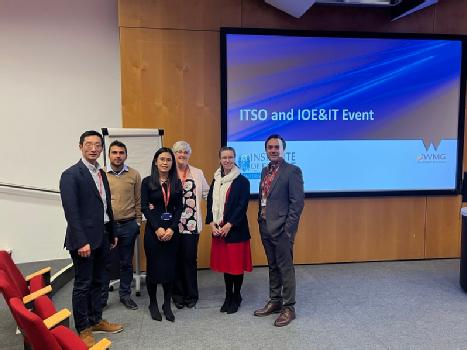 The MSc International Trade, Strategy, Operations (ITSO) course, at WMG at the University of Warwick is collaborating with the Institute of Export & International Trade (IOE&IT) to provide students with access to key industrial opportunities and engagements.
The WMG ITSO course is the first accredited Master’s programme in the UK by the IOE&IT. It is a unique interdisciplinary course that integrates the most essential and related pillars of international trade, strategy, and operations management within trade and business management towards supplying compound talents for industries. Following the philosophy of research-informed teaching for practical implementation, the course also seeks industrial access and opportunities for students.
As part of the collaborative partnership, an event was held recently introducing students to a new innovative way of learning and forging direct links between students and the IOE&IT.
At the event, Ms Helen Hastie, Membership Development Manager, from IOE&IT shared, with the students, information about professional memberships and the associated access to industry specialists and activities when studying ITSO. This includes annual events such as the import and export show, international trade awards, and MemberCon – a UK trade networking event. This helped students to improve their knowledge, skills, and opportunities for career development.
Ms Helen Hastie said: “It was a delight to return to welcome the newest cohort of students from WMG into our membership community. International trade offers a unique opportunity for development not only at a country-to-country level, but professionally. This next generation of international trade expertise is being actualised via WMG ITSO course facilitating exciting career opportunities and growing networks. The IOE&IT is delighted to continue supporting this growth.”
ITSO student course representative, Sitong Li commented: “The event is very helpful and we have also been given access to the latest daily news and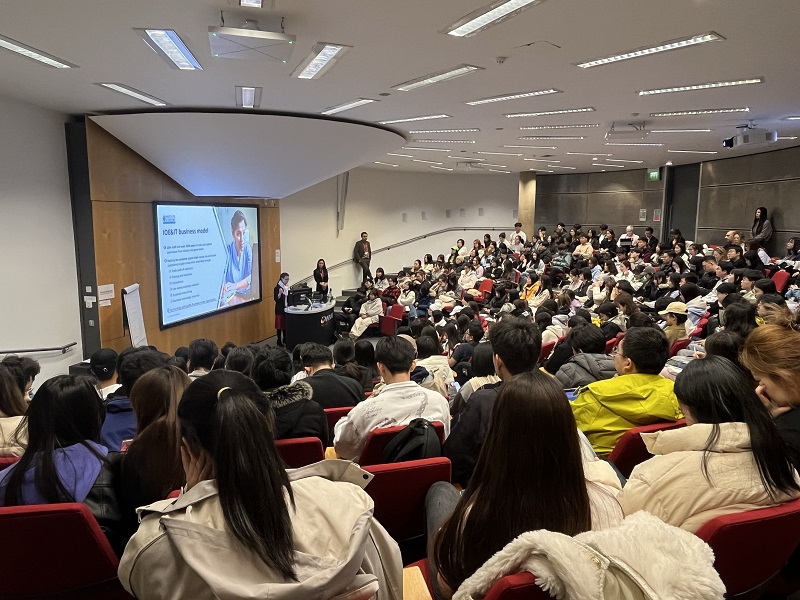 information on international trade. In addition to learning knowledge, the connection between our course and IOE&IT is a supplement to our study in the actual operations of international trade, and help us to gain more of the practices outside the classroom.”
Find out more about WMG’s International Trade, Strategy and Operations Master’s Programme here: MSc International Trade, Strategy and Operations | University of Warwick
If you have an enquiry about the ITSO course, please email WMG’s Assistant Professor and ITSO Course Director, Dr Di Li:d.li@warwick.ac.uk or wmgmasters@warwick.ac.uk
Mammography can be reduced for some breast cancer survivors, finds WMS study
Mammography for some breast cancer survivors could be reduced, according to research led by Warwick Medical School’s Clinical Trials Unit.