
TIA Centre: News
To see our previous half-yearly newsletters click here.
Scaling New Heights: Reflections on ICCV 2025 in Hawaii
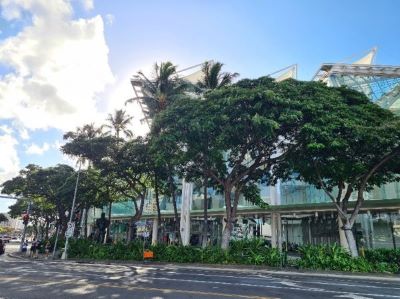
This year’s International Conference on Computer Vision, one of the world’s leading biennial events in the field, drew over 7,000 researchers from 65 countries to the Hawaii Convention Centre, with only 2.6% from the UK. As one of this 2.6%, I was thrilled to attend and present my latest work amid the palm-lined boulevards and ocean breezes of Honolulu. No offence to Leeds, but the backdrop was a far cry from my last conference, where I presented the ASTERLink opens in a new window segmentation model at MIUA. With the excitement of the venue, sunny skies, and opportunity to explore Hawaii for the first time, it was hard to imagine a more appealing setting for scientific exchange.
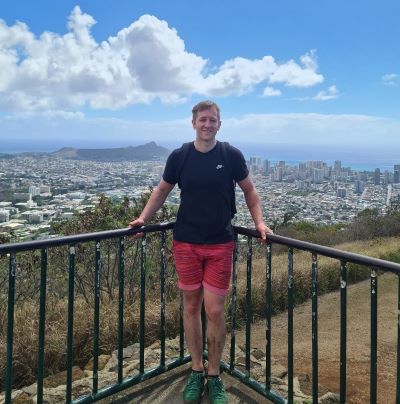
However, the conference wasn’t without its drama – in fact, after traveling halfway across the world, my ICCV poster presentation almost didn’t happen. With a free day in Honolulu, I set out to hike a mountain to beat jetlag. A local warned me about a recent landslide but encouraged me to continue, and I started the day in high spirits, surrounded by bamboo and rainforest sounds. But not long later, I realised I had lost the trail, a feeling strangely reminiscent of a PhD journey! Knowing from the PhD experience that, when lost, you can’t stand still or turn back, only move forward, and inspired by machine learning in particular, I tried gradient descent, heading downhill and hoping to find the trail again. However, this plan was foiled by exploding gradients, which made the terrain far too steep to carry on. Facing real risk, I luckily managed to use GPS to scramble back to another trail. Like a PhD, sometimes you need that timely intervention to get back on the right track (many thanks to Fayyaz Minhas, who acts as my PhD GPS). Grateful and exhausted, I pressed on and reached the summit. After seven hours, covering fifteen miles and over 2,000 feet of elevation on just four hours’ sleep and a banana, I realised my conference prep had been unconventional at best, but at least it made a good story.
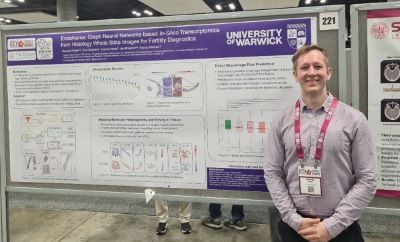
After the day's drama, I was relieved to see the workshop schedule confirmed with my name on it. My poster, “Endonama: Graph Neural Networks based In-Silico Transcriptomics from Histology Whole Slide Images for Fertility DiagnosticsLink opens in a new window” was part of the first session and drew lots of informal chats. It was encouraging to see genuine interest in the computer vision approach and recognition of its potential real-world impact, and I left the session feeling motivated to push forward with the next paper, expanding on this work in several exciting directions.
After finishing the poster session on day one, I was able to engage fully with the rest of the programme. I was struck by the sheer range of submissions, especially the strong presence of industry-linked work backed by significant funding and resources. The talks ranged widely, including a presentation on a feature extraction method closely aligned with my own research. Among the keynote speakers, there were also some extraordinary applications, as we heard from the first person to image a black hole (a breakthrough that validated aspects of Einstein’s theories via computer vision) and another researcher who used image analysis to decipher the burned scrolls of Herculaneum, revealing words lost for two millennia. A personal story from the latter about unwisely biking up a Hawaiian mountain during his PhD reminded me of my own misadventures. The third keynote revealed how infants curate their own visual data, providing insights from developmental psychology that could inspire future machine learning models. And finally, the best paper winner also impressed with a project that turns text prompts into buildable Lego structures, a rare practical application to generative AI which, given my background in construction, I personally found especially interesting.
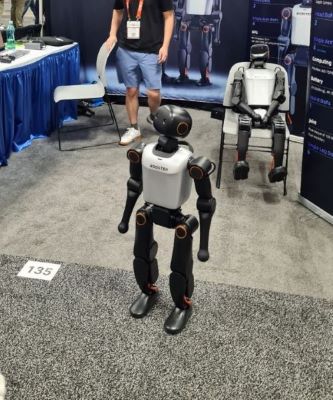
The expo featured stands from industry giants like Waymo, Google, Amazon, and Meta, offering an excellent opportunity to network and explore future roles. While many applications were outside my domain, I found it fascinating to see technologies like anomaly detection in factories alongside more familiar applications such as autonomous vehicles and robotics. I even tried Meta’s new smart glasses, though I couldn’t quite bring myself to mention that, back in Coventry, sunglasses aren’t a daily necessity. The variety of cutting-edge ideas reminded me of how rapidly the field, and consequently the world, is evolving.
The last day saw the second poster from the TIA group, authored by Manahil and presented by Nasir. It attracted a great deal of attention, so much so that I didn’t actually get a chance to discuss the work (although I’m sure there will be more opportunities to do so at an upcoming lab meeting). Their poster, titled “PS3: A Multimodal Transformer Integrating Pathology Reports with Histology Images and Biological Pathways for Cancer Survival Prediction,” clearly resonated with the community and made another impressive showcase of our group at the conference.
After five intense days, I was exhausted but deeply inspired by the immense scale and depth of research on display, including things I don’t often encounter in my daily work. I felt I had earned a well-deserved breather before the mad rush to Christmas and the subsequent push to publish our next paper. Over the weekend, I hiked up Diamond Head, explored the city, and snorkelled in Hanauma Bay before the long trip back to Coventry. Underwater, struggling to catch a breath, and surrounded by other creatures effortlessly gliding through, snorkelling provided one last forced metaphor for the PhD journey. My travel budget well and truly spent, I remain grateful for this incredible opportunity to attend, learn, and grow from such a remarkable experience.

Contributions from the TIA Centre:
George Wright [Poster Presentation]: Endonama: Graph Neural Networks based In-Silico Transcriptomics from Histology Whole Slide Images for Fertility. Link to paperLink opens in a new window.
Manahil Raza [Poster Presentation]: PS3: A Multimodal Transformer Integrating Pathology Reports with Histology Images and Biological Pathways for Cancer Survival Prediction. Link to paperLink opens in a new window. Link to videoLink opens in a new window.
By George Wright
Newsletters
Newsletters from 2024/25: