
OSS Lab
Welcome to the OSS Lab
Research
Headed by Orkun S. SoyerLink opens in a new window, the current focus of the OSS lab is to develop a quantitative understanding of cellular metabolism and metabolic interactions among species. On the former topic, we develop theoretical 'toy' models of key motifs in cell metabolism and conduct experimental analyses on single cell physiology in yeast and mammalian cells. On the latter topic, we create model ('synthetic') microbial communities and study species co-existence and interactions in these. These efforts currently focus on a 15-species cyanobacterial microbial community that develops extensive spatial organisation. For additional information please see our ResearchLink opens in a new window, PublicationsLink opens in a new window, and Pre-PrintsLink opens in a new window pages. You can access software and code developed by our team from our GitHubLink opens in a new window page and experimental protocols from our Protocols.ioLink opens in a new window page.
Teaching and Outreach
We are currently involved in undergraduate teaching with taught modules focussing on 'Dynamics of Cellular Systems' (LF305) and 'Synthetic Biology' (LF306). We have also contributed to an open book project on Economic Principles in Cell BiologyLink opens in a new window with a chapter focusing on 'Dynamics of Cellular Metabolism'. We occasionally participate in Outreach activities, including an interviewLink opens in a new window with the Microbiology Society and a recent collaborative project involving artistic expressions to communicate our research into cyanobacterial communities - see details. Soyer is also interested in interfaces with social sciences and was a visiting fellow at the 'Wissenschaftskolleg zu Berlin', focusing on a project on metabolismLink opens in a new window.
To communicate some of our research to the public and younger scientists, we currently collaborate with the award-winning science author Ben Martynoga Link opens in a new windowand a local engineering company, Neave EngineeringLink opens in a new window, together with support and funding from the Warwick Institute of EngagementLink opens in a new window. This collaboration aims to use a purpose-built device, called “SymbioSphereLink opens in a new window", to allow engagement with microbial communities and their metabolic activities. SymbioSphere will allow people to directly observe how microbes - micron-sized organism, not visible by eye - can undertake collective actions to form microbial macrostructures. These macrostructures enable co-existence of many different microbes, the collective metabolic actions of which result in significant contribution to the Earth’s overall chemical makeup, shaping the atmosphere, the soil, and the oceans. Symbiosphere users will be able to collect time lapse images and chemical measurements to capture microbial ecosystem dynamics and metabolic activities, and share their results and understanding.
Collaborative Initiatives
We are founding members of the Warwick Bio-Electrical Engineering Innovation Hub (BEE)Link opens in a new window and Warwick Aquatic Monitoring Station (WAMOS)Link opens in a new window. We have also led previous collaborative projects on anaerobic microbial communities focusing on Engineering Synthetic Microbial Communities for Biomethane ProductionLink opens in a new window and temporal metagenomics of AD reactors: Monitoring UK Anaerobic Digestion MicrobiomesLink opens in a new window. In 2014 and 2022, we led the development of two residential meetings at the Isaac Newton Institute focusing on microbial communities. The full program and selected talks from these two meetings are available online at the INI website: 2014 Microbial CommunitiesLink opens in a new window and 2022 Microbial CommunitiesLink opens in a new window. In 2025, we led the organisation of a workshop at the NSF-Simons National Institute for Theory and Mathematics in Biology (NITMB), who's aim is to integrate Maths and Biology by facilitating theorists and experimentalists to meet and interact. The workshop overview and recordings are available online via the NITMB webpage: Microbial Communities: Energetics and Dynamics Across Space and TimeLink opens in a new window.
Our Funders

News
More from Japan (Sep '26)
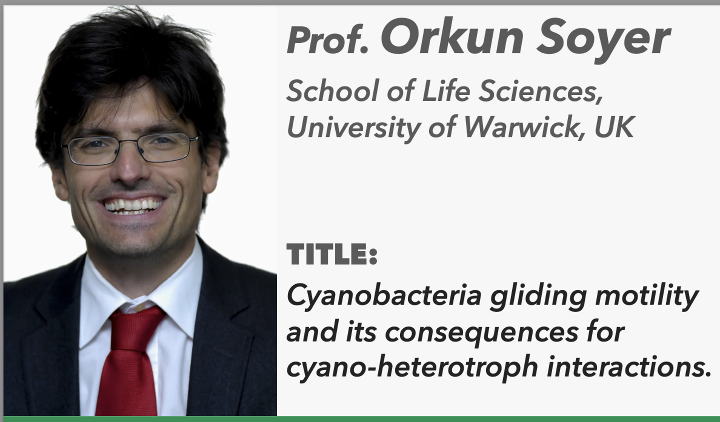
Orkun to present in the upcoming "Principles of Microbial Ecosystems 2026Link opens in a new window” meeting in Tokyo, sponsored by the Japan Society of Microbial Ecology and organised by Prof. Dr. Shin Haruta from Tokyo Metropolitan University.
and
Orkun delivers public lecture at the Tokyo University of Agriculture, hosted by Ass. Prof. Dr. Gen Enomoto
Lecturing in Japan (Aug '26)
Orkun delivers public lecture at the University of Tokyo, hosted by Prof. Dr. Chikara Furusawa
Fellowship host (June-Aug '26)
OSS lab hosts Dr. Zeynep Nircan Delen through a Warwick IAS fellowship award. Zeynep has an interdisciplinary scientist, exploring the evolution of liberal arts education and new ways of science education through innovative public engagement programs. Read more about Zeynep’s research through IAS =>
https://warwick.ac.uk/fac/cross_fac/ias/about/community/vfs/Link opens in a new window
Review published (Aug 26)
Albi and Orkun's latest review paper is live and open access: 'Community metabolism in dynamic redox landscapesLink opens in a new window'.
Exploring Sake yeast in Japan (July '26)
Orkun visited the laboratory of Watanabe Daisuke, who studies fermentation in yeast. A developing collaboration between the two labs will look at the NADH dynamics and its impact on respiro-fermentation in different yeasts
SymbioSphere in Japan (July '26)
SymbioSphere is in Japan! As part of his fellowship at Tokyo Science, Orkun gives a talk on SymbioSphere and our research on cyanobacterial communities at the Sano Nihon High School, near Tokyo, Japan.
Best Poster for Kelsey (July '26)
Congratulations to Kelsey for winning the Best Poster Award for Bioprocess Microfluidics at the 7th European Summer School on MicrofluidicsLink opens in a new window, hosted by UCL.
Follow OSS LabLink opens in a new window on X (formerly Twitter)