
Events
Documentary Film Screening: The Tribunal and Post-Screening Talk with Malcolm Rogge (Producer) and Johanna Lorenzo (Discussant)
About the Event:
Join us for a screening of The Tribunal, a powerful documentary by Dr Malcolm Rogge in partnership with the Columbia Centre on Sustainable Investment (CCSI), that shines a light on a significant environmental and social justice battle in the Ecuadorian Amazon. The documentary tracks the experiences of community members in the Intag Valley who were directly impacted by a potential mining project, a dispute that erupted as a result of the project, and the eventual arbitration proceedings in which the Canadian mining company sued the Ecuadorian government under the Canada-Ecuador bilateral investment treaty (BIT). Filmed in the megadiverse Ecuadorian cloud forest, the film brings to light the troubling human rights impacts on local nature defenders of the international investment arbitration system.
The screening will be followed by a discussion with Dr Rogge and Dr Johanna Lorenzo to reflect on the intersections of law, activism, and film and the ongoing struggle to confront corporate impunity and environmental destruction.
About the Speakers:
Dr Malcolm Rogge is lecturer in law at Exeter Law School, University of Exeter. He is business and human rights scholar and practitioner, as well as an international award-winning documentary filmmaker. Dr Rogge is also senior advisor to Ecoforensic, a community interest company that supports rights of nature advocacy through citizen-science initiatives.
Dr Johanna Lorenzo is an Assistant Professor in Public International Law at the University of Amsterdam and the Amsterdam Center for International Law (ACIL). She is currently a Visiting Research fellow at the GLOBE Centre. She specialises in international law and development, international trade law, and the law of international financial institutions (IFIs).
This event is followed by a drinks reception.
Please email globe@warwick.ac.uk if you have any dietary or access requirements.
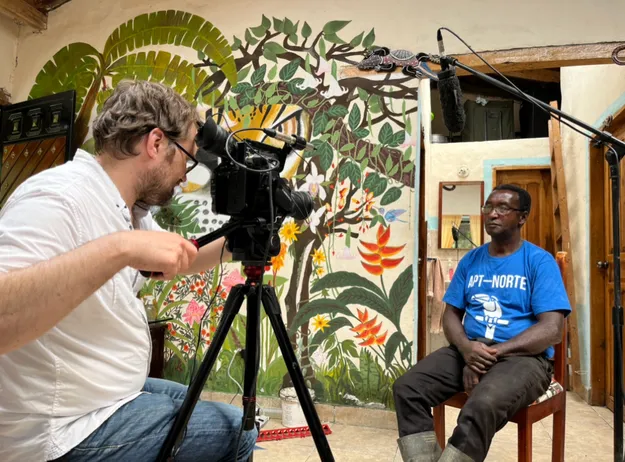
Image: Malcom Rogge filming Julio Espinoza in Ecuador
The Tribunal reviews:
Dr Lorenzo Cotula, International Institute for Environment and Development; University of Strathclyde, UK
This beautifully filmed documentary sheds light on asymmetries and exclusions in arrangements to settle investment disputes – whose interests are protected, and whose voices are marginalised. Through their powerful testimonies, the participants lucidly expose the limitations of the system and highlight the need for a different model that does justice to their rights and to the complexities of investment disputes.
Professor David R Boyd, UN Special Rapporteur on Human Rights and the Environment
A powerful and moving film - the people interviewed radiate integrity, and the natural beauty of the region is stunning. Directed by Malcolm Rogge and produced in association with the Columbia Center on Sustainable Investment, The Tribunal should be widely viewed. This film will help people to understand more clearly the injustices perpetuated by investor-state dispute resolution mechanisms.
Professor Catherine Kessedijan, Professeur émérite de l’Université Panthéon-Assas
The Tribunal is a “tour de force” which shows all of the important points about investment law and human rights in only thirty minutes. Movies of this kind are great tools to help our students understand the challenges that we are facing in trying to reconcile investment law and human rights.
Dr Anil Yilmaz Vastardis and Dr Tara Van Ho, Co-directors of the Essex Business and Human Rights Project.
This documentary film is essential viewing for anyone working in the fields of international investment law and business and human rights, but most importantly for arbitrators and practitioners of investment law and arbitration. The Tribunal brings to light powerfully two themes: (1) the physical distance of investment arbitration from the lived realities of impacted communities; and (2) the erasure of human rights and environmental impacts in the investment arbitration process.
Professor Peter Muchlinski, author of Multinational Enterprises and the Law, Oxford University Press.
Malcolm Rogge’s The Tribunal/El tribunal, produced in association with the Columbia Center on Sustainable Investment, is a clear and impactful documentary film that conveys the real injustice of investor-state dispute settlement (ISDS) and the absurdity of an investor being able, in effect, to buy the right to violate human rights albeit with some reduction of damages for contributory fault. The film offers a strong argument for tribunals being more open to human rights issues and to gather relevant evidence from local witnesses and also from site visits. With some noble and laudable exceptions of individuals who are already doing this, arbitrators and legal counsel must wake up to their responsibilities as international lawyers and integrate human rights properly into ISDS to ensure justice for those adversely affected by irresponsible and illegal corporate behaviour. A good starting point would be to watch this film and listen to the voices of the people thus heard.
Professor Nicolas Perrone, Universidad Andrés Bello, Chile
Who are the real losers of international investment agreements (IIAs) and investor-state dispute settlement (ISDS)? The states that are sued by foreign investors and sometimes lose ISDS disputes, having to pay compensation? Or those living near the investment site, regardless of the outcome of ISDS disputes? This documentary shows that the real losers in extractive ISDS disputes are the local communities struggling to defend their territory from governments and foreign investors alike. Through interviews with local residents and activists, the Tribunal takes the viewer through the intricacies of one of the most infamous ISDS cases: Copper Mesa v Ecuador. The locals suffered Copper Mesa misconduct and the absence of government control, and later saw how the state, the investor and the arbitral tribunal made local suffering invisible when the case was heard in Washington. Copper Mesa is one of the many disputes that illustrate how IIAs and ISDS are constitutive parts of extractivism in the Global South, not just an imposition from the outside. The Tribunal adds to the growing academic literature that since the early 2010s has uncovered the perils of ISDS for local communities, taking the debate beyond the traditional private (investor) - public (state) framework.
Dr Andrea Shemberg, Former Legal Advisor to the UN Special Representative on Business and Human Rights
Rogge’s new film, The Tribunal, produced in association with the Columbia Center on Sustainable Investment, offers the viewer a unique opportunity to observe the profoundly personal experiences of one set of community members in Ecuador, relative to the development of a copper mine in the Intag Valley. It documents a perspective that literally never gets heard. For those who work in international investment and ISDS, this film will undoubtedly arouse the urge to counter the story being told with technical and legal arguments about how investment arbitration is not the appropriate venue to hear claims about human rights abuses. But the film is an invitation to grapple with whether those technical counter-arguments are actually on point.
Shin Imai, Professor Emeritus, Osgoode Hall Law School, Member of the Board, Justice and Corporate Accountability Project
Rogge’s 2023 follow up to his 2008 film, Under Rich Earth, is a powerful affirmation of the strength of affected communities and a blistering critique of the international investor protection system. Rogge does not hit you over the head with his message; instead, he communicates through the words of local farmers, activists, and educators; and through his stunning photography. The most poignant sequence in The Tribunal comes after the international arbitration panel orders Ecuador to compensate the Canadian mining company for revoking its licence. Three witnesses from the Intag valley had been flown to Washington to give their testimony at the arbitration hearing. They were left waiting around for days, and finally, they were told to go home and that their testimony was not needed. Back in Ecuador, Rogge shows the lengthy written decision of the arbitration panel to a community member – she starts to flip through the document and realizes that many of the sections describing the violent assaults on the communities by the mining company’s paramilitaries are redacted. This was not a symbolic disregard of the community by international law – it was a literal erasing of history. I loved Rogge’s 2008 film, Under Rich Earth, and I have screened excerpts in my classes at Osgoode Hall Law School in Toronto. At about half an hour, its 2023 sequel, The Tribunal, is perfect as an educational tool for the classroom.
Professor Gus Van Harten, author of The Trouble with Foreign Investor Protection, Oxford University Press
The Tribunal is a powerful indictment of the arbitrations conducted under investment treaties over the last 25 years. It documents the experiences of members of a besieged community in Ecuador’s highlands — a community caught between an aggressive Canadian mining company and a complicit national government. The arbitrators appointed to hear the dispute in Washington, DC, find in favour of the company without even hearing from those most directly affected, the local community. In this documentary, people who survived brutal events - experiences redacted by the arbitration process - can have their story heard by a wider audience. It is a story of gross unfairness suffered in an opaque and exclusive system of foreign investor protection.
Background Reading:
Investment treaty News (ITN) Special Issue: The Tribunal
How a documentary film can help UNCITRAL Working Group III think through ISDS reform by Lorenzo Cotula and Ladan Mehranva, 10 April 2024