
Departmental news
The Manufacturing Commission calls for greater support for businesses to navigate further education reforms and upskill their workforce for a digital future
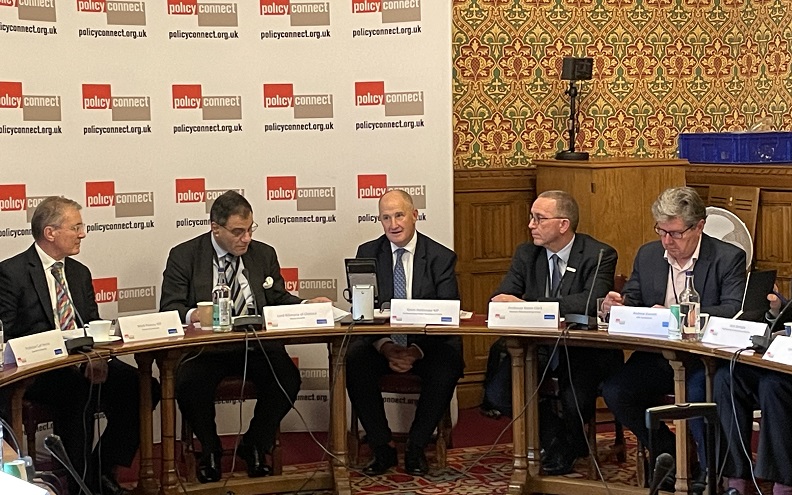 The Dean of WMG at the University of Warwick, Professor Robin Clark, spoke at the launch of Policy Connect’s new report on manufacturing skills this week (Wednesday 25th October). WMG supported the development of the report, including holding a roundtable with West Midlands employers; Higher Education (HE) and Further Education (FE) providers; and regional skills experts.
Lord Bilimoria of Chelsea CBE DL, launched Policy Connect’s latest report – Upskilling Industry: Manufacturing Productivity and Growth in England, alongside Minister for Enterprise and Markets, Keving Hollinrake MP; WMG Advisory Board member, Mark Pawsey MP and the Shadow Minister for Innovation, Chi Onwurah MP.
The Manufacturing Commission’s inquiry considers the implications of recent skills system reform in England on the manufacturing sector. It concludes that labour shortages are restricting productivity across the economy, with skills gaps in the manufacturing sector costing between £7.7 and £8.3 billion annually in lost economic output.
To address this the report recommends government make several reforms to the skills system:
· Support for SMEs in the manufacturing sector to help upskill their workforce, including incentives to deliver T-Levels and host skills boot camps.
· Greater flexibility in the use of the Apprenticeship Levy funds, including ring-fencing of unused Levy funding for investment in wider upskilling.
· A national campaign to increase the uptake of STEM subjects by women and people of minority ethnic backgrounds.
· Appointment of a government manufacturing ‘Champion’ to raise awareness of the manufacturing sector in schools and promote the role that the manufacturing sector is playing in combatting the climate crisis.
Inquiry Chair, Lord Bilimoria of Chelsea, CBE, DL said: “As Chair of the Manufacturing Commission and a proud supporter of British manufacturing, I am delighted to have been involved with this inquiry, which considers the impact of skills shortages across the sector.
“Throughout the evidence sessions that have informed this work, I have been inspired by accounts from manufacturing businesses that are using all levers available to them to upskill their workforces. The recommendations that we have made seek to help businesses, education providers, and individuals best navigate the current policy landscape and deliver the skills that the manufacturing sector so vitally needs.”
Inquiry Vice-Chair, and WMG advisory Board member, Mark Pawsey MP added: “As a member of the Business and Trade Committee and co-chair of the All-Party Parliamentary Manufacturing Group, I regularly hear of the skills shortages that limit productivity within the UK’s manufacturing sector. This inquiry explores how businesses can collaborate better with education providers to deliver the skills that local communities need. This is particularly important in the West Midlands, which is home to a significant part of the UK’s automotive and future battery technology capability.”
Professor Robin Clark, Dean of WMG, said: “The proposals in the report contain lots of good ideas on how to develop a system that really works for learners and employers, and suggests practical changes that can make a real difference to our skills system.
“The report is a call to action for all of us working in skills to encourage learners, course providers and employers to get engaged in manufacturing, give SMEs strong incentives to support skills and collaborate to improve course design, provision, and approval.
“We’ve got great examples of how skills can be transformative for businesses and students in manufacturing. Now we need to work together to make that the experience everyone has from our skills system.”
Read the full ‘Upskilling Industry’ report here: https://www.policyconnect.org.uk/research/upskilling-industry-manufacturing-productivity-and-growth-england
Towards universal software for quantum dynamics simulations
Prof. Scott Habershon receives a share of EPSRC funding for COSMOS - a major project to create a universal software framework for quantum dynamics simulations with UCL.
Assay_ready Cryopreserved Hepatocytes for Toxicity Testing
Liver hepatocytes are the front-line cells for screening new compounds for toxicity. However, hepatocytes are stored frozen in vials, not in monolayers meaning they need substantial processing to be ‘usable’ especially for high throughput screening. To solve this the Gibson and Dallman groups have collaborated, so show that immortalised and primary hepatocytes can be cryopreserved whilst attached to 96 well microplates. These can then be taken from the freezer, and simple thawed and are ready to use in under 24 hours. Post-thaw the cells show equal performance to fresh. This was achieved by careful consideration of the molecular mechanism damage during freezing, with the team using patent-pending controlled ice nucleation technology, rather than a traditional re-formulation of cryoprotectants approach. This work was in collaboration with Cryologyx, a University of Warwick Spin out, which has commercialised aspects of this technology.
Read the paper hereLink opens in a new window.
Passive diffusion accounts for the majority of intracellular nanovesicle transport
Trafficking of proteins, lipids, and other molecules between cellular compartments is carried out by vesicular carriers. Material destined for transfer is packaged into a small trafficking vesicle at the donor compartment; the vesicle must then travel to its destination, before fusing with the target compartment to deliver the material.
Sociology Seminar Series Event - Shamim Miah (University of Huddersfield)
Monday 30th October 2023
17:00 - 18:30
S0.13, Social Sciences
In the second of the Sociology Seminar Series, we welcome Dr Shamim Miah who will explore the works of Ibn Khaldun (d.1406) who was a historian and philosopher and is considered to be one of the founding fathers of sociology. This event further aims to discuss the paradox of Ibn Khaldun's influences on the formative years of modern western sociology, alongside its marginality from mainstream western academia. Dr Miah proposes ways to bring Ibn Khaldun into the mainstream through the systematic application of his theory. This event will be ideal for those interested in developing sociology beyond the western canon.
Bio: Dr Shamim Miah is Senior Lecturer University of Huddersfield and author of Ibn Khaldun: Education, History and Society
A Gourd day for a pumpkin: the health benefits of this over-looked veg
Pumpkins make their appearance every Halloween, swiftly disappearing for the next year, but scientists believe we are over-looking their health benefits. Researchers at WMS are keen to share the positive impact pumpkins can have on our health and wellbeing – which range from aiding weight loss, improving skin and even reducing risk of cancer.
Warwick Festival of the Gothic
WMG research shapes the future of autonomous vehicles
WMG, at the University of Warwick, is part a unique £2 million consortium, entitled Sim4CAMSens.
 The Sim4CAMSens project, led by Claytex, is made up of a consortium of prominent industry partners, including AESIN, rFpro, Syselek, Oxford RF, National Physical Laboratory, Compound Semiconductor Applications Catapult and WMG.
Together the consortium will create a framework for sensor evaluation that incorporates modelling, simulation, and actual testing. In order to enable Automated Driving Systems (ADS) and sensor developers to speed their development, this project will involve the development of new models for sensors, noise and materials, and new test methodologies.
The role of WMG will be to understand which noise factors have the higher impact on the different perception sensors (i.e., camera, LiDAR, RADAR,) and how to correlate virtual testing to real-life testing to support the entire supply chain.
Professor Valentina Donzella, who leads the Intelligent Vehicles Sensors research at WMG explains: “The Sim4CAMSens project is an extremely exciting opportunity for WMG, to work with UK based world leading industrial and research partners, to speed up the development of sensors models and testing methodologies. These are key considerations for the future safe deployment of robust and reliable ADS. The success of this project will ensure the UK leads the way globally in this field."
Find out more about WMG’s Intelligent Vehicles Sensors research here: https://warwick.ac.uk/fac/sci/wmg/research/cav/ivsensors
High student satisfaction reported in latest Postgraduate Taught Experience Survey 2023
We are pleased to announce that Warwick Law School has achieved high levels of student satisfaction, as reported in the latest Postgraduate Taught Experience Survey (PTES) 2023.