
Departmental news
Isaac Harris
It is with great sadness that we share the news that Isaac Harris, a third year Data Science student died on Monday 5th June 2023, in Coventry.
Isaac was a well-liked and talented student who will be very much missed by everyone who had the privilege of knowing him during his studies at Warwick.
The whole department are tremendously saddened by the news of Isaac’s death. He was a hugely valued member of our student community and his loss is particularly felt by his fellow students on the Data Science programme.
We offer our deepest sympathies to Isaac’s friends and family.
The sudden and unexpected loss of anyone we know can be traumatic, and we will continue to provide support to anyone who needs it. To speak to someone for bereavement support, please contact wellbeing support services or the chaplaincy.
An online condolence book has been opened to share memories of Isaac and offer condolences to his family and friends: https://warwick.ac.uk/fac/sci/statistics/condolence/
Entries will be published weekly and will be printed as a book for Isaac’s family to keep. If you would rather, you can write a message in a physical Condolence Book in the chaplaincy.
Warwick Researcher takes on the Race Against Dementia
Dr Jake Brooks has been awarded a prestigious fellowship by Alzheimer's Research UK and Race Against Dementia.
The first British Baked Beans could be on the breakfast menu thanks to University of Warwick research
Professor Eric Holub, a plant scientist at Warwick Crop Centre, has developed Haricot bean varieties which can be sown in early May and harvested as a dry grain before mid-September, matching the UK's warmer months. Until now, it has been impossible for farmers to grow the haricot variety used for baked beans in the UK because they are incompatible with the climate.
Press Release (16 June 2023)
The story was also on BBC Breakfast. Watch it on iPlayer (from 22m 30s)
Faculty Post Doc Prizes awarded to Amol Bhandare and Richard Guillionneau
Each year, the Faculty of Science, Engineering and Medicine (SEM) funds a prize for the best Warwick-affiliated research output from an Early Career Researcher (ECR). Each department nominates a winner out of the applications received after a judging process as determined by the Faculty. This year the School of Life Sciences has awarded two prizes:
- Dr Amol Bhandare
- Dr Richard Guillioneau
The Panel recognised the scientific excellence of the research published in these outputs and the leading roles that both researchers had taken in conceiving and undertaking the research.
New taste and smell test could diagnose Alzheimer's long before memory loss starts
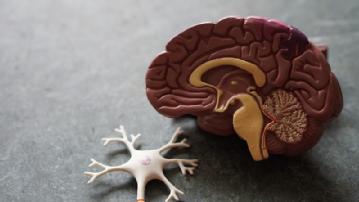
A simple smell and taste test could revolutionise diagnosis of Alzheimer’s – long before symptoms of memory loss even arise.
Scientists are working on a ground-breaking medical screening for the disease which could also improve treatment options. The research is based on growing evidence that people with Alzheimer’s can lose their sense of smell and taste many months or even years before other symptoms, such as memory loss, become apparent.
An early diagnosis is critical for those with the disease. New drug technology can slow, or even reverse the progress of Alzheimer’s, but only if the disease is detected early enough. The drug, lecanemab, is one of two new treatments for the disease.
The research, led by WMG at the University of Warwick together with Superlunary Labs and with support from University Hospitals Coventry & Warwickshire (UHCW) NHS Trust, New-Food innovation, and Alzheimer’s Society, could lead to UK-wide screening services where members of the public can take a simple smell and taste test. Those who perform poorly can then be referred for further tests which could result in an Alzheimer’s diagnosis.
The novel solution provides accurately simulated flavour samples (known as virtual flavour, developed in collaboration with New Food Innovation) via an easy-to-use low-cost dispenser, which could be used by a nurse as part of an annual health check, in pharmacies, care homes, community centres and even in the home.
While in the trial stages at the moment, academics hope that one day an inclusive mobile Alzheimer’s screening unit could reduce significant pressures on the NHS and ease waiting times for those who are struggling to get an appointment with their GPs.
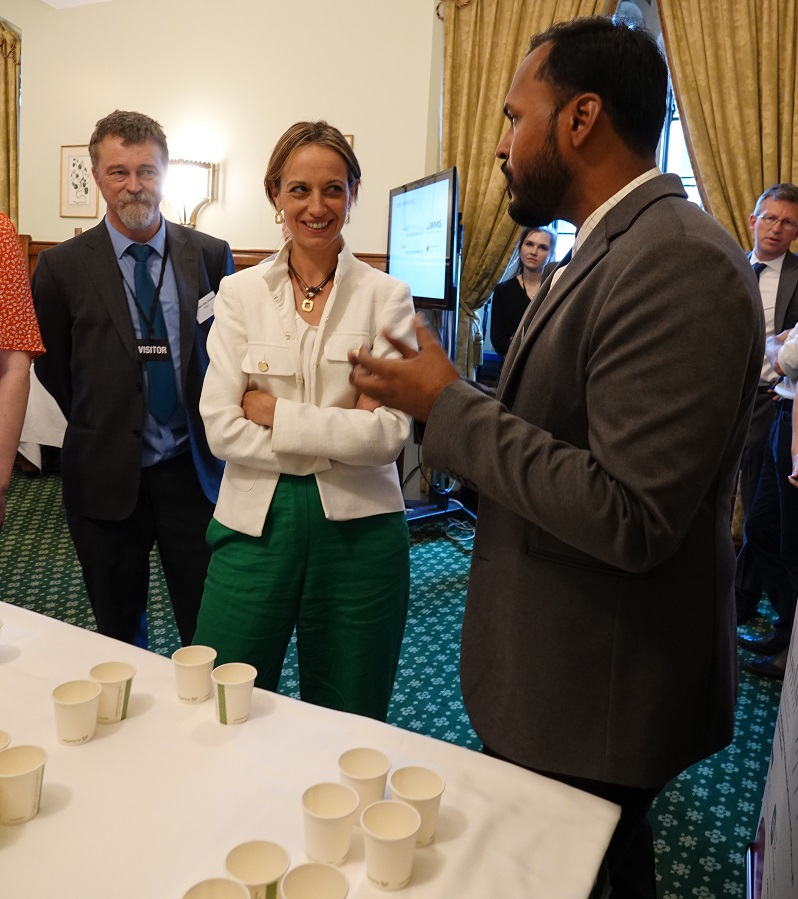 Professor Alan Chalmers from WMG at the University of Warwick said, “In this simple screening test, people will be given different flavours to smell and taste – they then determine which is sweeter, less astringent, smells more of lemon, for example. It’s an easy, non-invasive test which can be rolled out to people quickly across the UK.
“At the moment, people who present with symptoms of memory loss are referred for MRI scans and spinal fluid tests to confirm a diagnosis. By the time memory loss occurs things are often too late; pioneering drug treatments only perform well in the early stages of degeneration. MRI scans and spinal fluid tests are currently not done before there is an indication of the disease as they are incredibly invasive, can cause distress and are expensive and time-consuming for the NHS. Failure of the flavour test can give the necessary early indication.
“Our preliminary data shows that there is a difference in the flavour detection of those with Alzheimer’s compared to those without the disease, so we hope to get further backing and implement these screening tests UK-wide.
“It’s important to note that the loss of smell and taste associated with Alzheimer’s is quite different to that of long COVID. While COVID could cause a loss of the sense of taste and smell, long COVID can alter your sense of flavour – a combination of taste, smell and mouthfeel – rather than diminish it.”
This research was showcased by the University of Warwick alongside the Alzheimer’s Society, at an All-Party Parliamentary Group (APPG) on dementia, on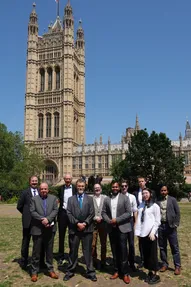 14 June. The APPG is hosted by Sir Jeremy Wright, MP for Kenilworth & Southam and vice-chair of the all-party parliamentary group on Dementia.
Sir Jeremy Wright MP added: “I am delighted to be hosting an event at the House of Commons focussing on a development that could contribute to a significant improvement in the mass diagnosis of Alzheimer’s, alongside the new strides in treatments that have been announced in recent months.”
Dr Richard Oakley, Associate Director of Research at Alzheimer’s Society, said: “It’s really exciting to see how researchers are thinking outside of the box about potential methods to detect the diseases that cause dementia at the earliest stages. This is so important now that new disease-modifying treatments are just around the corner.
“The NHS needs to be ready for these new treatments. We can’t be in a situation where new drugs are being approved but people can’t access them early when they work best. Alzheimer’s Society will continue to stand up for people living with dementia and push for more accurate, earlier dementia diagnosis in the NHS.”
Malcolm Barnes, Director of Superlunary Labs added, “Simplicity of the device and test is key to collecting big data across different age groups and demographics.”
Research Spotlight: Dr Nathan Canen
Dr Nathan Canen joined the Department of Economics in April 2023. Here he discusses his work in the areas of political economy and econometrics, and what attracted him to join the Department.
What research projects are you currently involved with?
My research can be broadly categorised into two fields. The first one is political economy, which studies the role of politics in shaping economic policies and outcomes. The second one is econometrics, which studies statistical methods for economics problems.
Within political economy, my main research projects focus on the organisation of political parties and the use of information by citizens, voters and politicians. For example, I have been studying sources of political polarisation – which is the divergence in political behaviour across party lines. This is a fascinating question given its relevance and implications for policymaking. But it is also deceptively hard to answer: politicians may diverge in their behaviour because of their ideologies, or because opposing parties are effective at convincing them to behave in a certain way. Disentangling these explanations requires careful use of economic theory and data. With new methods, we find that a party’s effectiveness at corralling its members has been an important driver of polarisation in politicians’ behaviour in the U.S. over the last few decades.
As researchers, we typically do not observe what drives legislative or citizens’ behaviour. Instead, we must infer those explanations from outcomes (e.g. how politicians vote on bills, what committees decide to approve, what news citizens view on TV). Quantitative answers to these questions often involve nonstandard datasets (e.g. network relationships among politicians), computationally intensive methods or theoretical properties making them hard to quantify (e.g., our theoretical models may have multiple solutions). Most importantly, we cannot easily ’randomise’ treatment to evaluate alternative political systems and institutions. My research in econometrics addresses these challenges by providing new statistical tools designed for the political economy problems I work on. By carefully thinking through the type of assumptions in such contexts, we can develop better suited estimators and statistical tests.
Why did you choose this research field?
I have always been fascinated by the interaction between politics and economics: it was my main interest during my undergraduate degree! As I continued within the field of economics, I learned more about political economy and became even more passionate about it. I particularly liked its emphasis on thinking through the feasibility of desirable policies. This led me to my PhD at the University of British Columbia, where I worked with my amazing supervisor and co-authors. My first paper studied networks in Congress: how politicians choose who to work with to craft and pass bills.
While I was working on those topics, I found myself facing methodological challenges that required new tools. For example, data about politicians’ networks cannot rely on commonly used statistics, which are built on assumptions of independence across observations. So, I continued to take econometrics classes and think about how I could improve the statistical approaches in my political economy papers. I was then very happy to be able to co-author with econometricians interested in the same types of statistical problems. The rest is history!
What are you planning to work on next?
On the political economy side, I am starting a research agenda on the role of deliberation in decision-making in committees. Many important regulatory bodies use advisory committees when making decisions. For instance, regulatory agencies in healthcare (e.g., the Food and Drug Administration (FDA) in the US or the Medicines and Healthcare Products Regulatory Agency (MHRA) in the UK) use such committees when deciding whether to approve a new product. Congressional and parliamentary committees also perform similar information gathering.
These committees deliberate before making a final recommendation. Their deliberations can be based on existing information, but committee members can also request additional information. Hence, they may act strategically to learn more information, with a goal of influencing (e.g., persuading or convincing their peers), thereby influencing the committee’s decision. In these projects, we use transcript data from FDA Advisory Committees. We transform this data in a way that can be quantified within a theoretical model of learning in committees. Then, we evaluate the role of individual preferences, information and strategic incentives in driving committee-level outcomes and compare their performance to alternative institutional designs. We are hopeful this will lend insights into evaluating the performance of these institutions.
On the econometrics front, I have become interested in the assumptions needed for counterfactual analysis (i.e. the evaluation of policies that have yet to be implemented). For example, how do we evaluate the effects of a future minimum wage, when that minimum wage has yet to be observed? Making these predictions is a hard statistical problem. Typically, researchers may use a theoretical model and assumptions to provide reasonable estimates. However, some of my recent results suggest that researchers may not need all of those assumptions, making their results more ’robust’.
What impact do you hope your work will have on society?
Broadly speaking, I hope my work shows the need for nuance in policymaking, and how theory and data are helpful. It is often tempting to make a conclusion based on a striking figure or descriptive evidence. However, when analysing individual actions – such as in politics – those answers may not faithfully represent actual behaviour or mechanisms. Hence, even well-intentioned policies may have different effects depending on what type of incentives are given.
For example, whether political polarisation is being driven by party organisation, rather than politician ideologies, matters for which policies get approved. Whether voters are demanding too little information, or just not having access to it, further changes the way we think about similar questions.
On the regulatory committees side, we hope that our work will help inform the way such committees are designed. This may include how the committees are composed, rules on what type of information they receive, and recommendations on when they can call a vote. While actual changes to committee design may take time, our findings have potential to help improve decision-making: for example, have products been approved that should not have been, and is that due to the way committees are designed?
Why did you join the Economics department at Warwick?
The Economics Department at Warwick is an incredibly dynamic, stellar, and vibrant community for economics. In fact, I was already familiar with much of the work being done at Warwick, especially within my research fields. There is world-leading research being done across the Department and in many fields. I can interact with cutting-edge theoretical and empirical, applied and technical research, with amazing colleagues and staff. This dynamism is also present through the ambitious work conducted by both staff and students, active visitor series, opportunities for presentations and conferences, among others.
An essential part of Warwick’s edge, though, is its collegiality: staff and students are incredibly warm, providing an environment that is ideal to collaborate. This allows us to exchange ideas across fields and methods which, I think, really helps break ground on new contributions. I am particularly grateful to all colleagues, support staff and students who have made me feel so welcome. All in all, Warwick is a very exciting place to be in and I am looking forward to contributing!
Nathan Canen is an Associate Professor in the Department of Economics. View his staff profile.
Economics PhD student wins Best Paper Prize in Industrial Economics
Warwick Economics PhD student, Jinlin Wei, has received the Best Paper Prize of the Business and Industrial Section of the Royal Statistical Society awarded at the PhD Symposium in Industrial Economics.
Jinlin’s paper, Branching for Caution: Banks in England and Wales during the 1878 Financial Panic discussed his research on how exposure to an unexpected financial panic resulting from the failure of the City of Glasgow Bank in 1878 led to the geographic expansion of banks affected, based on a bank-level dataset on joint-stock banks in England and Wales in the 1870s and 1880s.
Jinlin (third year PhD student of Economics) was awarded the Best Paper Prize of the Business and Industrial Section of the Royal Statistical Society for the best contribution to the use or advancement of statistical-econometric methods or data collection to the analysis of industrial economic issues.
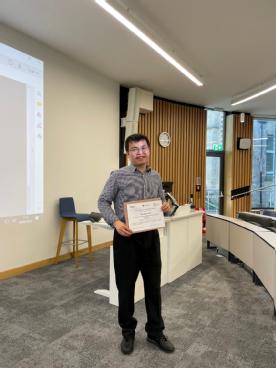 Jinlin was presented with the prize at the PhD Symposium in Industrial Economics he attended last week, as part of a two-day research conference of the Network of Industrial Economists (NIE) held at the University of Leicester School of Business. The symposium brings together early career economists (PhD students and postdoctoral researchers) to foster discussion and dissemination of research in all areas of industrial economics and to provide them with feedback on their work from a designated discussant drawn from both internal and external faculty.
Commenting on the award, Jinlin said:
"Witnessing the collapse of the Silicon Valley Bank, I hope that this paper can add to our understanding of how accountability affects the responses of banks to financial panics and how regions with low financial access are affected."
We congratulate Jinlin on this fantastic achievement and wish him more successes in the future.
Related information
Jinlin Wei is a third year PhD student in the Department of Economics at the University of Warwick. For further information about his research and publications can be found on his PhD student Profile - Jinlin WeiLink opens in a new window.
The Network of Industrial Economists
Established in 1970s, the Network of Industrial Economists (NIE) is a forum for interchange among university economists in the UK, and for interaction between academia, business, and government on topics of industry economics.
NIE Conference and PhD Symposium 2023Link opens in a new window, 8-9 June 2023, University of Leicester School of Business
Royal Statistical Society
Founded in 1834, the Royal Statistical SocietyLink opens in a new window is one of the world’s leading organisations advocating for the importance of statistics and data. It’s a professional body for all statisticians and data analysts with more than 10,000 members in the UK and across the world.
Image banner attribution
Wikimedia Commons license: A cleared cheque from 1877, the year before the collapse of the City of Glasgow Bank,Link opens in a new window 4 June 2014, author AllyD
Warwick trio win prestigious RSC Prizes
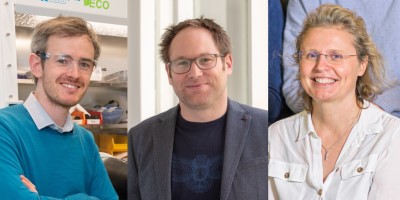
Dr Sebastian Pike wins the Sir Edward Frankland Prize, Dr Dr Adrian Chaplin, takes the Sir Geoffrey Wilkinson Prize, and Professor Julie Macpherson has been named winner of the Tilden Prize. Read more.Link opens in a new window
A very warm welcome to the 20 Ukrainian Students visiting the department
The History Department are delighted to be co-hosting 20 students from the Ukrainian Catholic University in Lviv with the English Department, from 12 - 25 June. Professor Christoph Mick has helped organise a Summer School for the students with lots of amazing teaching and social events planned.
The students have arrived on campus for their first day and we hope they have a wonderful few weeks in the Faculty!