
Embedding Researcher & Research Professional Staff Wellbeing into Higher Education (Re-Well HE)
Project Team
Prof Elena Riva (PI)
Head of Department, Institute of Advanced Teaching & Learning (IATL).

Elena has been the PI for a number of Enhancing Research Culture projects, including Building Wellbeing Literacy and Embedding Wellbeing into Research Culture.
Dr Amber Tout
Research Fellow, Warwick Medical School (WMS)

Amber has co-led several Enhancing Research Culture-funded projects, including the Re-Well HE project and Phase 1 of Women in Academia (WinA) project.
Dr Hatice Gundeslioglu
Postdoctoral Research Associate, IATL

Co-PIs:
Dr Carla Toro
Deputy Pro-Dean (Research) / Associate Professor, WMS

Professor Nicole Tang
Professor of Clinical and Health Psychology, Head of Lifespan Health and Wellbeing Group, Director of Warwick Sleep and Pain Lab, Department of Psychology

Dr Jagjeet Jutley-Neilson,
Director of Student Experience and Progression,
Reader in Psychology,
Department of Psychology

PhD Candidates
Katie Cuneen
Department of Psychology


Contact
For further information about this project, please email E.Riva@warwick.ac.uk, Amber.Tout@warwick.ac.uk, and/or Hatice.Mastacan@warwick.ac.uk
Project Summary
The wellbeing of researchers and research professional staff in UK Higher Education Institutions (HEIs) is a significant concern. Across the sector, reports reveal that levels of mental wellbeing and considerably lower than population norms, with fewer than one-third of UK Higher Education (HE) employees achieving average wellbeing, and over half showing probably signs of depression (Education Support, 2021).
Although staff wellbeing has received growing attention from universities, funders, and sector organisations in more recent years, there remains a limited national understanding of the organisational responses being implemented to address the underlying causes of these problems.
The Embedding Researcher and Research Professional Staff Wellbeing into Higher Education (Re-Well HE) project was established to address this gap.
The Re-Well HE project had three key aims:
Aim 1
To establish an up-to-date understanding of wellbeing and the key drivers of occupational stress among researchers and research professional staff in UK HEIs.Aim 2
To identify, consolidate, and map the organisational responses and initiatives being implemented across the sector to address these key drivers.Aim 3
To examine how these key drivers and associated organisational responses map to the HSE Management Standards Framework for the prevention of work-related stressA Note on the HSE Management Standards Framework:
The HSE framework recognises six aspects of the work environment that influence the mental health and wellbeing of staff.- Demands – workload, work patterns and work environment
- Control – how much autonomy people have in the way that they work
- Support – encouragement, resources, and support provided by the organisation and colleagues
- Relationships – promoting positive working relationships and addressing conflict
- Role – clarity about job responsibilities and alignment of expectations
- Change – how organisational change is managed and communicated.
Methods & Approach
The project adopted a multi-stage participatory approach. Together, these strands of work provide a national picture of wellbeing, the key drivers of occupational stress, and the organisational approaches being used to address them.

Stage 1
The project began with a participatory desk review of the literature to explore what is already known about organisational factors contributing to poor wellbeing and stress in HE, as well as interventions (Cunneen et al., 2026).
Stage 2
A National Advisory Group was established to provide strategic oversight and bring together expertise from funding bodies, professional organisations, sector networks and universities.


Stage 3
Four participatory insight-gathering workshops were held with researchers, research professional staff and sector stakeholders (N = 100). These explored the key drivers of poor wellbeing and occupational stress, as well as identifying current organisational responses being used to address them.
Stage 4
Alongside this, a national researcher and research professional wellbeing survey examined the relationship between occupational stressors and wellbeing across the wider research workforce, including both researchers and research professional staff.
This provides a contemporary picture of working conditions at a time of significant financial pressure across UK universities, while addressing a gap in existing evidence, which has often focused primarily on academic research staff.
Stage 5
A national stakeholder consultation survey captured the policies, practices, programmes and initiatives being implemented across the sector (N = 40 from 20 different UK HEIs).
Stage 6
Key drivers of poor wellbeing and stress as well as organisational responses were then mapped to the HSE Management Standards Framework.
This helped to see how current approaches aligned with established principles of work-related stress prevention and identify opportunities to strengthen preventative action across the sector.

Findings:
12 Key Drivers of Poor Wellbeing & Stress
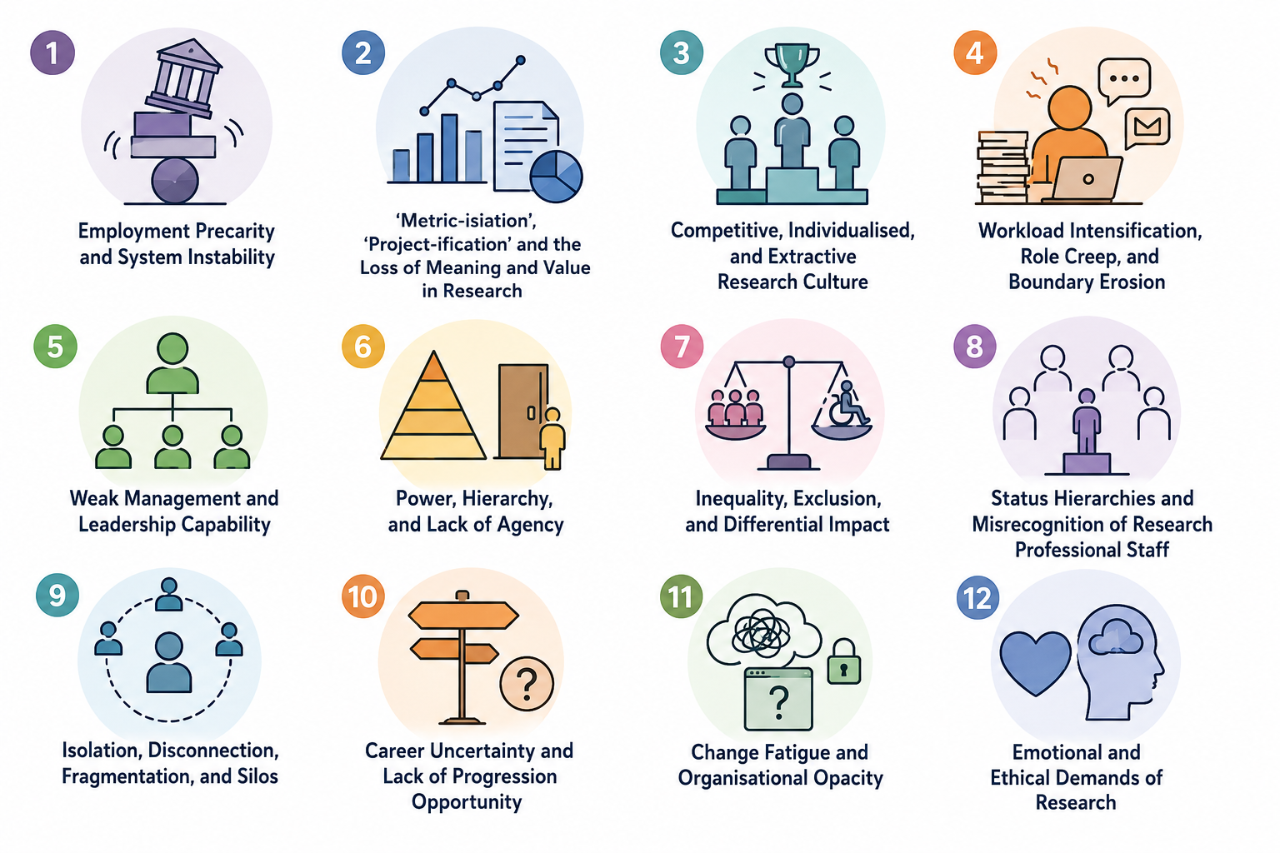
Participatory insight-gathering workshops (N = 100), complemented by a participatory desk review of the literature, identified 12 key drivers of poor wellbeing and occupational stress.
These drivers were broadly consistent with the existing literature on the wellbeing of academic and non-academic staff working in university environments.
Stressors were experienced as interconnected challenges and aligned strongly with all six domains of the HSE MSF—Demands, Control, Support, Relationships, Role, and Change.
Workshop findings were further supported by the results of the national survey (N = 536), which found significant associations between these sources of workplace stress and mental wellbeing/occupational outcomes (e.g., anxiety, depression, stress, sickness absence, use of wellbeing services, and retention intentions).
Higher odds of sickness absence and wellbeing service use were also observed for those with disabilities and those employed on permanent contracts, while those from minoritised ethnic backgrounds reported higher loneliness.
There were no differences in mental wellbeing outcomes for researchers and researchers professionals; however, research professionals were more likely to consider taking sick leave, consider using wellbeing services, and consider leaving their current role.
Organisational Responses: Evidence of progress, but limited primary prevention
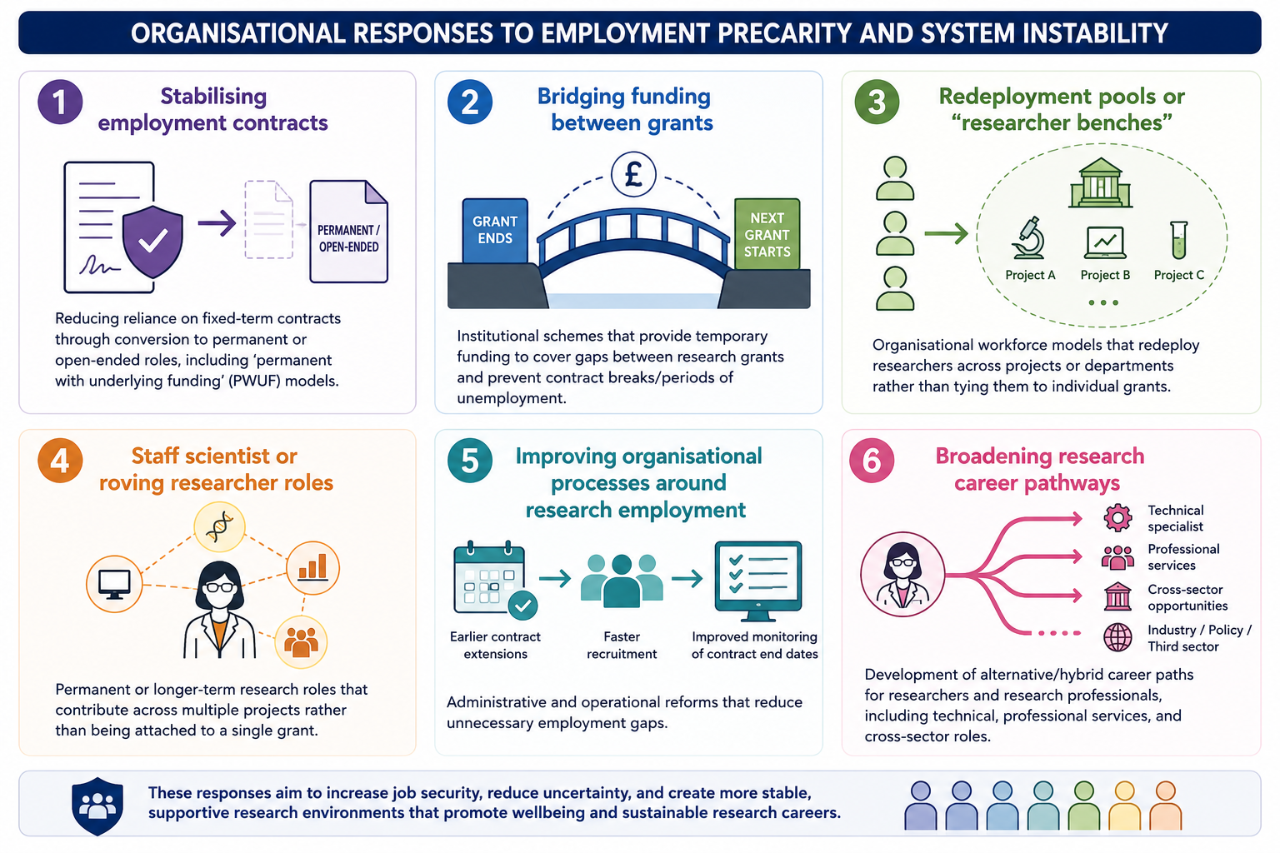
Project findings also reveal a growing landscape of organisational activity intended to improve research culture, staff experience, and wellbeing across UK HE.
Universities, funders, and sector organisations have introduced a wide range of initiatives relating to research culture, leadership, responsible research assessment, career development, employment practices, equality and inclusion, community building, and organisational governance.
Examples include initiatives to:
- Improve employment security
- Redesign career pathways
- Reform research assessment
- Strengthen leadership capability
- Develop team science approaches
- Embed research culture infrastructure
- Improve organisational accountability and transparency
- Strengthen staff voice
- Foster collaboration and belonging, and
- Promote healthier management practices.
However, while these examples demonstrate encouraging progress, organisational initiatives remain relatively limited, fragmented, unevenly implemented, and largely unevaluated.
Example:
Why do wellbeing challenges persist?
The persistence of poor wellbeing should not be interpreted as evidence of limited institutional commitment. Rather, it reflects the reality that occupational stressors are embedded within the wider organisation of research itself.
Many emerging initiatives seek to improve work environments while operating within systems that continue to generate employment insecurity, excessive workloads, competitive performance incentives, organisational restructuring, and resource constraints.
Indeed, while UK HEIs increasingly promote collaboration, inclusion, and healthier research cultures, they continue to operate within funding, assessment, and reward systems that reinforce competition, individual achievement, and short-term performance.
Implementation also varies considerably across institutions and even within universities, reflecting the decentralised nature of HE.
Consequently, positive organisational initiatives frequently coexist alongside continued reports of poor working conditionsand wellbeing consequences.
Improving the wellbeing of researchers and research professionals therefore requires more than expanding individual-level support provisions – it requires sustained attention to the organisational systems, management practices, governance arrangements, and incentive structures that shape how research work is experienced across the sector.
Re-Well HE Advisory Group
Funding Bodies
- Wellcome Trust: Shomari Lewis-Wilson, Equitable Research Ecosystems Lead – UK
- UK Research & Innovation (UKRI): Dr Nik Ogryzko, Senior Talent Programme Manager
Professional Organisations, Networks, and Charities:
- Health & Safety Executive (HSE): Dr Jo Rick, Senior Work Psychologist, Science Division
- University Mental Health Advisers Network (UMHAN): Dr Rachel Spacey, Head of Research & Engagement
- Mind: Jonathan Stuart, Workplace Partnerships Lead
- Careers Research & Advisory Centre (CRAC/Vitae): Dr Yolana Pringle, Deputy CEO
- Professional Research Investment & Strategy Managers (PRISM) Network: Dr Claudia Matz & Dr Rika Nair
- Research Culture Enablers Network/Research Professional Futures Co-lead: Dr Rika Nair
- White Rose University Consortium: Dr Karen Hinxman, Head
- The Research Companion: Dr Petra Boynton, Social Psychologist
UK HEIs
- Dr Rebecca Upsher,SeniorLecturer in Psychology Education, Kings College London
- Dr Sarah Penny, Researcher Developer, University of York
- Dr Amy Cook, Associate Professor in Psychology, Birmingham City University
- Professor Kate Lister, Directory of EDI, Arden University
- Dr Hugh Fulham-McQuillan,Assistant Professor,University College Dublin
- Ashley Collins, SeniorProjectManagerofREC-HURDLE,University of Nottingham
University of Warwick Advisory Sub-group
- Professor Kirstie Haywood, Deputy PVC Research Culture,DirectorNational Centre for Research Culture (NCRC)
- Rhiannon Martyn, Head of Doctoral College
- Dr Fiona Fisher, Associate Director, Institute of Advanced Studies
- Denver Thorpe, Staff Wellbeing Co-ordinator/Lead
- Dr Amy Godfrey, Ambassadors for Better Research Culture Lead
- Dr Rosie Bellamy, Head of Research Integrity & Quality Assurance
Other Research Culture Projects Conducted by the Team:
Building Wellbeing Literacy
The Building Wellbeing Literacy project used participatory approaches to develop targeted online wellbeing literacy resources specifically for PhD students and postdoctoral staff.
Principle Investigator
Professor Elena Riva
Research Fellow
Dr Tania Villanueva-Cabello
Funder
Enhancing Research Culture Fund (2024-2025), University of Warwick
HealthyMindEd
HealthyMindEd aims to raise awareness of student and teacher wellbeing at national and international level and to equip university staff with the knowledge and skills to design digital teaching-learning environments that promote health and wellbeing.
Principle Investigator
Professor Elena Riva
Research Fellow
Dr Tania Villanueva-Cabello
Funder
Erasmus+
The Women in Academia (WinA) Project – Phase 1
The WinA project
used a mixed-methods approach to explore challenges to the progression and retention of early- to mid-career stage women in academia. Results informed a co-developed report of actionable recommendations for funders and higher education institutions.
Principle Investigator
Dr Talar Moukhtarian
Research Fellow
Dr Amber Tout
Funder
Enhancing Research Culture Fund (2024-2025), University of Warwick