United Nations Security Council Resolution 1540 TechHorizon Symposium
The team
- Prof Sai GuLink opens in a new window, Engineering (Project Lead)
- Dr Yu GuanLink opens in a new window, Computer Science
The project
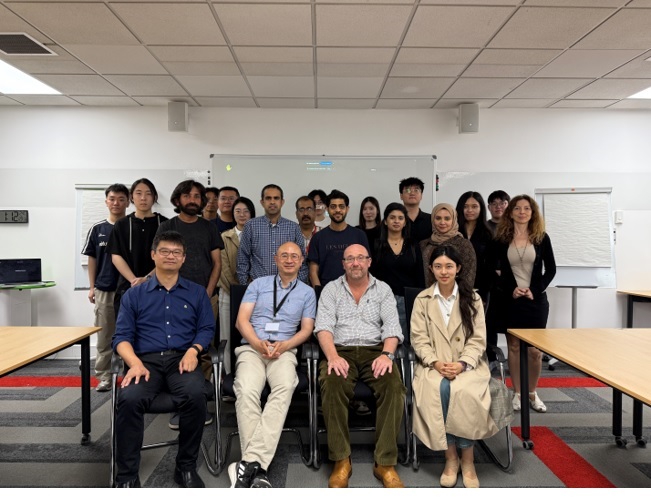
A one-day symposium on 29 June 2026 which brought together academics, technical experts, policy specialists, practitioners and early-career researchers to examine how AI, data analytics, sensing and other emerging technologies both create dual-use risks and can support implementation of UN Security Council Resolution (UNSCR) 1540.
Intended outcomes: develop a shared, interdisciplinary understanding of the changing UNSCR 1540 implementation environment; obtain expert feedback and contributor alignment for a special academic issue and a strategic roadmap/policy report; strengthen links between academia, government, international organisations and practitioners; and identify follow-on research, training, policy-engagement and network activities.
Project outcomes
Completed activity: a full-day programme of expert presentations, roundtables, an emerging-technology landscape session, a future-collaboration discussion, contributor presentations, a publication workshop and a timeline/next-steps session. Selected contributors joined virtually, enabling direct input from UNODA and UK export-control/UNSCR 1540 specialists. 30 places were booked; the programme featured approximately 6 invited experts and around 20 PhD students/early-career researchers, with selected contributors joining virtually. Participants represented academia, international organisations, government/export control and operational practice.
Warwick participation included colleagues from Computer Science, Engineering, Warwick Manufacturing Group, Warwick Business School, the Centre for Applications of Mathematical & Computing Sciences, Cross-Faculty Studies and Psychology, alongside PhD students and postdoctoral/early-career researchers.
External contributors included: Prof. Sai Gu (project lead, School of Engineering, Warwick); Dr Yu Guan (Computer Science, Warwick); Dr Yifei Li and Ms Xiaohui Wu (UNODA); Andrew Horton (UK Export Control Joint Unit/Counter-Proliferation and Arms Control Centre and UNSCR 1540 expertise); Dr Matthew Healy (Cranfield Forensic Institute); Dr. Weidong Liang, Dr Hassan Elbahtimy and Prof. Jonathan Brewer (King’s College London).
Key outcomes: participants clarified that UNSCR 1540 is technology-agnostic and that work should remain anchored in WMD non-proliferation, non-State actors, related materials and means of delivery. The group considered both risks and benefits of emerging technologies; refined priority themes including AI-assisted monitoring, export controls, intangible technology transfer, biological/chemical risks, means of delivery and research security; aligned contributors; and agreed follow-up actions for the publication and network.
Publication development: refined article themes, contributor alignment, scope/framing guidance and an outline submission/review process for a special academic issue. A complementary strategic roadmap/policy report was also scoped.
Follow-on activity: proposed academic-policy-practitioner network development, future workshops, training/short-course ideas, research-security awareness and continued engagement with UNODA and relevant practitioner communities. Publications and follow-on activities were not yet complete at the report date
Enhancing interdisciplinarity
The award strengthened an interdisciplinary academic-policy-practitioner network spanning AI/computer science, engineering, manufacturing, business, mathematical/computing sciences, psychology, law and policy, CBRN/forensic practice, export control and UN work. It connected Warwick researchers and early-career colleagues with Cranfield, King’s College London, UNODA and UK government experts.
The symposium generated concrete follow-on work: contributor alignment and revised framing for a special issue; development of a strategic roadmap/policy report; possible short courses and training on emerging technologies and UNSCR 1540; and continued network-building, research and policy engagement. These publication and follow-on activities were in development at the report date.