Dr Sara Parisi, School of Modern Languages and Cultures
Disseminating LaleoLab: A Hands-on Workshop Exploring an Innovative Approach to EDI
This funding contributed to a larger ongoing project exploring how gamification can foster students’ awareness of gender stereotypes in science and education through collaborative and reflective learning. The project adapts and pilots the research-informed board game LaleoLab, originally developed by Italian researchers in Physics to challenge gender stereotypes in STEM and beyond. The work is the result of a collaboration between Sara Parisi (School of Modern Languages and Cultures), Ninna Makrinov (WMG), David Reynolds (WMG), and Andreana Pastena (Universitat de les Illes Balears). Drawing on the team members’ complementary expertise, the project combines gamification, co-creation, and cultural and linguistic adaptation to engage students as active contributors in the design and testing of the game.
Previous funding supported the translation and cultural adaptation of this card game for English-speaking audiences, including the development of twenty new “special cards” featuring individuals who have challenged gender norms. This development phase was completed in August 2025, resulting in a translated and student-tested pedagogical tool ready for wider dissemination and pilot testing.
The present Spotlight Small Grant supported the transition from development to dissemination by enabling two members of the project team, Sara Parisi (School of Modern Languages and Cultures) and Ninna Makrinov (WMG), to participate in the Advance HE Equality, Diversity and Inclusion Conference in Manchester on 25-26 March 2026. The event provided an opportunity to present the completed work to a wider Higher Education audience and gather feedback from academics and EDI practitioners working across different disciplines and institutional contexts.
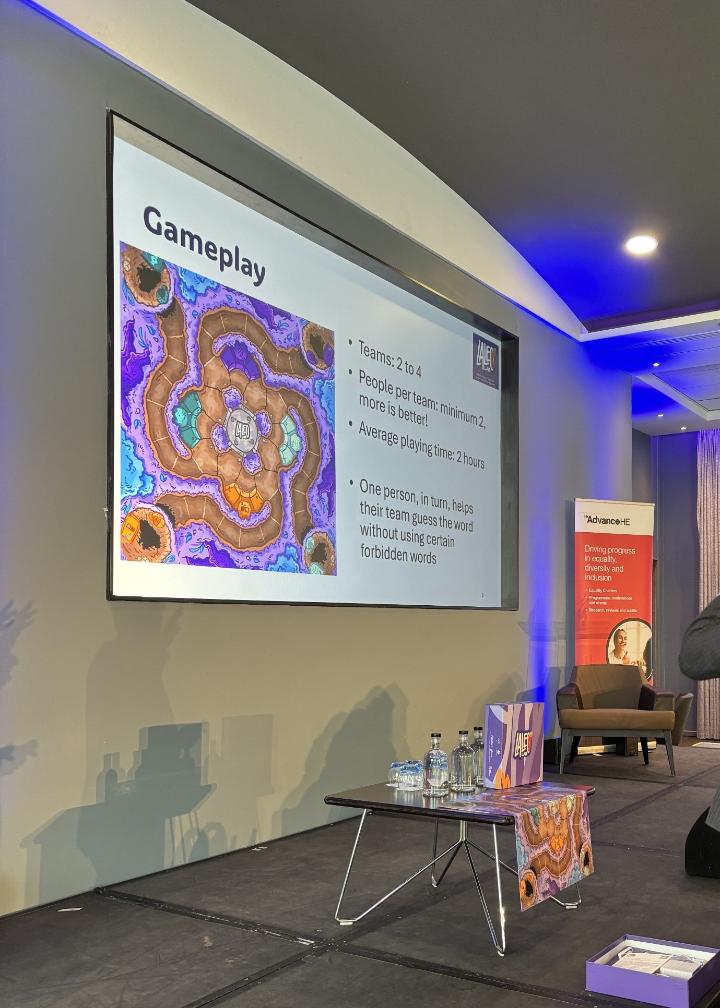
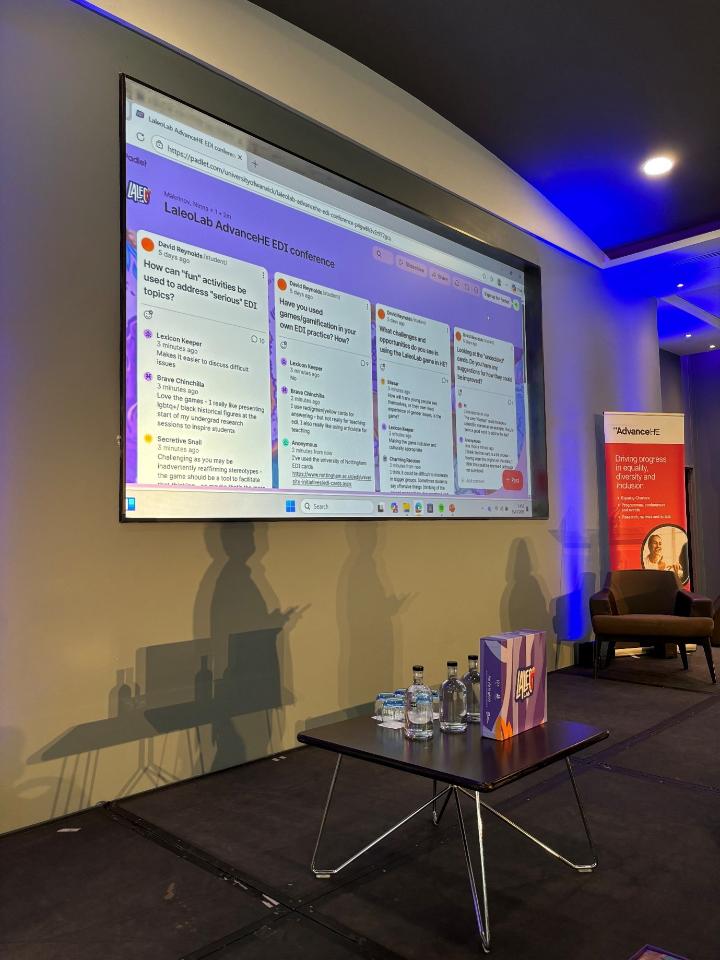
As part of the conference, we delivered a 60-minute interactive workshop entitled "Tackling gender stereotypes through play: A hands-on workshop on the LaleoLab board game and its pedagogical implications." The session combined a hands-on experience of the adapted game with a critical discussion of its pedagogical implications. Participants reflected on the potential of LaleoLab to address gender stereotypes through play, considered how the tool could be integrated into different educational and institutional contexts, and discussed possibilities for its adaptation and scalability.
The intended outcome was to introduce the game to institutions that could adopt it, while building a network for its future development and wider implementation. The discussion provided valuable insights that will help us further strengthen the pedagogical and EDI dimensions of LaleoLab.
Summary of project outcomes
The conference enabled us to disseminate the outcomes of the project, while also collecting valuable professional feedback on the game and its potential applications. It created opportunities to engage with academics and EDI practitioners from different institutions, laying the groundwork for future collaborations and wider dissemination.
Overall, this funding was an important step in extending the impact of the project beyond the University of Warwick. The outcomes of the conference will inform further pilot testing and future publications, as well as larger funding applications to support the wider implementation of the game. In the longer term, these activities will contribute to the development of a final version of LaleoLab and an accompanying pedagogical toolkit, providing an accessible, evidence-based resource for embedding EDI in teaching and outreach.
The project generated valuable professional feedback on the LaleoLab game, identifying areas for further development and potential applications, including the possibility of creating a digital version of the game. The workshop also resulted in the development of a larger international team of collaborators, with whom we are now working towards a future funding application to support the further development, testing and dissemination of LaleoLab.
Has the project supported further interdisciplinary work
The conference facilitated new interdisciplinary collaborations and discussions around the potential development and wider implementation of LaleoLab. Following the conference, we held further meetings with five new collaborators from universities in the UK and Luxembourg, bringing together expertise from different disciplines and institutional contexts. We are now working towards submitting a larger joint grant application.