
Resources for staff
The programme
Effective transferable skills training for Warwick’s postgraduate is essential to our success in producing not just good but excellent researchers and future employees.
Warwick’s PGCTS has been developed as the only academically accredited and developed course of its kind in the UK (and as far as we know internationally) and several UK universities are now following suit with similarly formalised programmes for their graduates. The PGCTS has been developed in consultation with the students, industry and bodies such as the EPSRC and the learned societies. It is anchored in the current training and future career needs of students. The programme has systematically expanded over the past 15 years and currently has ~900 PhD students registered. Warwick Researcher Development Framework (RDF) is aligned with the structure of the PGCTS and as such, students completing the Certificate fulfil the recommended training requirements.
The well-developed skill training programmes in the University are crucial to the continued success of our University in securing training grants: including DTCs, CDTs, Initial Training Networks (ITN) and other doctoral training partnerships. Additionally, a number of charter marks and benchmarks, including Athena SWAN and HR Excellence in Research Award, require an ongoing commitment to researcher and staff training, which PGCTS helps to fulfil.
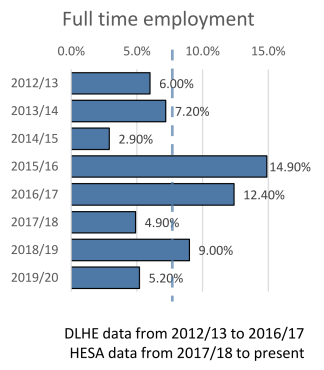
The evidence gathered from graduates of the programme shows that PGCTS graduates are on average 8% more likely to be in full-time employment after graduation, compared with the SEM Faculty as a whole.
Aims
The course aims to develop a wide range of transferable skills to enable the student:
- to be a successful doctoral researcher undertaking world leading research,
- to improve their research effectiveness,
- to maximise their talents in their future career
- to transfer skills developed in academic research to other careers
- to understand what they already know and how to use those skills to maximum effect.
Time commitment
The programme is designed to be integrated into a PhD project life without creating a lot of additional work while creating opportunities for training, networking and reflection. The Doctoral Skills modules focus on gathering evidence of developmental activities that students will be completing during their PhD e.g. progress reports, attending conferences/meetings, presenting their research etc. The optional modules require approximately 3 days, which is almost all training/workshop time with a small amount of assessment completion time.
PGCTS contributes towards the University and UKRI requirementLink opens in a new window for each PhD student to spend a minimum of ten days on professional development and skills activity in each year of their PhD.
Department, Directors of Graduate Studies and Supervisor Contribution to PGCert in Transferable Skills
The core Doctoral Skills modules are designed to integrate transferable and professional skills development with activities undertaken as part of a researcher’s doctorate. Supervisors and departments therefore can play an important role in supporting student engagement and development, while responsibility for assessment and moderation is clearly defined across the programme. These roles have been clarified to improve consistency in assessment and strengthen departmental engagement with the programme.
Assessment and moderation
Students complete the required assessment and submit via Skillsforge.
For the core Doctoral Skills modules, assessment is undertaken by the Postgraduate Certificate in Transferable Skills (PGCTS) team. These are pass/fail requirements: assessment establishes whether the student has completed the activity requested and provided appropriate evidence, rather than grading the quality of their doctoral research.
As part of departments’ academic contribution to PGCTS, moderation of assessment is undertaken by Directors of Graduate Studies (DGSs) or nominated departmental delegates. Moderation will involve work from across the programme and is not restricted to students from the moderator’s own department.
For optional modules, one of two arrangements applies:
- where the module trainer undertakes the assessment, the PGCTS team moderates the work;
- where the PGCTS team undertakes the assessment, moderation is undertaken by a DGS or nominated departmental delegate.
This provides independent academic oversight of assessment while avoiding routine duplication of first-line assessment by supervisors or departments.
Role of supervisors
Supervisors continue to have an important developmental role in the core Doctoral Skills modules because most activities draw directly upon the student’s doctoral research.
Depending on the activity, supervisors may:
- discuss or provide feedback on research-related work;
- confirm that an activity has taken place;
- provide feedback generated through normal doctoral processes, such as progression or advisory meetings;
- comment on disciplinary or project-specific matters where this is needed for the student to complete a task.
Supervisors are not expected to undertake separate PGCTS assessment or provide additional feedback where suitable feedback or evidence already exists through other research processes.
Students remain responsible for completing their PGCTS activities, obtaining any evidence they need and submitting their work.
Departmental role in supporting engagement and completion
Departments retain an important role in ensuring that PGCTS is embedded within the wider doctoral experience.
The DGS or nominated departmental delegate should help drive engagement by:
- ensuring that PGR students are aware of PGCTS and the opportunities it provides;
- ensuring that supervisors understand the contribution expected of them within the core Doctoral Skills modules;
- including PGCTS within appropriate departmental PGR communications, induction and other established processes;
- encouraging students to complete core-module activities alongside their wider doctoral development;
- responding to information from PGCTS about participation, progression or non-completion;
- helping to address barriers to completion, including cases where a student is unable to obtain appropriate supervisory input.
The intention is for departments to focus their contribution on engagement, progression and successful completion, alongside an academic contribution to the programme through moderation.
Optional modules are taught PGCTS provision and do not normally require supervisory or departmental involvement in the student’s learning activities.
Examples of supervisor contribution
The intention is to make use of normal doctoral supervision and research activities wherever possible, rather than create additional PGCTS-specific work for supervisors or departments.
Doctoral Skills 1.1 – Research Plan, literature review, project budget & risk analysis
Supervisors can support this by helping students recognise all four elements as part of effective research planning, rather than focusing only on the research subject matter. In particular, supervisors should encourage students to consider the practical resources required to complete their research, the likely costs involved in both research and research dissemination/networking, and the risks that could affect delivery of the project. Where these elements have already been considered through normal supervisory, progression or project-planning processes, students may use appropriate existing material as evidence. Where they have not, supervisors can help students identify what should reasonably be included for their project and discipline.
Doctoral Skills 2.5 – Oral presentation
Supervisors can support this by helping students identify an appropriate opportunity to present their work, for example at a research group meeting, departmental event or conference, and by encouraging them to seek and reflect on useful feedback. The presentation does not need to be arranged specifically for PGCTS. Where a student is already presenting their research as part of their normal doctoral activity, this can be used as evidence for the assessment.
Doctoral Skills 3.8 – ethical and professional considerations
Where a student is considering ethical issues specific to their research area or project, a supervisor may help them identify relevant disciplinary considerations or confirm that the issues identified are appropriate.
Additional resources
Post Graduate Certificate in Transferable Skills PGR induction talk (2024)
SkillsForge Quick User Guide for Supervisors and DGS
Course Codes
TDCA-F1S0 - PG Certificate in Transferable Skills
Legacy Course Codes
TCHA-F1PC – PG Certificate in Transferable Skills in Science
TCHA-F1PD – PG Award in Transferable Skills in Science
TCHA-F1PH - PG Certificate in Transferable Skills for Postdoctoral Researchers
TCHA-F1PJ – PG Award in Transferable Skills or Postdoctoral Researchers.
If you have any queries contact Louise Hockenhull (transferable.skills@warwick.ac.uk) or Course Director Dr Daniel Franklin (Daniel.Franklin@warwick.ac.uk).