
Convert legacy editor content

Convert legacy editor content
This step-by-step guide is intended to take web editors and admins at Warwick through the process of converting their existing SiteBuilder content from the legacy editors (the old "Classic" visual editor and raw editor) to the Components Editor.
Step 1: Prepare your content for conversion
As a first step, we recommend you download a site content report, which provides an overview your site, and lets you see which pages are still using the legacy editors.
When generating the report, we suggest you focus on the following information. which will help you prioritise pages for conversion:
- URL, Type, and Page heading. Only items with a Type of
text/htmlare relevant - images, videos, and other files are not impacted by conversion, and can be filtered out of the content report once it's generated. - Whether the page is Live. Since only content that's being actively maintained needs to be converted,
Deletedpages can be filtered out. - Page visibility and Search Engines allowed. This helps identify the content visitors are most likely to see, which lets you prioritise the most high-profile content for conversion.
- Components Editor status. Pages with a
TRUEresult in this column already use the Components Editor, and can be filtered out. - The Last modified date, to show currently-relevant content (or pages that might be in need of an update soon!).
Reminder: Although we're retiring the legacy editors, nothing is going to happen to pages created with those editors. If you do nothing to a legacy editor page before the editors are retired, you will simply need to convert the page to the Components Editor the next time you want to edit.
At this stage, we recommend you focus on active, high-traffic pages that are either regularly updated, or that you expect will need to be updated in future.
Step 2: Bulk convert simple pages
If you have admin permissions on the site homepage, you have the option to bulk convert pages to the Components Editor.
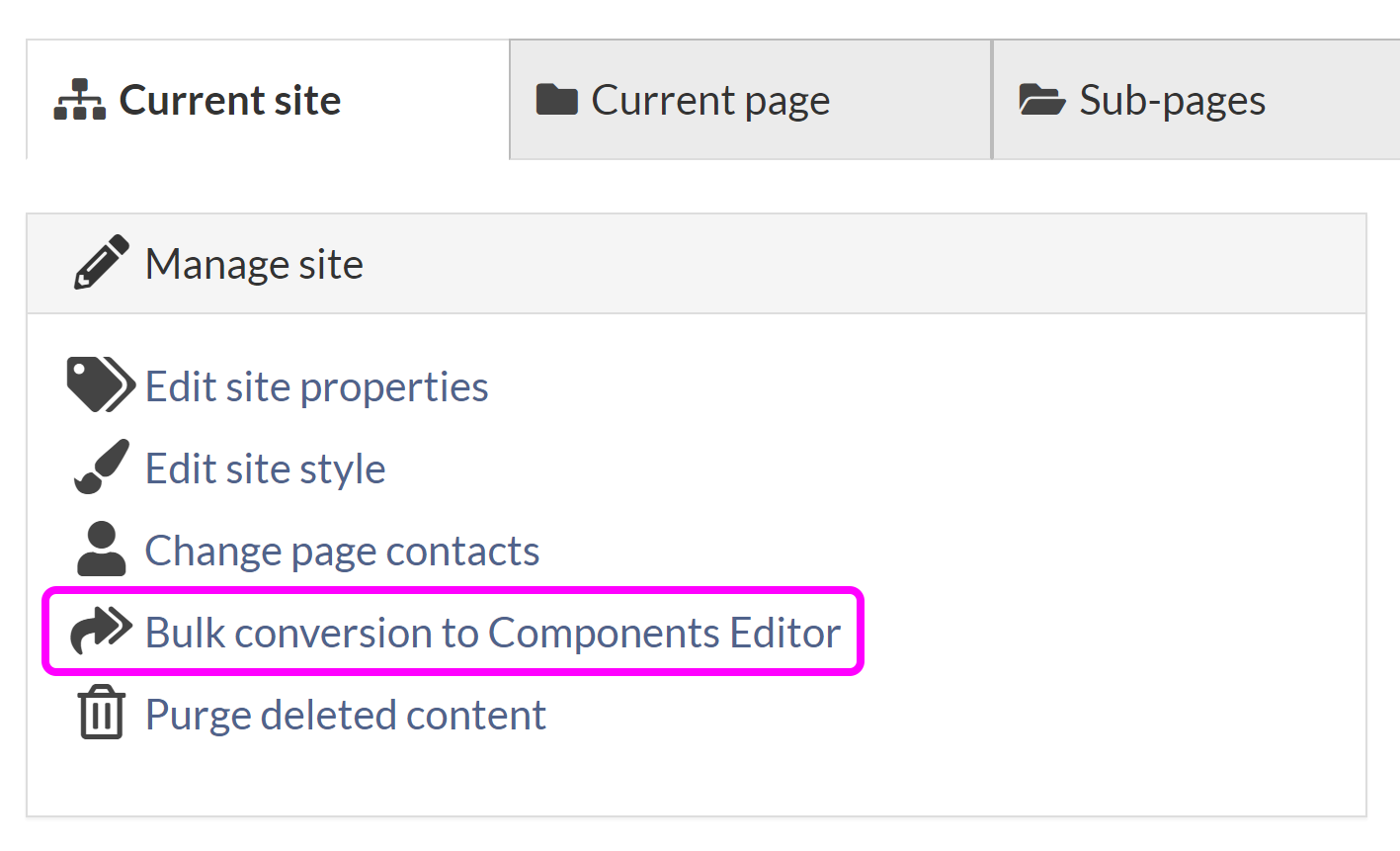
To ensure a high quality of conversion, this option only applies to pages below a certain complexity threshold. Pages with complex layouts or features will be labeled as Unable to convert - to deal with those, move on to step 3.
Step 3: Copy & convert complex pages
Important: Wherever possible, legacy editor pages that Use RHS from another page should be converted before the page whose right hand content they inherit. Components Editor pages do not have a separate right hand side - any pages that are using the right hand content of another page will lose access to that content when the source is converted, and the right hand side will appear blank.
For more information, see our guide to converting right hand content.
Before you move on to pages that can't be handled by bulk conversion, we recommend that you first make a copy of the page. When making the copy, be sure to select the options to hide the copy from local navigation and search, and remove view permissions. This will ensure visitors don't stumble onto the copy while you're working on it.
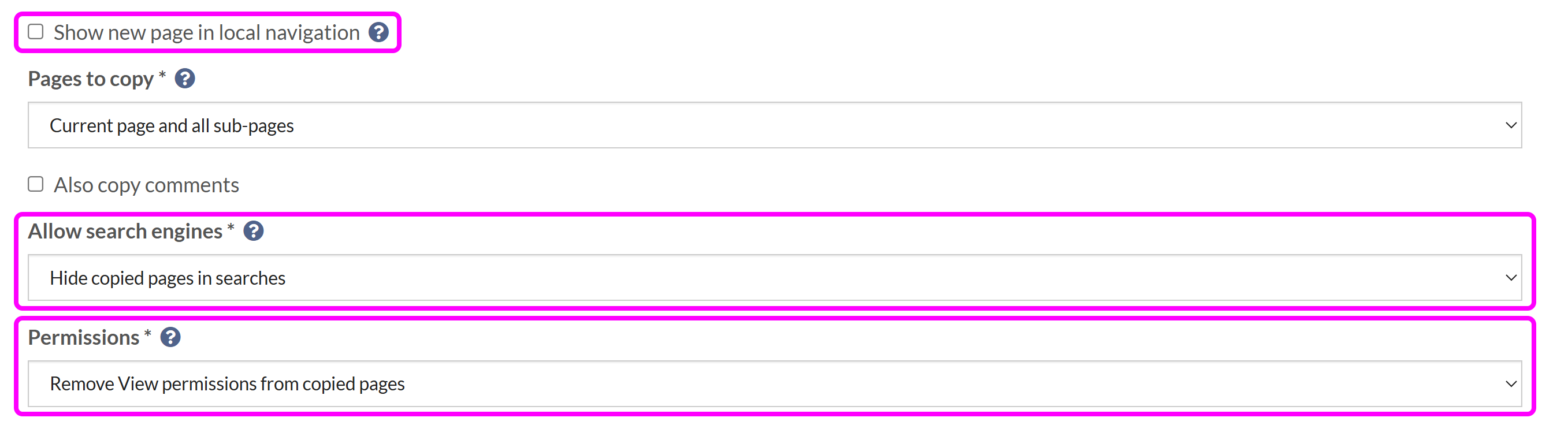
Once the page has been copied, follow the instructions for how to convert a single page to the Components Editor.
Step 4: Recreate custom content
Some legacy editor pages use custom HTML or scripting to achieve more complex functionality - some of which are now standard features in the Components Editor, such as content tabs or accordions.
Converting these pages using the processes described above can be time-consuming, and it may be faster and more straightforward to start with a new blank page and rebuild the content using content blocks and other available components. This will ensure that the page remains simple to update in future, and its content is as accessible as possible.
Tip: If your site commonly uses HTML or code to create the same kind of custom functionality, use the Editor Feedback form to let us know what problem(s) you're trying to solve this way - if the option doesn't exist in the Components Editor yet, we might be able to add it in a future update.
Step 5: Copy updated content back to the original location
Once you're done converting or recreating pages, you can use SiteBuilder's Copy page contents feature to quickly transfer all your changes back to the original location, without needing to delete and copy additional pages.
Note: The Copy page contents feature rewrites relative links to point to the source page's location - we advise that you use absolute links on pages when you intend to copy page content to a new location, and double-check links after copying to make sure everything points to the correct location.
Step 6: Delete copies
Once you've copied your converted content back to the original location, the copy page is probably no longer required - be sure to delete any pages you don't need.