A
How are electrochemical scanning and toothpaste connected?
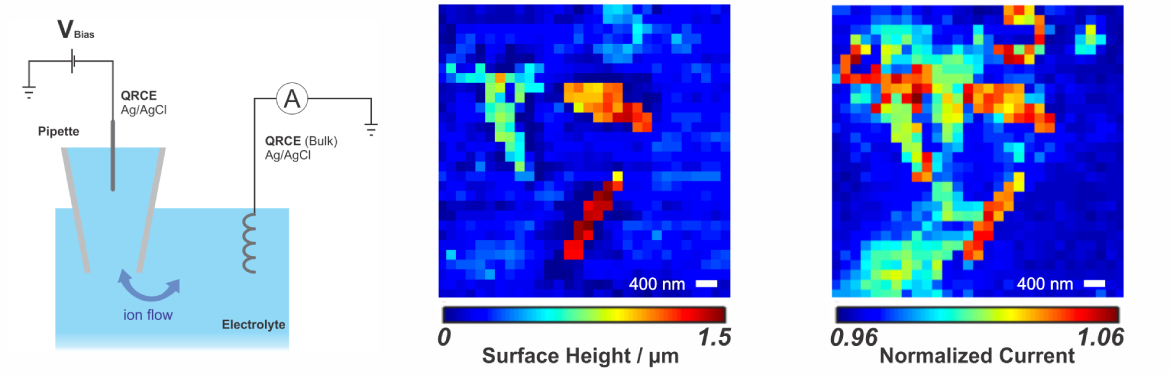
What if we could uncover key details of the most complex molecular processes? Professor Pat Unwin and his team of researchers have designed software that visualises the most complex molecular processes, making previously invisible activity visible. The Warwick Electrochemical Scanning Probe Microscopy (WEC-SPM) platform combines modern microscopes with electrical monitoring, allowing true nanoscale imaging with very simple probes and speeding up the rate at which images can be acquired. Researchers across science disciplines, including physics, engineering, chemistry and life sciences, have all benefited from this unique tool. Its effects are being felt outside the laboratory as well, with new products relying on the WEC-SPM for their development.
Science has linked biology, chemistry and electricity since the 1700s. Yet, creating a practical imaging tool has proved difficult. Loosely connected technologies had to be brought together for the first time. Chemical fluxes from living cells, electrochemical processes and localised reactions needed careful tracking. Probe imaging had to locate active surface sites down to the smallest scale. This data then needed translating into visual information.
Professor Unwin and his team drew in key findings from a number of fields when creating the WEC-SPM, including:
Chemical reactivity modelling
Co-location microscopy
Surface structure-activity analysis
Topography-charge and topography-activity mapping
Nano-pipette manufacture
The software is already being used to test new technology, from sensor systems to energy storage. The University of Warwick is world-leading in the design of electrochemical imaging systems. This expertise has important commercial uses. Unilever created a new toothpaste, ‘Regenerate’, with the data it collected from the WEC-SPM. The technology let them model each trial version against the acidic erosion of tooth enamel. Every day, new uses are being found for the WSC-SPM thanks to Professor Unwin and his team.