
Valeria Cesaraccio
Thanks to short-term fellowship generously funded by the HRC and Warwick’s Centre for the Study of the Renaissance, I was able to spend three weeks at the Newberry Library of Chicago in April 2026. The main purpose of my visit was to consult fifteenth- and sixteenth-century materials related to my doctoral research, which focuses on education in Renaissance Italy. The Newberry is a wonderful place to work and study. Special collections are handled very efficiently, and I was able to look at many sources while I was there. The library is also a lively place where lots of events and exhibitions happen.
At the Newberry, I was able to meet in person the director of the CRS (Center for Renaissance Studies) Lia Markey, who involved me in the activities that were happening at the Newberry during my stay in Chicago. I could also meet with assistant director Christopher Fletcher, who helped me familiarising with the library, its history and collections. Both Lia and Chris gave me great advice and made me feel very welcome at the library. I was also able to meet emeritus director Paul F. Gehl, with whom I had fruitful conversations. Paul gave me very helpful advice and suggestions for my research. I also met curator Suzanne Karr Schmidt, who helped me with the Newberry collections.
The Newberry houses lots of good sources for my research, including both manuscript and printed materials. While there, I was able to look at some miscellaneous manuscripts containing form letters. One of these sources, dating to the fifteenth century, contained models of letters and orations (VAULT Case MS 92.5). I am planning on examining it further and use it for an article soon after my PhD submission. I also examined several sixteenth-century schoolbooks (some of which very rare), which I am including among the primary sources of my dissertation. Among these, the Latin grammars Grammatices phoenix by Girolamo Cafaro (Cortona 1546), of which very few copies survive, and De fundamentis grammatices methodus by Pietro Cittadella (Venice 1535), of which the Newberry houses the only extant copy. I also consulted several letter-writing manuals, including the Sententiarum variationes by Stefano Fieschi, of which the Newberry houses both a manuscript copy and several printed editions. Letter-writing represents an important part of my thesis, and Fieschi’s manual was the source of some sixteenth-century textbooks that I examine in a chapter of my dissertation. I finally consulted a rare copy of a rhetorical manual by Petrus Mosellanus (Progymnasmata Petri Mosellani in privatum discipulorum suorum usum comparata, Strasbourg 1534), which I will use both for my thesis and for a conference paper that I will present in September.
I also had the chance to see in person some primary sources for my thesis of which I had only seen digital copies so far. Seeing the objects and their format allowed me to have a better sense of the practical use of such books. Moreover, some copies at the Newberry had marginal annotations that evidenced the practical use of these textbooks by contemporary readers. For example, the letter-writing manual by Girolamo Cafaro (De conscribendis epistolis, Cortona 1546) had several annotations by a sixteenth-century hand, which I plan to examine further in my thesis.
Upon Paul Gehl’s suggestion, I also examined a fifteenth-century miscellany produced at the school of Sicilian humanist Tommaso Schifaldo, which I am planning to use for a brief article. The miscellany also contains a printed copy of Laudivio Zacchia’s Epistulae Magni Turci, a fictitious fifteenth-century letter collection on which I was preparing a contribution (together with prof. Luigi Silvano) for a forthcoming miscellaneous volume. The copy at the Newberry had marginal annotations that have been helpful evidence of the interest of fifteenth-century readers on the text, and which I included in my article.
During my stay in Chicago, I had the chance to attend two workshops organised by the CRS. Both included moments in which participants were able to view and examine some items from the Newberry special collections. These moments gave me the chance to see materials from the Newberry collections (manuscripts, printed books, and maps) that I would not have consulted otherwise. Moreover, in these two occasions I could meet other PhD students and researchers from American institutions. I was also able to attend a fellow seminar, presented by prof. Delia Cosentino. This gave me the opportunity to hear about her research and learn from the suggestions that other Newberry fellows proposed. It was also interesting to observe a different way to handle seminars from that to which I am used in Warwick’s CSR. In this occasion, I could also meet some long-term fellows at the Newberry, such as Zachary Hines from The Ohio State University.
On the last week of my stay, I also managed to attend a two-day Symposium (“Premodern Fragments: Remnants and Recovery”) organised by the CRS. This conference allowed me to meet with several American scholars and hear about their research. I was also able to see some fragments housed in the Newberry special collections and hear more about them from librarian Megan Kelly. The papers that I heard were all fascinating and the discussion after the presentations often very insightful. In this occasion I could meet several scholars from American institutions, such as Carina L. Johnson and Christopher Platts.
While in Chicago, I also had the opportunity to visit the UChicago campus, where I viewed some items from the special collections. These consisted of sixteenth-century printed books, such as the Latin grammar by Neapolitan teacher Lucio Giovanni Scoppa (Naples 1520) and Giovanni Fabrini’s edition of Horace with vernacular commentary (Venice 1566). Both items presented marginal annotations that would deserve further examination as they provide evidence of the use of these books by sixteenth-century readers.
I am glad for having this opportunity, which has been beneficial from several points of view, and very grateful to the HRC, Warwick’s CSR, and Newberry’s CRS for making it possible. I hope this has just been a first step towards other visits and collaborations with the Newberry. After my PhD, I am planning on applying for one of the Newberry longer fellowships.
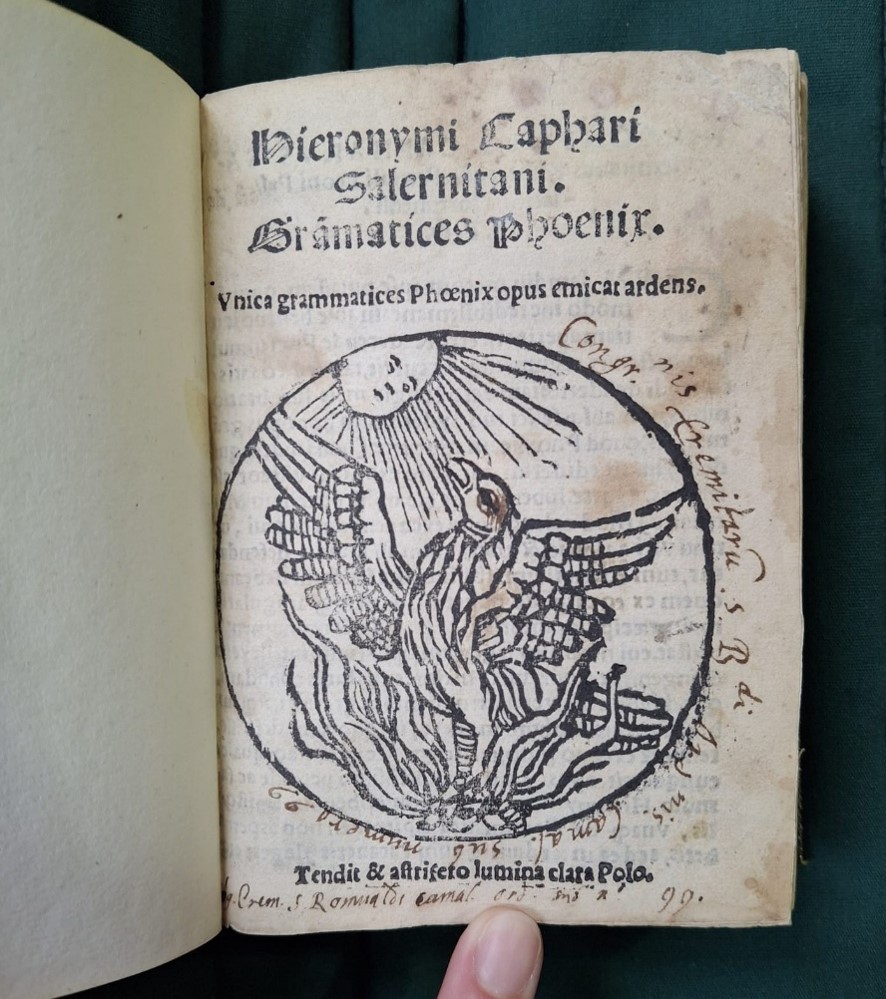
Title page of Girolamo Cafaro’s Grammatices phoenix (1546)
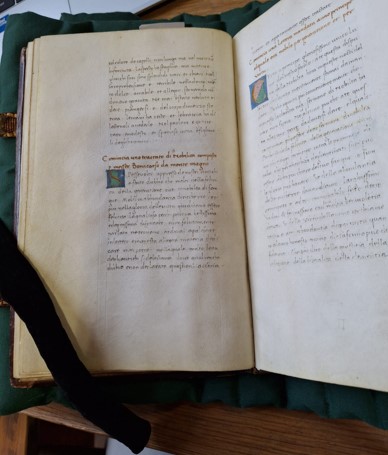
VAULT Case MS 92.5