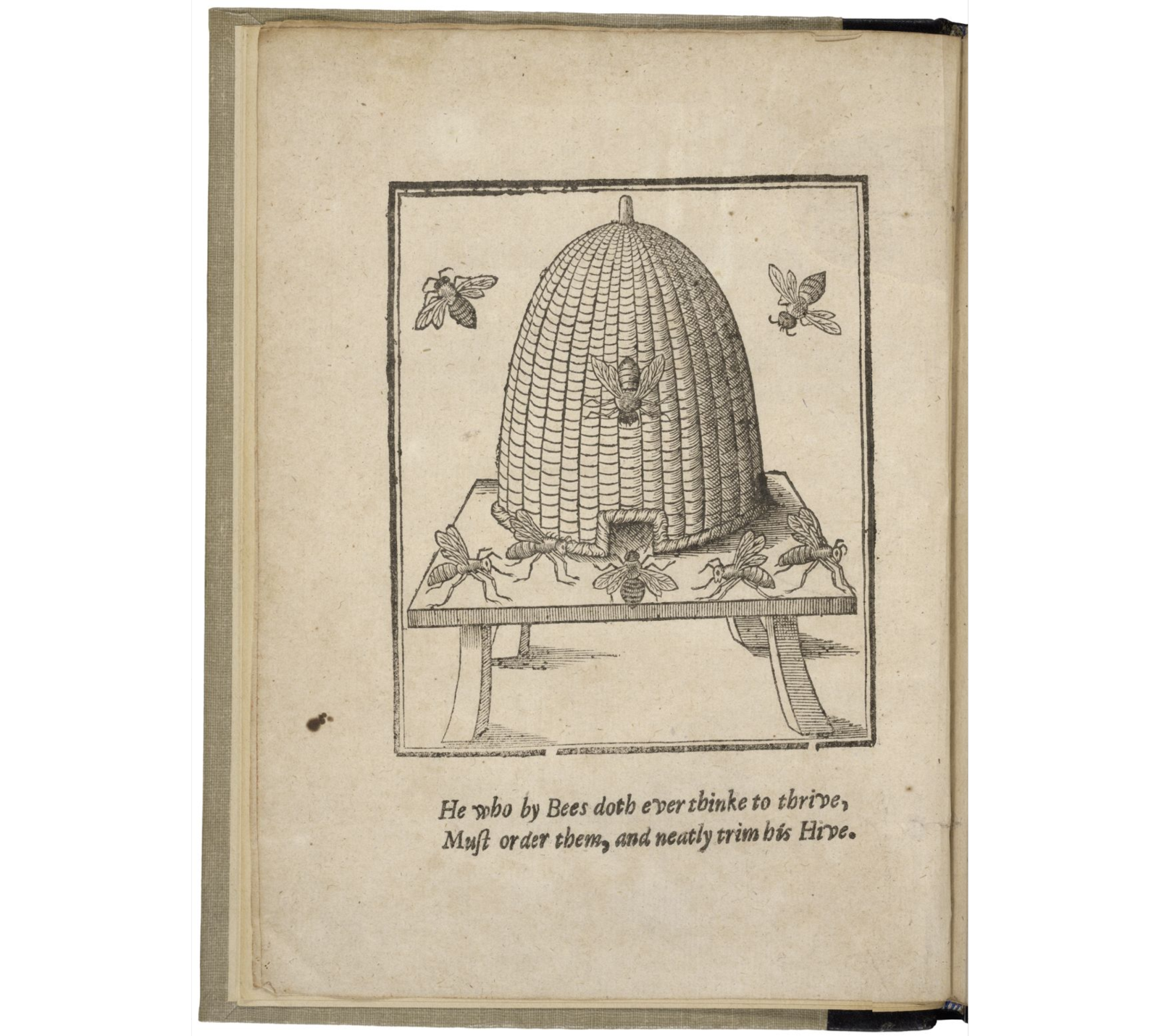
from John Levett, The ordering of the bees (1634), Folger Library, STC 15555
Humans have always had a complex and fraught relationship with their environment. The Renaissance was no exception: early modern authors, artists, artisans, proto-scientists and experimenters have left behind fascinating records of their understanding and interactions with the natural world.
This course considers a variety of such records, produced across different genres and geographical spaces, in order to probe the various categories and binaries that operated during the period: 'natural', 'social', 'cultural', 'man-made', 'elemental', and more. Together we will analyse the influence of the recent medieval past, the reception of Classical authors, as well as contemporary early modern discourses including around artisanal processes, travel, luxury items, and social and cultural practices.
The aim of this course is to glean the full spectrum of early modern attitudes to nature, from instrumentalisation to preservation, symbiosis to destruction, and to use this understanding to re-examine our own modern approaches to ecology and eco-criticism.
This module can also be taken at PG level, code RS900-30, PG application form here.
Classes are on Monday afternoons, 4-6pm, in room A0.14 (Social Sciences)
Module codes are: RS201-15 (intermediate year students) and RS301-15 (final year students)
Assessment method is 100% essay. Yr 2 students-1 x 3500-word essay chosen from a list of given titles; Yr 3 students-1 x 4000–4500 word essay, on a freely chosen topic determined in consultation with the module convenors and/or tutors. Essay deadline, noon on Tues 12th January 2027.
This introductory session will set out the aims and objectives of the course and familiarise students with some key concepts and tropes:
- Debates about nature versus artifice;
- The proliferation of natural world metaphors in humanist writings;
- Modern writings theorizing the interaction between humans and the environment.
We will also look together at a fascinating and eclectic case study, the ceramics and writings of Bernard Palissy.
Students who wish to do some pre-reading for the course might find the following secondary texts a helpful place to start:
Jane Bennett, Vibrant Matter: A Political Ecology of Things (Duke University Press, 2010)
Pauline Goul and Phillip John Usher (eds), Early Modern Écologies: Beyond English Ecocriticism (Routledge, 2020)
Donna Haraway, Staying with the Trouble: Making Kin in the Chthulucene (Duke University Press, 2016)
Eduardo Kohn, How Forests Think: Towards an Anthropology Beyond the Human (University of California Press, 2013)
Renaissance Mysticism and the Natural World: The Case of Saint John of the Cross – Dr Maria Czepiel
St John of the Cross was a Carmelite friar and reformer, as well as one of the most important mystics in early modern Spain. This class will introduce you to the mystical tradition and St John’s spirituality in particular, focusing on his attitude to the natural world.
Writing Nature in Early Modern Sino-European Encounters - Dr Cynthia Liu
This session will introduce early modern European writings about East Asia, focusing on the place of Nature in these texts. We will look at how authors communicated knowledge about the flora and fauna of the far east and Asian traditions of thinking about nature, as well as how they used natural images and concepts already familiar to European audiences to ’translate’ these foreign peoples and places.
This session offers an introduction to the development of maps and cartography, across the late Middle Ages, and into the Renaissance. In this session, we will cover the influence of Ancient cartography on influential medieval texts, the style and goals of the medieval mappa mundi, and how mapping changed rapidly in the fifteenth century. Our case studies will focus on Italy, and particularly Venice. We will ask: why do medieval maps contain so many elements that do not appear on later maps? Do maps that look “accurate” and detailed always tell the whole truth? By examining the changing ways Renaissance Europe represented the world to itself, this session suggests that to understand “Renaissance ecologies” we must grasp how these cultures viewed the environment as part of a broader cosmology, a means of situating human beings and our planet within divine creation. The history of maps reveals the changing vision of humanity’s place within creation, and how we relate to each other.
This interdisciplinary session, co-taught with Dr Jonathan Green (School of Life Sciences, University of Nottingham) will consider the importance of the bee in early modern writings, putting some key Renaissance texts (including by Shakespeare, Erasmus, Montaigne and Charles Butler's 1609 The Feminine Monarchie) in dialogue with a modern ecological perspective.
On the Move: Renaissance Travel Writers and Ecology - Dr Tim Wade
Early modern men and women were often on the move. Their travels brought them into contact with new places and posed novel challenges to their understanding of the climate and the built environment. A wave of new travel books were also published to help travellers understand how to prepare, where to go and what to see. This session will look at several such guidebooks, as well as actual travel accounts from Europe to consider how travel affected the period’s understanding of ecology.
Wit, Water, Wanderlust: Montaigne and the European Renaissance Garden - Dr Vittoria Fallanca
How well the skillful gard’ner drew
Of flow’rs and herbs this dial new
(Andrew Marvell, 'The Garden')
This session will explore Montaigne's writing about prominent Renaissance gardens in his Travel Journal, looking at questions of artifice, ingenuity, narrative and garden design, thinking about how Renaissance visitors interacted with these, part man-made and part natural, environments.
Gemstones were both old and new in the European Renaissance. They had a long history in Scripture, natural history, and medicine, yet they were encountered in new places in the fifteenth and sixteenth centuries. Emeralds were found in Colombia, pearls fished from the Caribbean Sea, turquoise imported in large volumes from Persia. These new gems were bound up with conquest, enslavement, and global commerce. They were displayed at Renaissance courts, scrutinised by naturalists, and ranked and graded by traders. They are a window onto the splendours and miseries of Renaissance culture.