
IM934 Regenerative Futures: Pathways to Planetary Wellbeing
IM934
Regenerative Futures: Pathways to Planetary Wellbeing
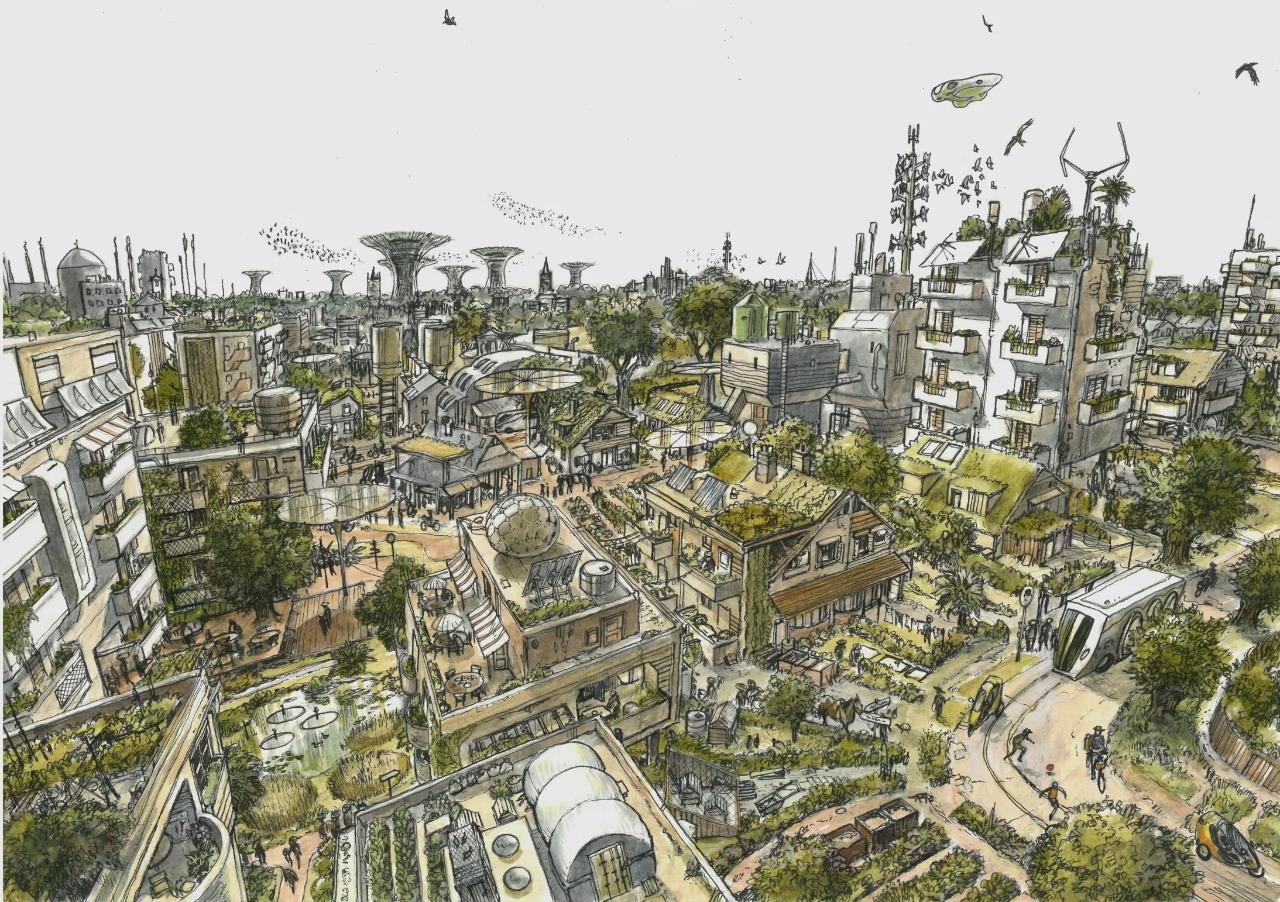
Image Credit: James McKay
15/20/30 CATS - (7.5/10/15 ECTS)
Term 2
Module Description
‘Regenerative Development’ is an emerging area of research and practice, enabling healthy and flourishing social and ecological systems. Moving away from a system where humanity and nature work against each other, to a paradigm where humans thrive as part of nature. From nature-based flood management to new bio-based materials, regenerative approaches are inspired by and work with the evolving, self-organising and self-healing potential of ecological systems. This module explores the potential that regenerative approaches have to transform areas as diverse as food production, construction, manufacturing, product design and urban planning and how technical, policy and social shifts can support these changes into the future.
This module develops students’ theoretical, methodological and practical skills to enable humanity to thrive, in the context of pressing environmental challenges. As environmental crises deepen, disciplines and practices respond by integrating new concepts, frameworks and methods into their ways of thinking and intervening in the world.
Module Convenor
Assessment
Formative:
- Short case study presentation midway through the term. Compulsory for module completion, but does not contribute to the final grade.
Summative:
- Final assessed piece of 1750 words for 15 CATS; 2500 words for 20 CATS; 4500 words for 30 CATS.
- In a disciplinary or professional context of interest, choose between:
- Present and analyse a case study that takes a regenerative approach.
- Present and critique a theoretical framework related to regenerative development.
Indicative Syllabus
Themes that the module will cover include:
- Understanding regenerative development
- Regenerative systems
- Working with nature - ecological and bio-inspired approaches to:
- Food and fuel
- Materials and products
- Art and design
- Engineering and construction
- Policy and society
- Ecoliteracy - crafting stories of regenerative futures
- Regenerative development - a critical appraisal
The course will combine the introduction to a range of theoretical and methodological approaches to regenerative development.
Weekly lectures will introduce key concepts and theories, using case studies and examples, and provide opportunities to explore and engage with these as a group. Seminar sessions will take a range of small group and class approaches and centre on the application of concepts, methods and approaches, encouraging critical reflection on how regenerative approaches can be used in real-world settings.
Illustrative Bibliography
Students will be encouraged and assisted in researching and developing their own reading list to support their final assessed pieces.
- Broadbent, O. and Norman, J. (2024) The Regenerative Structural EngineerLink opens in a new window. Institution of Structural Engineers
- Davis, H. and Turpin, E. (eds.) (2015), Art in the Anthropocene Encounters A mong Aesthetics, Politics, Environments and EpistemologiesLink opens in a new window, Open Humanities Press, London.
- Haraway, D.J. (2016) Staying with the Trouble. Making Kin in the ChtuluceneLink opens in a new window, Duke University Press, Durham.
- Lyle, J. T. (1994). Regenerative design for sustainable developmentLink opens in a new window. John Wiley & Sons.
- Morton, T. (2010) Ecological ThoughtLink opens in a new window. Cambridge, Harvard University Press, MA, USA.
- UK Architects Declare (2024) Regenerative Design PrimerLink opens in a new window
- World Business Council on Sustainable Development (2025) Sowing change: EU Policy Opportunities to Scale Regenerative AgricultureLink opens in a new window
- Camrass, K. (2020). Regenerative futures. foresight, 22(4), 401-415. https://doi.org/10.1108/FS-08-2019-0079Link opens in a new window
- Mang, P., & Reed, B. (2020). Regenerative development and design. Sustainable built environments, 115-141. https://doi.org/10.1007/978-1-4939-2493-6_303-4Link opens in a new window
- McPhearson, T., Cook, E. M., Berbés-Blázquez, M., Cheng, C., Grimm, N. B., Andersson, E., ... & Troxler, T. G. (2022). A social-ecological-technological systems framework for urban ecosystem services. One Earth, 5(5), 505-518. https://doi.org/10.1016/j.oneear.2022.04.007Link opens in a new window
- Steffen, W., Richardson, K., Rockström, J., Cornell, S. E., Fetzer, I., Bennett, E. M., ... & Sörlin, S. (2015). Planetary boundaries: Guiding human development on a changing planet. science, 347(6223), 1259855. https://doi.org/10.1126/science.1259855Link opens in a new window
- Krznaric, R. (2020). The good ancestor: How to think long term in a short-term worldLink opens in a new window. Random House.
- Raworth, K. (2018). Doughnut economics: Seven ways to think like a 21st century economistLink opens in a new window. Chelsea Green Publishing.
- Thomas, L. (2022). The intersectional environmentalist: How to dismantle systems of oppression to protect people + planetLink opens in a new window. Souvenir Press.
- Tsing, A. L. (2018) The Mushroom at the End of the World. On the Possibility of Life in Capitalist RuinsLink opens in a new window, Princeton University Press, Princeton/Oxford.
Learning Outcomes
By the end of the module, students should be able to:
- Demonstrate knowledge of contemporary issues and key transdisciplinary debates around global environmental challenges.
- Critically reflect upon the relevance of regenerative approaches for achieving sustainable futures, using theoretical frameworks and practices from across a range of disciplines.
- Critically examine responses to future global and local environmental challenges faced by contemporary societies (e.g. climate change, biodiversity loss)
- Apply knowledge to examples and analyse selected cases of regenerative approaches to environmental concerns.
- Apply theories of regenerative development to concrete disciplinary, and professional contexts
- Identify innovation in regenerative approaches and their significance for tackling emerging environmental and social challenges