
Understanding Wellbeing: Cultivating a Safe Space for Inter- and Trans- Disciplinary Exploration
Introduction
Elena shares that her first experience of interdisciplinarity was her educational background in her home country of Italy, where she found the school system less siloed than in the UK and there was “more freedom” to study and explore a variety of disciplines throughout primary and secondary school, without barriers related to prospective University choices. This helped her to see knowledge as an organic concept and to never never look at disciplines as organised in an hierarchical fashion, an approach that we often see, explicitly or implicitly, in academia.
When she came to Warwick, she was interested in understanding how to “communicate certain chemistry ideas and concepts using other methodologies.” Through a grant from IATL that she received while.she was a Department of Chemistry Postdoctoral Researcher, Elena was able to look at how concepts like polymers and antibiotics can be explored through film, TV, and radio podcasts.
Elena later went on to develop an entire module on Genetics: Science and Society, as well as Thinking Water and Understanding Wellbeing, all housed within IATL. Understanding Wellbeing challenges the idea of wellbeing as a “new” concept, rather wellbeing can be understood not only from a variety of academic disciplines but as a concept that “has been the topic of interest of many disciplines for millennia, from philosophy....to economics and arts and theatre” among others.
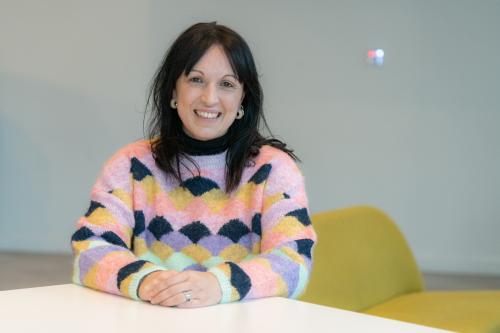
Professor Elena Riva

Principles of Practice
Moving from the Interdisciplinary to Transdisciplinary
An important part of Elena’s work has been in exploring not only interdisciplinarity but transdisciplinarity as well. Elena argues that there is “still this idea that knowledge resides in academia” and “that disciplines are the gatekeeper of knowledge.” Moving from the inter- to the transdisciplinary space means that “you have experiential knowledge or knowledge that is not necessarily academic knowledge... invited in.”
In a module such as Understanding Wellbeing, valuing the disciplinary perspectives of economists, scientists, and chemists is important, but so is inviting students, professors and guest speakers to “bring all they are....their culture, their vision of society. Elena argues that this is why creating a safe space is so important, so that “people feel comfortable not only being disciplinarians,” but full expressions of themselves.
Cultivating a Safe Space
Elena offers that: “a safe space is a reclaiming of wellbeing as an experiential, social, emotional, and truly academic experience, and rebuilding this knowledge with the students.”
Students’ final assessments speak to the benefits of fostering a safe space to share, as Elena notes that students’ work often reflects “new horizons of knowledge” that demonstrate a “merging and integration of disciplines and experience.” Students bring their own identities into their projects. For example, Elena says that some of her students of colour have examined the “westernised, white wellbeing vision that we push on students that often doesn’t allow them to express their culture or who they are.”
Another aspect that Elena says relates to safe space is the idea of failure. From looking at what failure means in wellbeing from a broader, economic, political and social level, students can “evaluate for themselves what works for them and for their community.”


Moving Forward
Elena argues that “the safe space is something that needs to be achieved in all interdisciplinary and transdisciplinary modules; it’s not necessarily specific to wellbeing."
Given its success, Elena co-created with students its online version, open to all Warwick students which is available for HEAR accreditation and Warwick Award point. This online module has already been taken up by three other universities in the UK, and the University of Copenhagen has produced it's Danish version.
In continuing to expand interdisciplinary work across different departments and universities, Elena shares that teachers need to embrace “collaborative knowledge when you walk into an interdisciplinary, transdisciplinary space, you have to admit that you aren’t an expert anymore.”
