
Applied Theatre: Arts, Action, Change
Introduction: Why Applied Theatre?
Theatre has great potential to be interdisciplinary almost by its very nature – Bobby suggests that perhaps “we are often doing it without realising”. Despite this, theatre practitioners often worry about how other disciplines will react to their input into interdisciplinary discourse. As Bobby comments: “Theatre people think that when they go into another discipline their background or their skills in theatre are going to be diminished.” Despite this, Bobby says that in his experience, colleagues have been very excited to work with those who have a background in theatre or other arts. Bobby aims to create a more “porous” attitude to collaboration with theatre, meaning theatre students and those from other academic backgrounds should become more used to collaborating and making the most of the resulting diversity in approaches to a task. This is crucial for Bobby’s ideas about interdisciplinarity, which he feels is helpful because it allows fresh perspectives to enter into an existing discipline and develop or critique it as appropriate.

Dr Bobby Smith

Principles of Practice
Defining Interdisciplinarity
Despite leading an interdisciplinary course, Bobby wasn’t sure how much prior interdisciplinary teaching he was able to say he had done – this is partly because interdisciplinarity can be hard to define, and there are several ways of looking at it. One thing Bobby highlighted was the amount of “subtle interdisciplinarity” which might already be found in theatre studies. Another important idea Bobby discusses is the difference between interdisciplinary teaching and interdisciplinary research. While it is true that the two are closely linked, as a module coordinator, Bobby is very interested in how he can promote and improve skills in interdisciplinary teaching both in himself and in other teachers to encourage similar interdisciplinarity in students. To Bobby, this is important as interdisciplinarity allows people from different backgrounds to bring new ideas and critiques to different disciplines, even whilst themselves learning how to get into that discipline’s mindset: “You need to be aware of what it means to be in that discipline or context. But equally, you should be pushing it and challenging it and bringing new things into it from theatre.”
Creating an MA in Applied Theatre
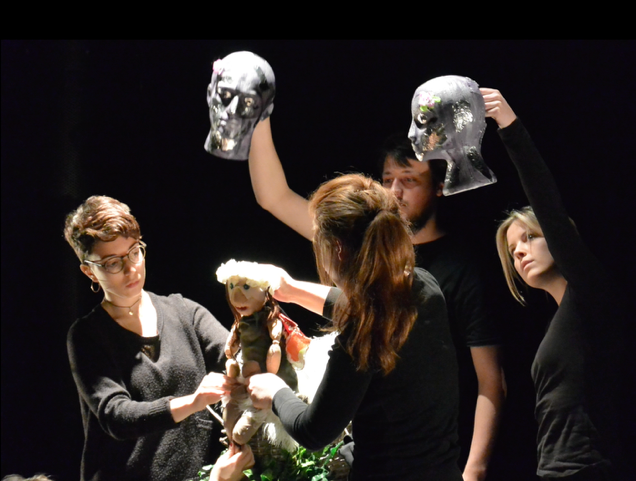
Interdisciplinary work in theatre at the University of Warwick culminated in 2021 with the launch of the MA in Applied Theatre course. This taught-postgraduate course encourages students to engage with performance practices which focus on social issues (examples include homelessness, the social justice system or disability). Three core modules cover topics such as performance, research, ethics and building a professional profile. Students also pick from a selection of optional modules, before completing a final project, which can be either written or practical. The aim is to create a vocational course which is able to suit students with a diverse range of interests and disciplinary approaches. Optional modules are often taken outside the department which encourages the cultivation of a wide range of interests, and for students to take it upon themselves to combine different disciplines into new ways of thinking: “It's not us teaching the interdisciplinarity, but their degree then becomes interdisciplinary for students… they carve it out for themselves”.
Deconstructing the Teacher-Student Dynamic
Bobby’s advice for interdisciplinary teaching is: “not feeling like you have to nail it completely.” In interdisciplinary courses like the Applied Theatre MA, putting teachers on an equal footing with students creates a good learning environment as it encourages students to fill gaps with their own learning and experience, which may derive from any number of sources. This really contributes to the interdisciplinary nature of the teaching; in some cases, a single teacher may only be able to discuss one side of an interdisciplinary conversation. Rather than a rigid teacher-student relationship, Bobby imagines teaching as a “co-inquiry” with students. The important thing about interdisciplinarity is “keeping it fresh”: being willing to take on new ideas but also not losing your own perspective from which to challenge other disciplines. The Applied Theatre MA also involves several associate companies who work with the students and contribute to the course; this enriches students in areas that are perhaps more practical and not so strictly ‘academic’.

Moving Forward
Individual Student Projects
Bobby outlined a plan for the MA course to support students in undertaking projects which take place outside of the course structure (e.g. modules and assessments). Bobby hopes that these projects will be “interdisciplinary in their nature” as it encourages students to pursue their own interests and their intersection with theatre. By not being assessed in the course structure, projects could become a source of professional experience to increase employability, something “that can go on a CV, that allows students to fail”. The projects also aim to break down the teacher-student dynamic even further, allowing teachers to treat students “more as colleagues and co-artists on a project”.
Work Within Prisons
Since the interview, Bobby’s colleague, Saul Hewish, has recently provided opportunities for students to do work alongside him in prisons with Rideout (Creative Arts for Rehabilitation), supported by funding from IATL. The project called “The Catalogue of Imagined Provenances”, involved discussions of objects made in prisons, whose purpose or maker is now unknown. Students have worked with artists and researchers from various disciplines to tackle social issues in prisons using art. New opportunities to do projects such as this are an indication of how the course is developing towards enabling students to explore a greater array of interests as part of their studies, and how interdisciplinary learning departments such as IATL can support these ventures.
