
The Fitrah of Water
Najiba Rahimi
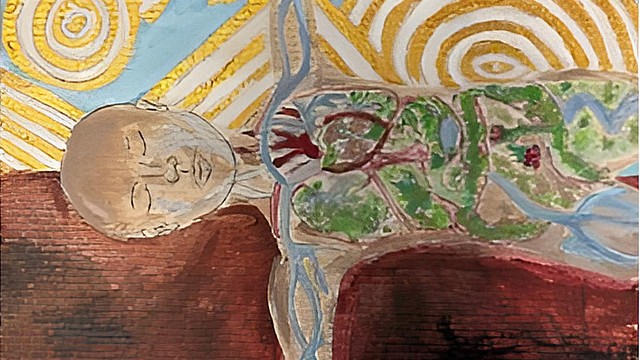
As a Muslim Chemistry student navigating through the world, I bridged empirical science and Islamic theology in The Fitrah of Water. This interdisciplinary artwork explores human anatomy as a sacred aquatic microcosm, utilizing the physics of cymatics to visually demonstrate how acoustic frequencies actively harmonize or corrupt our internal waters.
About the Project
Fitrah refers to the innate, natural disposition of human nature. The Quran states, “And We made from water every living thing” [21:30], a theological statement mirrored by the biological reality that the human body is roughly 60 % water. By shifting the focus from external oceanic pollution to the internal human soul, this project offers a more intimate lens for exploring spiritual purity. I want to look at the human body as a water ecosystem, which in turn, allows water to be a divine medium, rather than just a chemical resource. This emphasises our duty to protect our internal water vessel. My aim is to bridge the gap between macro-ecology and internal spiritual ecology by visually exploring the spiritual significance of humans being constituted from water. Our internal anatomy is not just biology; it is a sacred vessel. We are constantly exposed to external environmental factors that can either harmonise or corrupt the water we are made from, which depicts the core tension between Tahara (spiritual/ physical purity) and Ghafla (heedlessness). Rather than looking at global water systems, I am narrowing my focus entirely to the human body. In utilising the principles of Cymatics, which is the study of how sound waves physically shape fluid, I will examine how the acoustic vibrations we consume impact our internal ecosystem. To demonstrate this, my creative piece will be a detailed anatomical drawing, mapping veins as river streams and major organs as wetland ecosystems. The internal water will be visually split: one side reflecting the geometric harmony of sacred sound, and the other reflecting the turbulent distortion of heedless noise. This would ensure my artwork is grounded in real physics rather than pseudoscience. My goal with this piece is to provide a tangible, physical visualisation of abstract spiritual concepts. It concludes that the Islamic principle of environmental stewardship (Khilafah) must extend inward to the self. Ultimately, this project relies on an interdisciplinary framework, bridging the biological sciences (anatomy and acoustic physics) with the humanities (Islamic theology and fine art) to suggest that the human body’s internal water is a microscopic mirror of broader spiritual realities.