
MLIP School and Workshop Discussion Poll Report
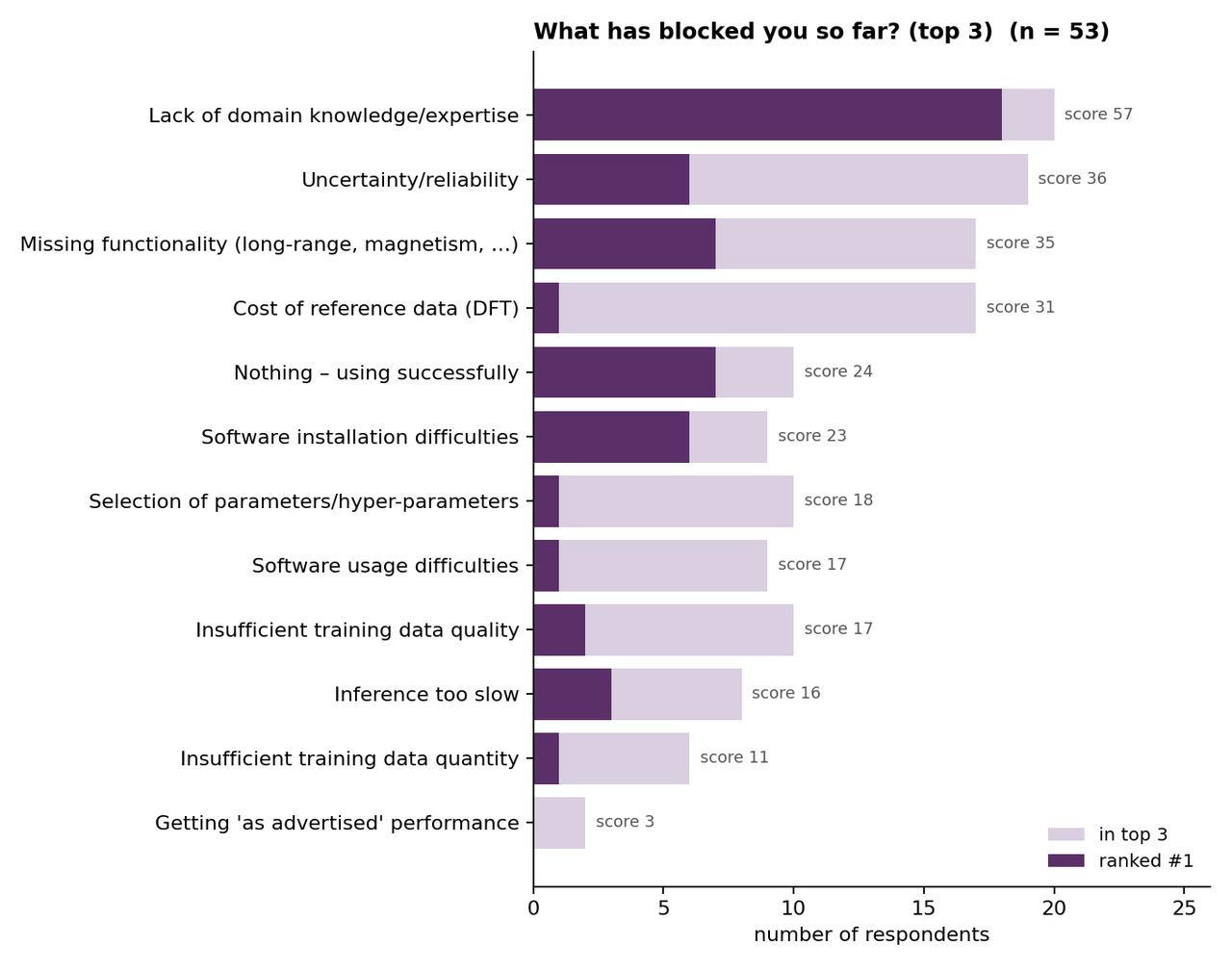
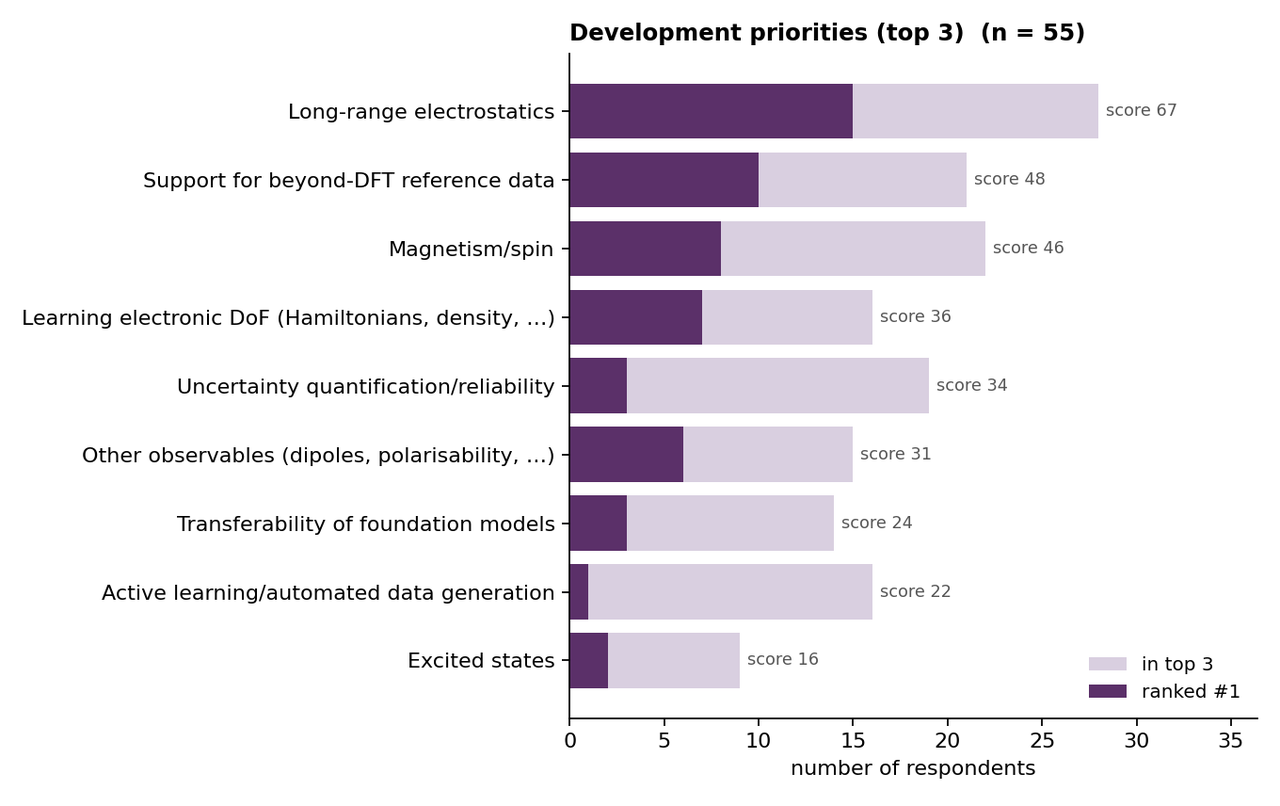
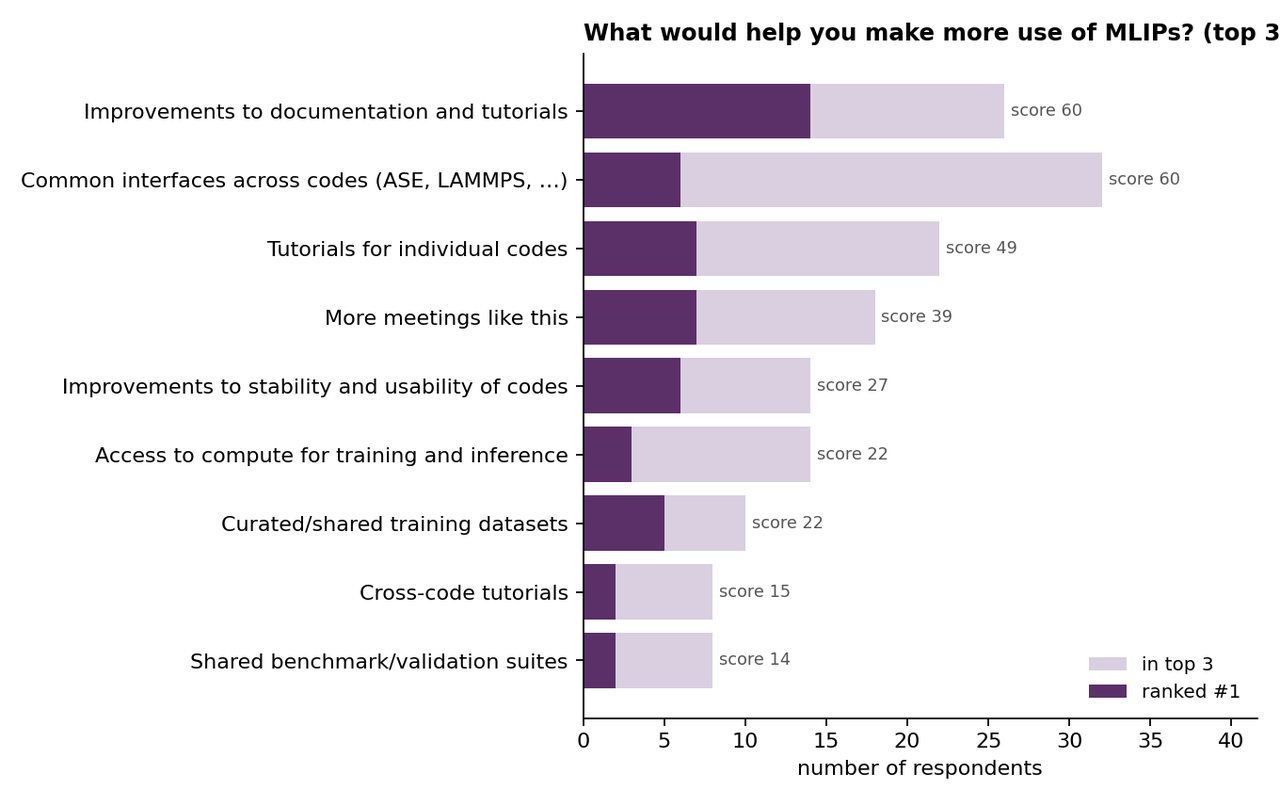
We ran a live poll during the closing discussion of the workshop, with around 60 people responding. Responses were anonymous. Ranking questions asked for a top 3; the charts show how many people placed each item anywhere in their top 3 (light) and first (dark), with a weighted score (3/2/1 points).
Who answered
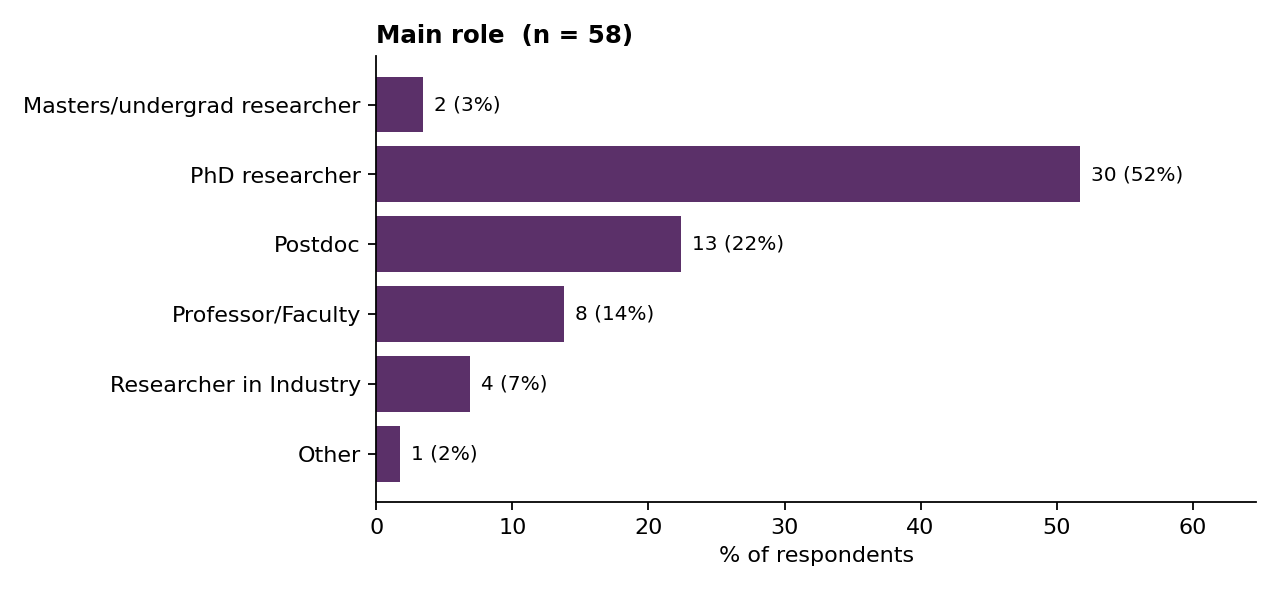
The audience was dominated by early-career researchers, half of them PhD students and a further fifth postdocs, with faculty and industry researchers making up about a fifth between them.
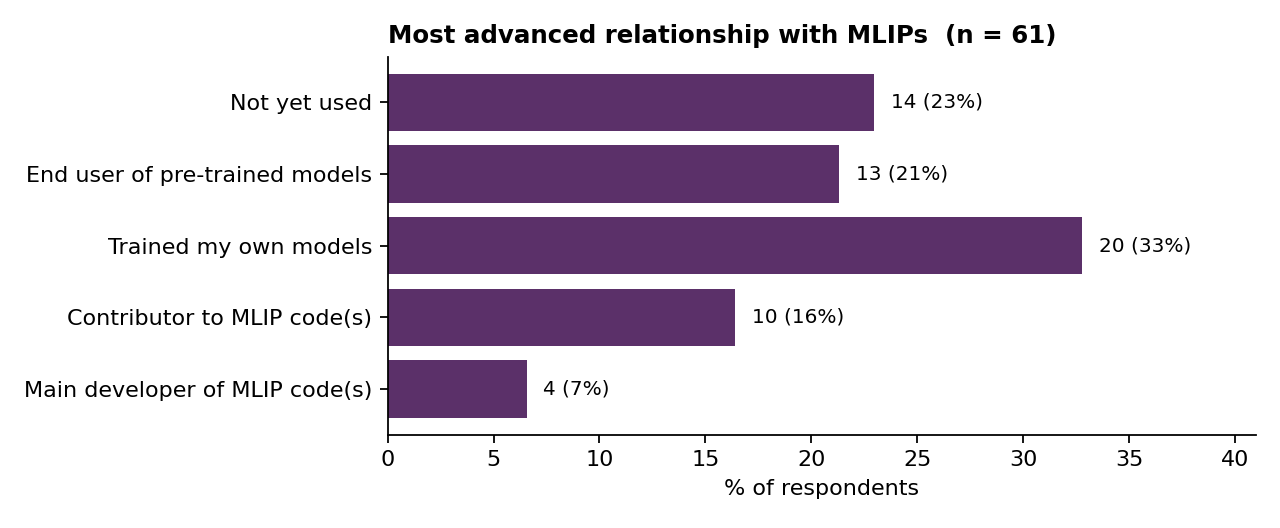
In terms of experience with MLIPs the room spanned the full range: about a quarter had not yet used an MLIP, a fifth were end users of pre-trained models, a third had trained their own models, and a quarter had contributed to or led the development of an MLIP code.
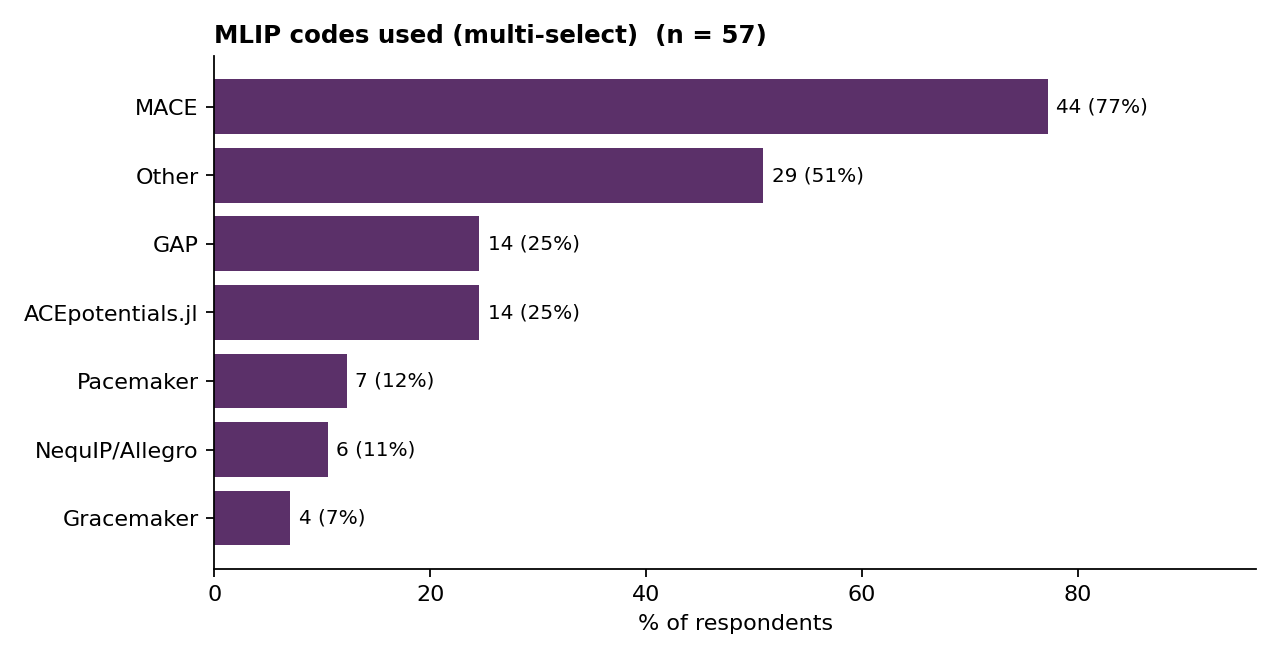
MACE was by far the most widely used code (77% of respondents), with GAP and ACEpotentials.jl each used by about a quarter. Half of respondents had also used something outside the list; in discussion, SNAP and RuNNer were named among the codes the poll options had missed.
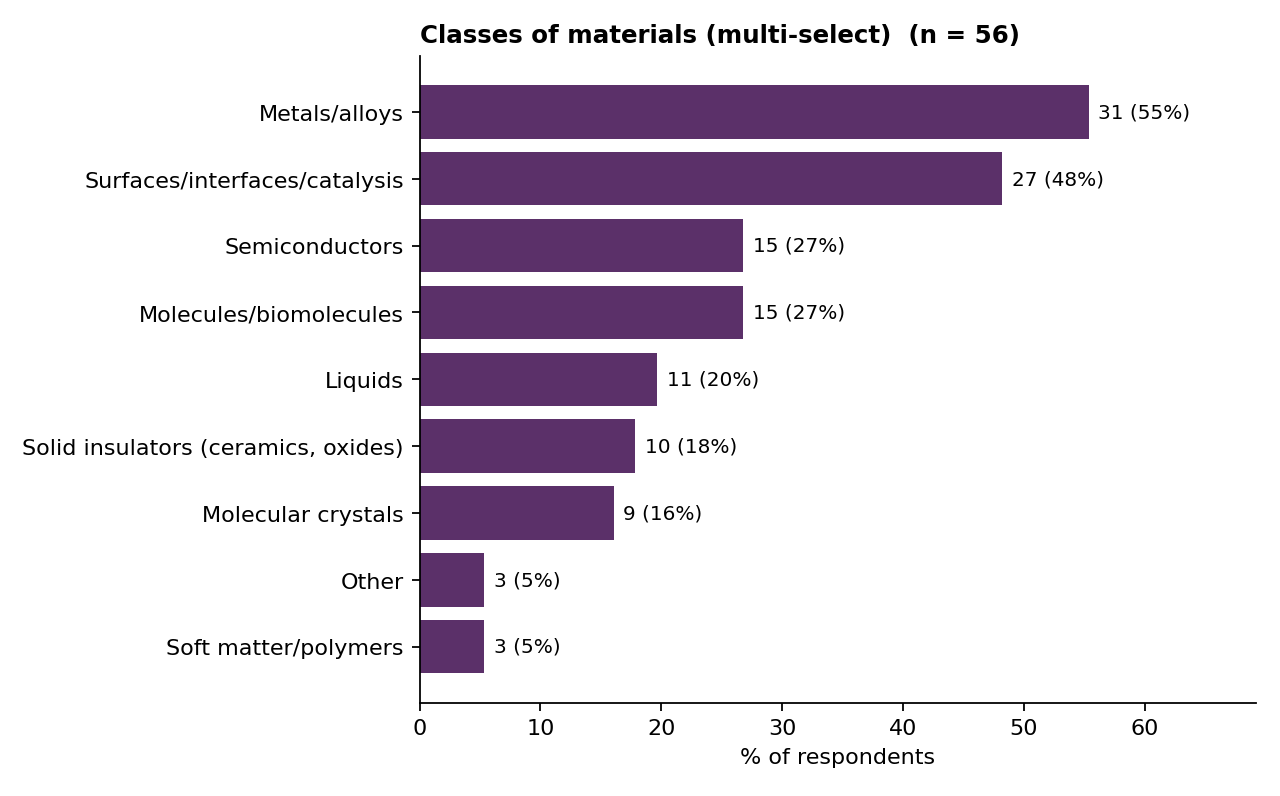
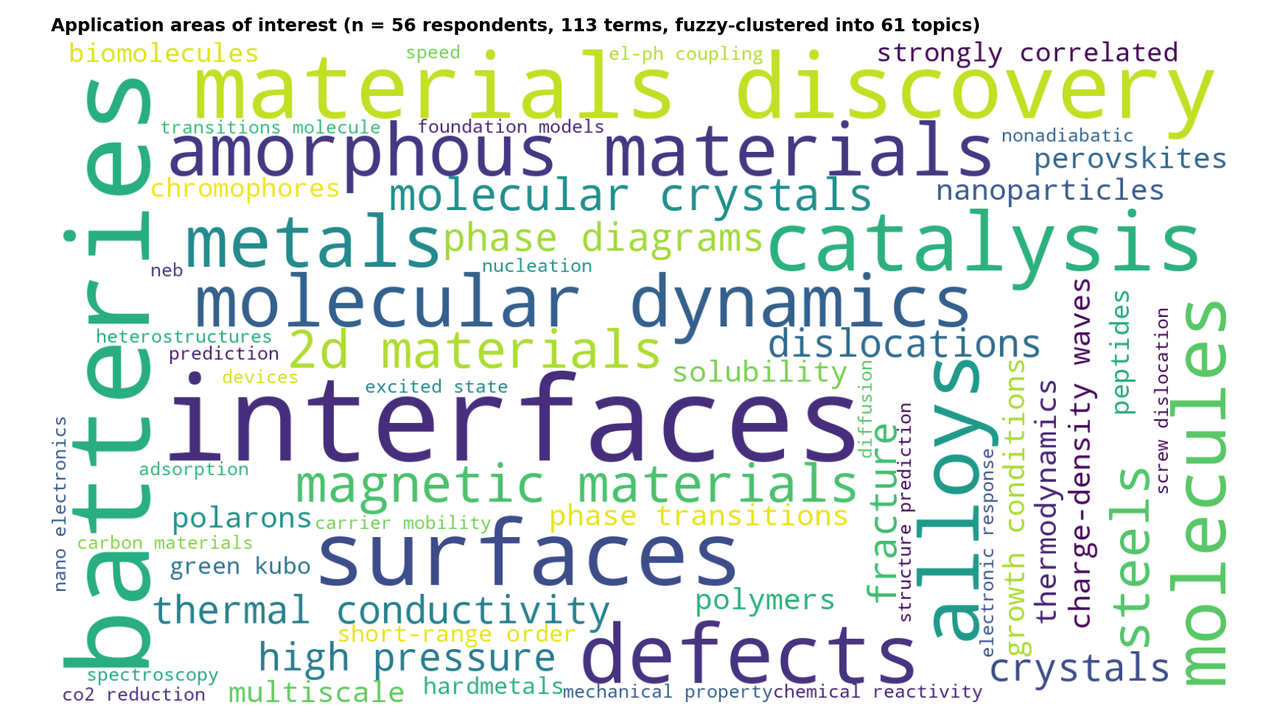
Metals and alloys (55%) and surfaces/interfaces/catalysis (48%) were the most common material classes, followed by semiconductors and molecules. Free-text answers on application area echoed this: interfaces, batteries, dislocations and other defects, alloys and catalysis were the most frequently mentioned themes, alongside a noticeable cluster of “beyond-energy” interests – excited states, spectroscopy, electron–phonon coupling and electronic response.
Free-text terms were lower-cased and fuzzy-clustered (Levenshtein similarity ≥ 85% after removing generic words), with a handful of merges for synonyms. Size is proportional to the number of respondents mentioning the topic.
Challenges
Asked what had blocked them from applying MLIPs so far, respondents most often cited lack of domain knowledge, closely followed by uncertainty/reliability (“can’t tell when it’s wrong”), missing functionality (long-range interactions, magnetism, non-standard observables) and the cost of generating DFT reference data. Roughly a fifth said nothing had blocked them.
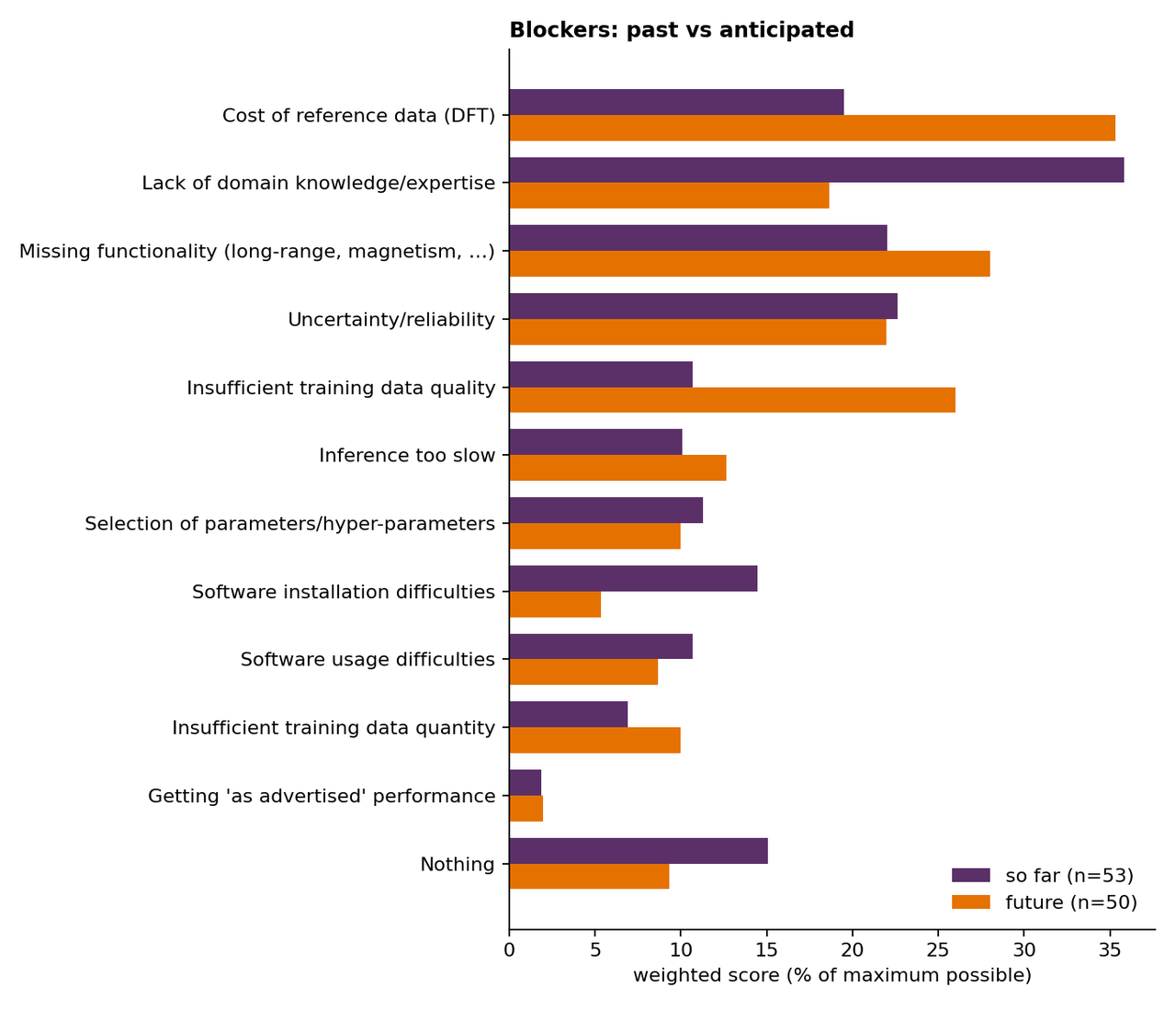
The picture shifts when people look ahead. Lack of expertise drops sharply and software installation almost vanishes as a concern, perhaps reflecting what a school like this is for, while the cost of reference data becomes the single largest anticipated blocker, and training-data quality more than doubles in importance. Missing functionality and uncertainty remain stubbornly high in both lists.
One barrier the poll did not list was raised from the floor: simply knowing what computational resources (e.g. CPU vs GPU, memory, wall time) a given model or training run will need, which is hard to find out in advance and can stop people before they start.
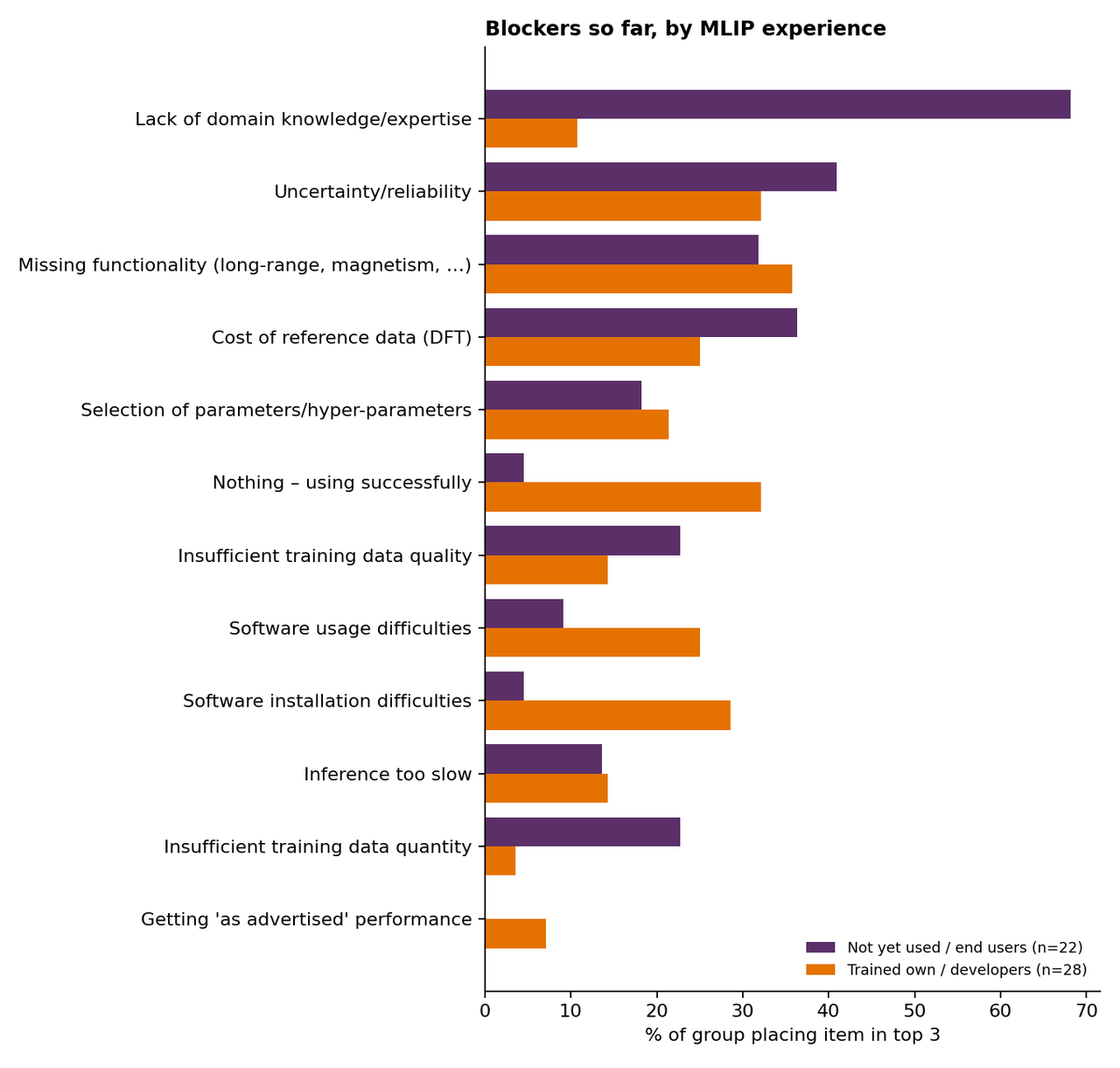
Splitting by experience makes the two populations visible. For those who have not yet used an MLIP or only use pre-trained models, lack of expertise dominates (68% put it in their top 3). For those who train their own models or develop codes, the leading blockers are missing functionality (36%), uncertainty (32%) and software installation and usage difficulties (29% and 25%), which barely register for the less experienced group. A third of the experienced group reported nothing had blocked them.
How do people decide if a model is “good enough”?
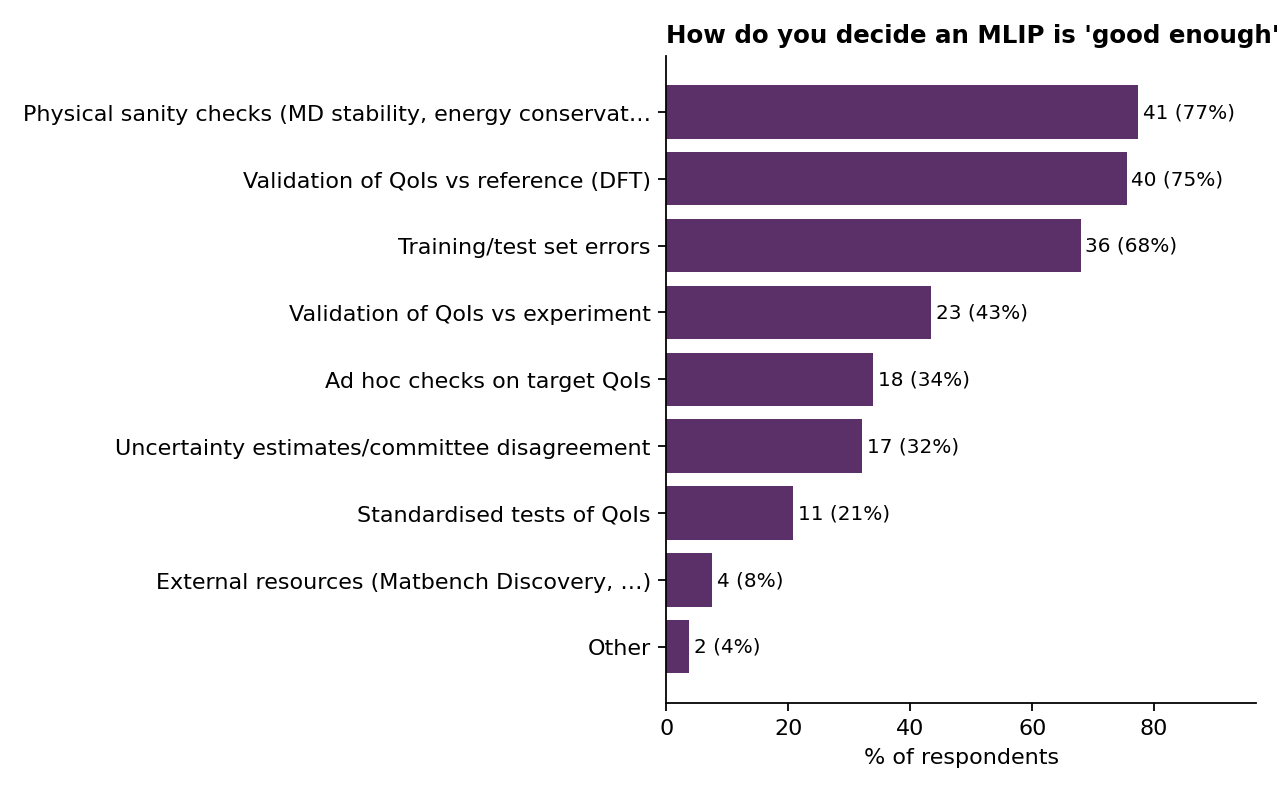
Validation practice is mature: over three-quarters use physical sanity checks (MD stability, energy conservation) and validation of target quantities against DFT, and two-thirds look at training/test errors. Validation against experiment is used by 43%. Formal uncertainty estimates (32%) and standardised cross-model tests (21%) are much less common, and only a handful use external leaderboards such as Matbench Discovery.
Development priorities
Long-range electrostatics was the clear top development priority (half of respondents put it in their top 3, and it was the most common first choice), followed by magnetism/spin, support for beyond-DFT reference data, and uncertainty quantification. The “electronic” directions, e.g. learning Hamiltonians and densities, other observables, excited states, attracted consistent but smaller support. Speed was not among the options offered and several people argued in discussion that it should have been: inference cost appeared as a blocker for about a fifth of respondents (rising for future work), and faster models were seen as a development priority in their own right.
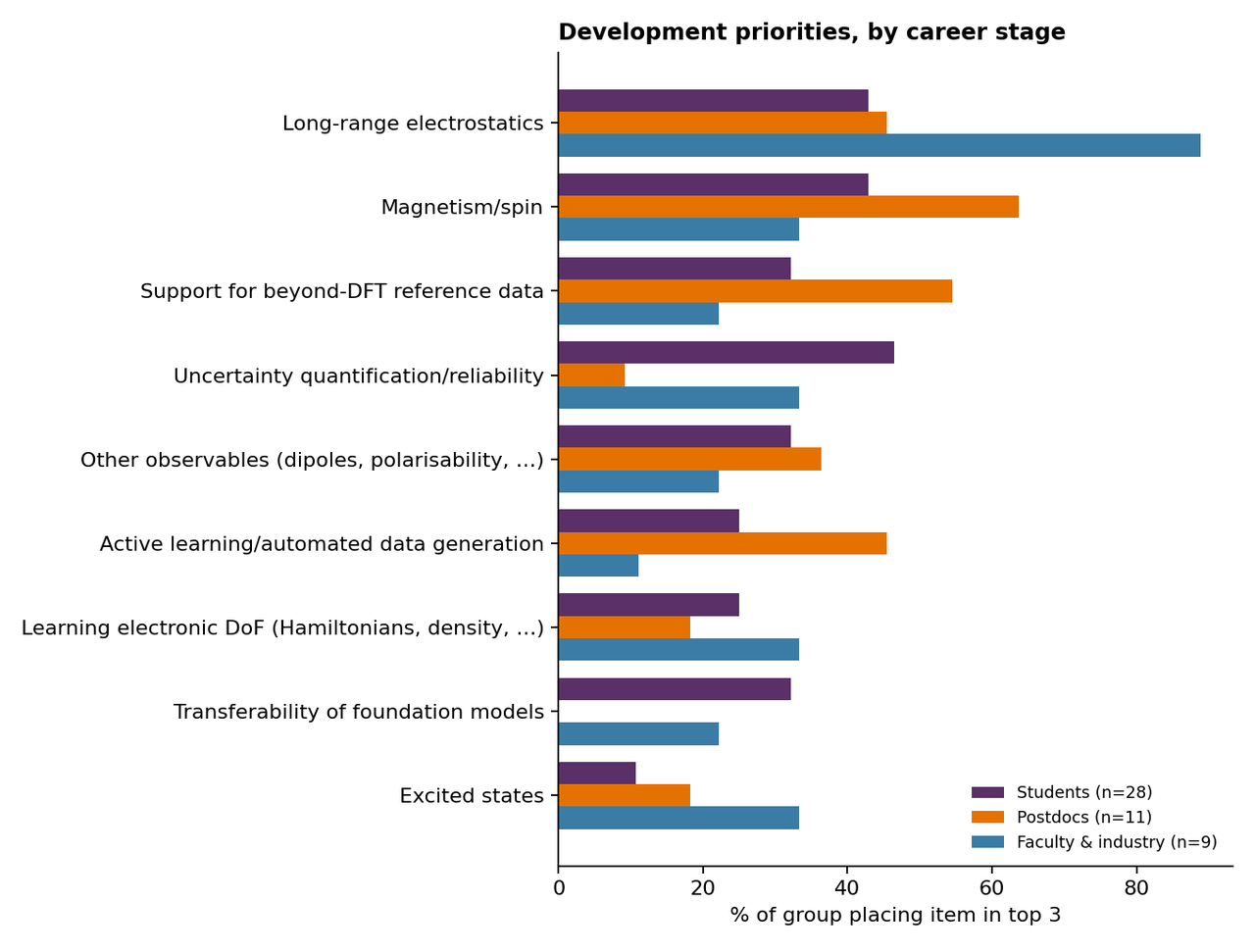
Priorities differed a little by career stage: students ranked uncertainty quantification highest, postdocs magnetism, and faculty/industry long-range electrostatics (8 of 9 put it in their top 3). Group sizes are small, so these are indicative only.
Will foundation models make training your own model obsolete?
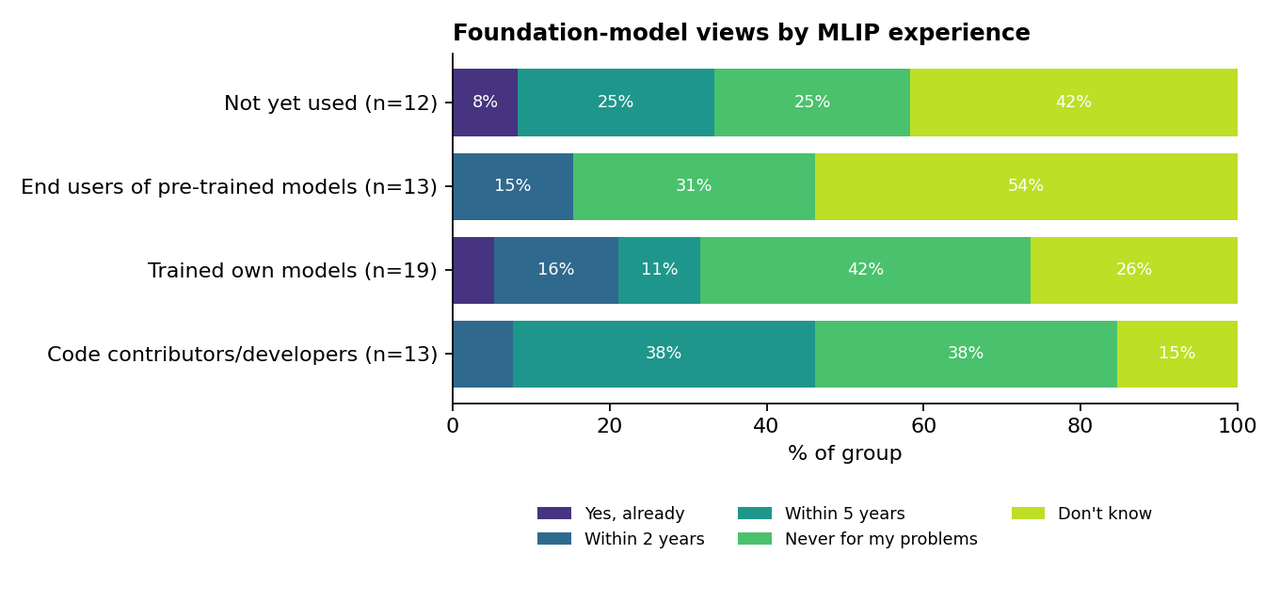
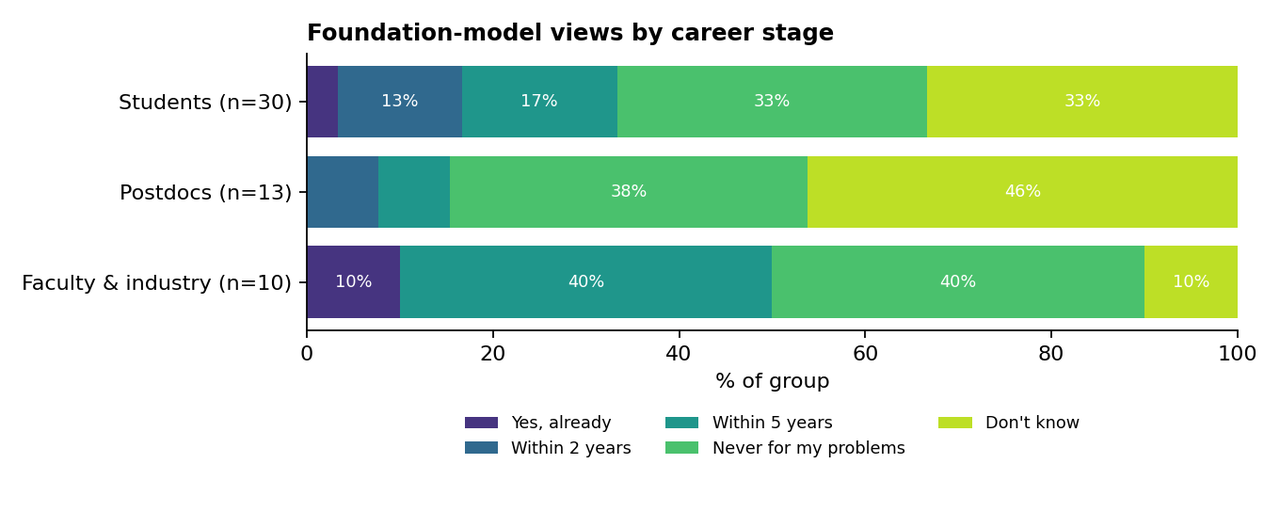
The room was split. A third said never for my problems, a third don’t know, and a third expected it within five years (with 15% saying within two years or already). Views correlate with experience: end users of pre-trained models were the most uncertain (54% don’t know), those who train their own models the most sceptical (42% never), while code developers were the most likely to expect a shift within five years (46%). Nobody in the developer group said “already”.
What would help?
The top-ranked community need was common interfaces across codes (ASE, LAMMPS, etc.), placed in the top 3 by 62% of respondents, followed by better documentation and tutorials (50%) and tutorials for individual codes (42%). Only 15% ranked shared benchmark suites in their top 3, and 19% curated datasets, despite data cost and quality featuring so prominently among the blockers.
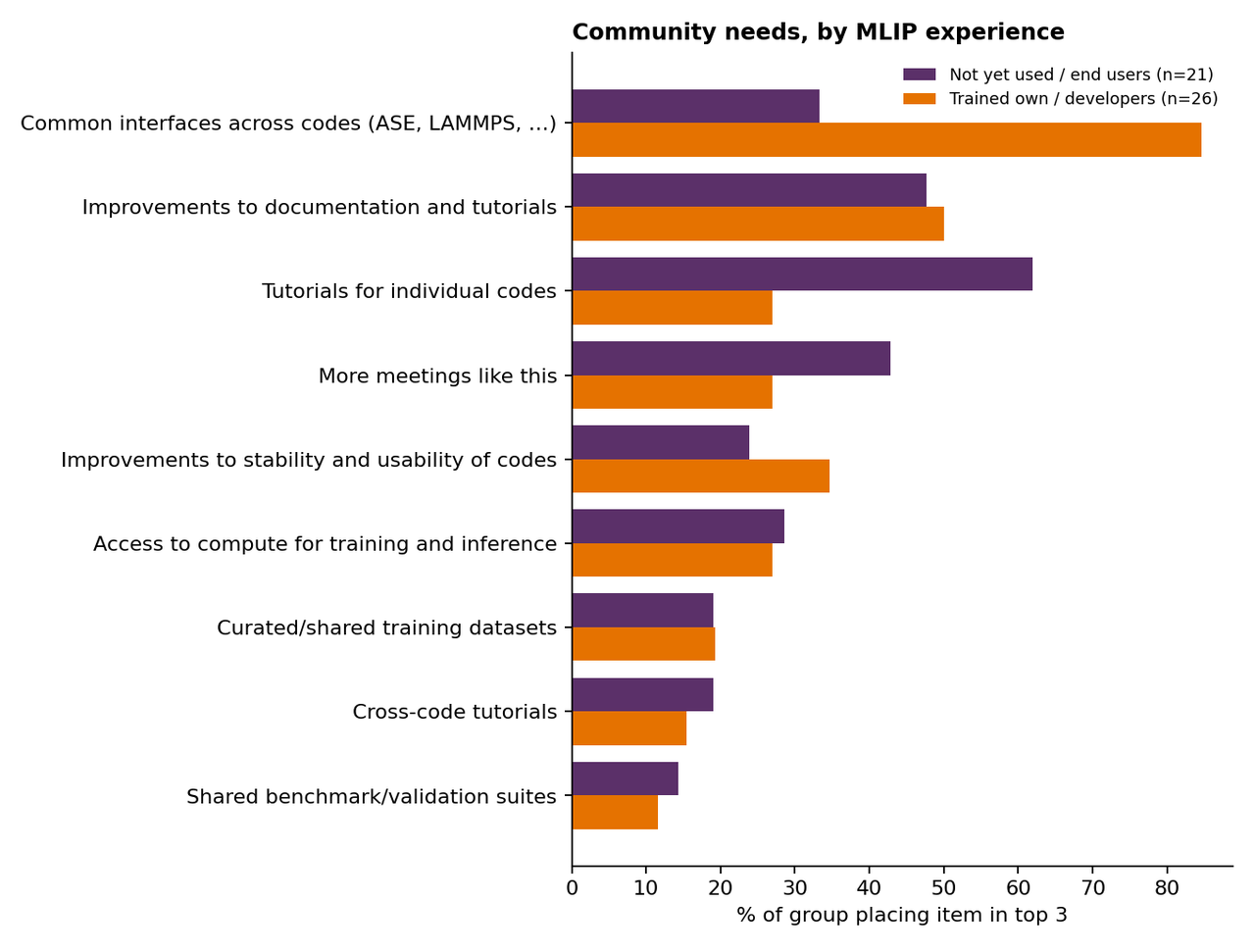
Again, the two populations want different things: newcomers and end users want tutorials (62% for per-code tutorials) and more meetings like this (43%); experienced users overwhelmingly want interoperability (85% placed common interfaces in their top 3) and more robust, better-documented codes.
The importance of training and tutorials came through strongly in the discussion as well as in the poll, though with an open question attached: how much of the role of tutorials, documentation and hands-on support will be taken over by AI coding agents in the next few years, and how the community should plan its training effort in that light.
If you had $1M…
Thirty-eight people answered a free-text question on how to allocate a hypothetical $1M in spending on MLIP science and/or community. The responses cluster into a few themes:
- People, not GPUs (mostly). The most common answer was to fund research software engineers to refactor, harden and document existing codes, with several calls for shared open-source backends and “robust dependencies” so that models port across hardware.
- Training and community. Schools, bootcamps (including at Master’s level), recorded online tutorials, regular developer meetings and users–developers meetings.
- Data and benchmarks. Curated, FAIR datasets to stop people recomputing the same structures; experimental benchmark data for calculable properties; a standard that models must pass before publication.
- Compute: “buy computational time and generate high-quality data”, “see where the limits of scaling laws in MLIPs are”.
- Specific science: long-range/electrostatic models, electronic-structure-in-MLIP, bridging simulation and experiment.
The next million-structure DFT dataset
There were 36 suggestions for what a next-generation ~100-atom-cell DFT dataset should contain. Two messages come through strongly:
- Defects, interfaces and disorder: by far the most common theme: point and extended defects (dislocations, stacking faults, grain boundaries, gamma surfaces, dislocation quadrupoles), surfaces and solid–gas/liquid interfaces, amorphous and disordered structures, organic–inorganic interfaces, 2D heterostructures and moiré cells, high-entropy and industrial alloys.
- Better labels, not just more structures: non-collinear and spin-polarised calculations, charged defects, coupled-cluster rather than DFT (“not PBE… let’s do something better”), excited-state energetics and spectroscopic response, external fields, beyond-energy properties, anharmonic strain data.
Summary
- The MLIP user base at this meeting was young, MACE-centric, and split roughly evenly between people who have never trained a model and people who develop the codes.
- The barriers of the past (expertise, installation) are receding; the blockers of the future are data cost and quality, missing physics (long-range, magnetism) and knowing when the model is wrong.
- The community’s top ask is interoperability across codes, with better documentation and tutorials close behind – with a live question over how much of the tutorial and support role AI agents will absorb.
- Two things the poll under-represented but the room did not: speed as a development priority, and knowing the resource requirements of a model before committing to it.
- Opinion on foundation models is evenly divided, and the most experienced practitioners are the most sceptical that they will replace bespoke training.
- Asked for a million dollars, the community would hire software engineers, run more schools, and build shared, better-labelled datasets.
Analysis and figures generated from the Vevox session export, with points raised in the open discussion folded in where indicated. Stratified breakdowns use small subgroups (n = 9–28) and should be read as indicative. An AI model was used to assist data analysis and report preperation, but all conclusions have been verified.