
HetSys Training
HetSys Training Aim:
The HetSys' training programme is designed to enable students to become high-quality computational scientists who are comfortable working in interdisciplinary environments, have excellent communication skills, and well prepared for a wide range of future careers in areas where there is demonstrable need.
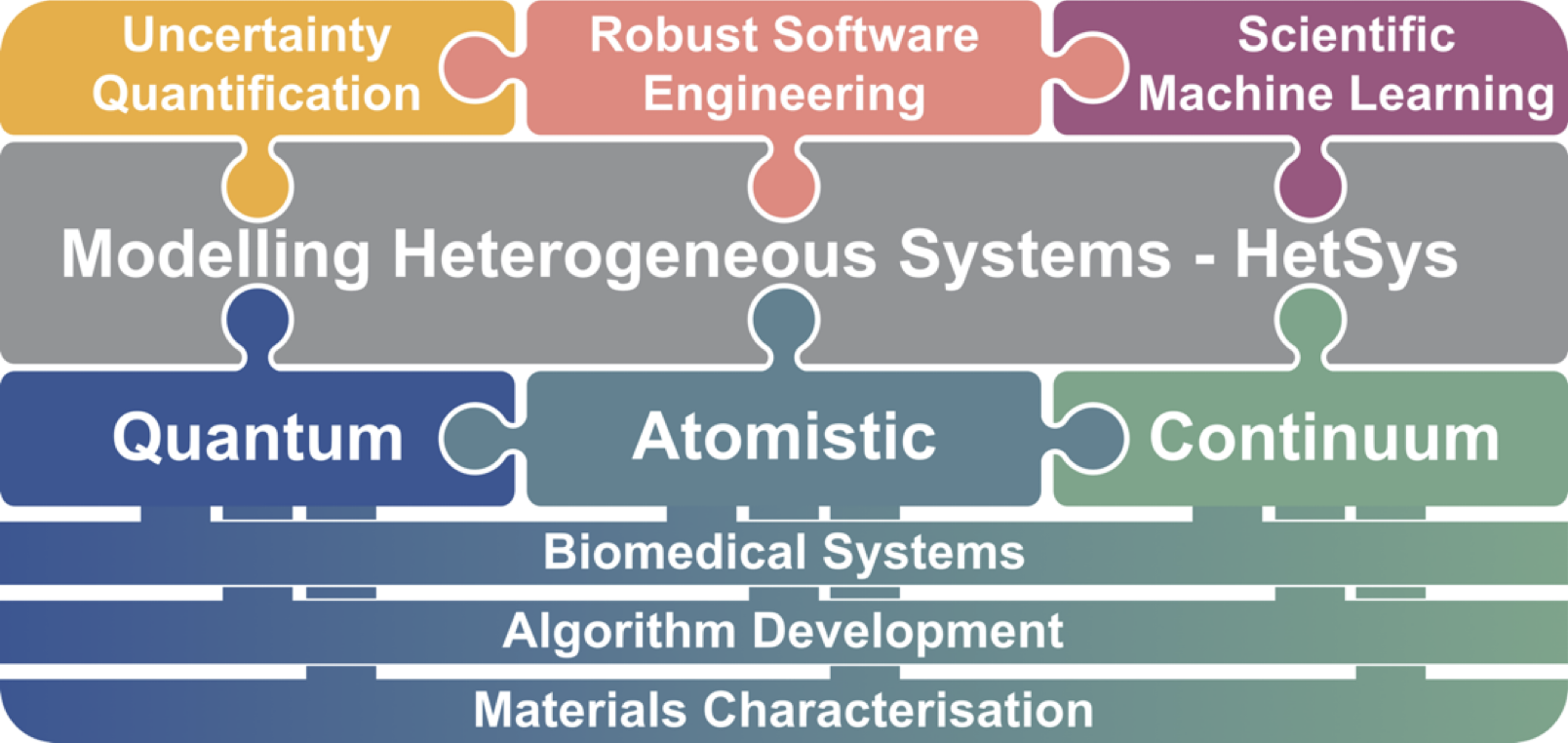
The HetSys training programme focuses on three key training needs - quantum, atomistic and continuum.
Overview of Training Programme
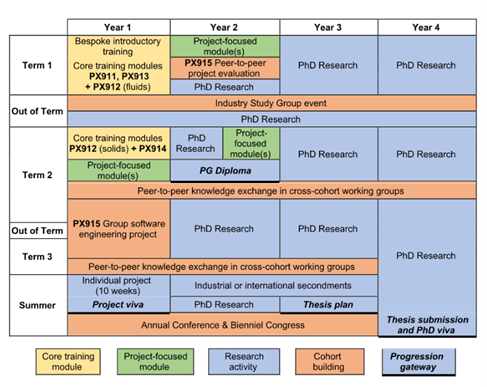
CDT training will run throughout the four year PhD programme as illustrated above, with all aspects designed to meet the three key training needs (left), and to develop transferable skills. Students will be recruited directly onto projects and will have a supervisor from the start of their course, as well as a second supervisor in a related area and a cohort mentor for academic and pastoral advice. In projects with industry links there will often also be an industry co-supervisor.
During the first 18 months of the programme each student will study 4 core modules (PX911, PX912, PX913 and PX914) and at least 2 optional modules, participate in a group software development project (PX915) supported by academics and RSEs, and carry out an independent research project (Individual Project) in the area of their PhD project assessed through a written report and viva 12 months into the programme.
The Individual Project also leads to a peer-to-peer activity in the second year (also part of PX915). These activities will contribute to the formal award of a postgraduate diploma (120 credits), which must be successfully completed 18 months into the programme. Each student will also have the opportunity to participate in the formal transferable skills course run by the University, which leads to a PG Certificate in Transferable Skills after 3 years.
In Years 2-4 the majority of the students’ time will be spent conducting PhD research. There will be ample opportunities for peer-to-peer learning and knowledge exchange through cohort-wide activities.