
Learning Locality: Equivariant ML generation of optimised orbitals for DFT simulation of 2D Materials
This is a fully-funded 4-year PhD position based in the HetSys Centre for Doctoral Training at the University of Warwick.
Project Outline
Novel 2D materials, particularly in heterostructured and ‘twisted’ forms, promise solutions to multiple pressing technological challenges, from low-power electronics and quantum information processing to next-generation sensors and catalysts.
Quantum mechanical simulation is vital to understanding and harnessing their properties, but the scale of required modelling makes traditional approaches unfeasibly expensive. In this project we will develop powerful new machine learning techniques in combination with state-of-the-art electronic structure methods.
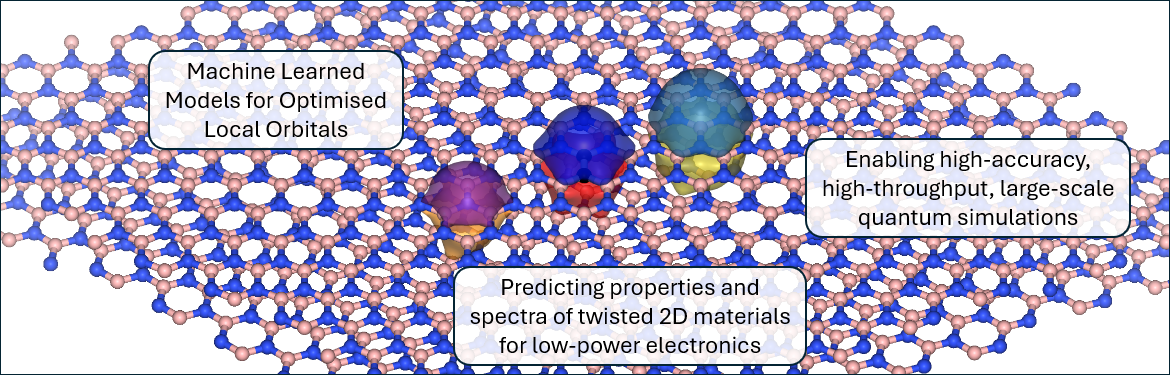
We will learn to predict in-situ optimised local orbitals from the environment of every atom, such that accurate large-scale property prediction on heterostructures become tractable with high throughput.
Supervisors
Primary: Prof. Nicholas Hine (Physics)
Prof. James Kermode (Engineering)


Machine-learned interatomic potentials (MLIPs) are revolutionising materials modelling, particularly of twisted 2D materials, the focus of the Monash-Warwick Alliance Major Research Initiative on Atomically thin moiré materials for low-energy electronics. MLIPs typically learn only energies and forces, but ab initio methods can also predict e.g. transport, optical and excitonic properties, quantum geometry for insight into superconductivity, and dielectric response.
However, ab initio training data for ML models is expensive: DFT scales cubically with atom count and must iterate to self-consistency, and field and ion-displacement responses are harder still. Linear-scaling codes like ONETEP help, capturing long-range effects vital for training data.
This project bridges gaps in both ML and DFT: from the local environment of each atom, a minimal set of in situ optimised local orbitals (NGWFs) and response NGWFs, enabling rapid electronic structure calculations with minimal optimisation.
The materials challenge is to understand the interlinked electronic bandstructure, polarization, dielectric susceptibility, quantum geometry, and phonon and exciton properties of 2D twisted bilayers and heterostructures. Building on experience with Hamiltonian prediction, we will devise a general scheme for prediction of local orbitals and response orbitals for LS-DFT and Linear-Scaling Density Functional Perturbation Theory (DFPT), from the local environment.
We would be able to much more rapidly and efficiently model the moiré materials required for next-generation low-energy electronics, engineered to have properties not observed in their bulk counterparts. Before devices can be built, we must understand how electric and magnetic fields and strain manipulate electronic properties: this novel ML-accelerated linear-response capability offers a clear route, even for very large moiré supercells.
This project suits a student interested in both condensed matter physics and machine learning, featuring code integration into two large projects (ONETEP and ACE/MACE), each with robust RSE practices but different languages and compute paradigms.
Orbital reconstruction accuracy, errors from the reduced SCF, and accuracy of predicted spectroscopy will be assessed against full DFT.
The ML problem is challenging because gauge freedom of optimised orbitals makes naive regression ill-posed: a representative of the correct gauge must be targeted.
HetSys training will provide electronic structure, SciML, uncertainty quantification and software engineering skills to take on this challenge.
The student will also engage with the Monash-Warwick Major Research Initiative team, with closely linked experimental work on crystal growth, device fabrication and characterisation, and regular interaction between theory and experimental PhD students, PDRAs and staff at Warwick and Monash.
ONETEP (onetep.org) “The ONETEP linear-scaling density functional theory program” J. Chem. Phys. 152, 174111 (2020)
https://pubs.aip.org/jcp/article/152/17/174111/198202Link opens in a new window
"Equivariant electronic Hamiltonian prediction with many-body message passing", npj Computational Materials 12, 169 (2026)
https://www.nature.com/articles/s41524-026-02020-1Link opens in a new window
We require at least a II(i) honours degree at BSc or an integrated masters degree (e.g. MPhys, MChem, MSci, MEng etc.) in a physical sciences, mathematics or engineering discipline. We do not accept applications from existing PhD holders.
If you are an overseas candidate please check here that you hold the equivalent grades before applying.
For postgraduate study in HetSys, the term “overseas” or “international” student refers to anyone who does not qualify for UK home fee status. This includes applicants from the European Union (EU), European Economic Area (EEA), and Switzerland, unless they hold settled or pre-settled status under the UK’s EU Settlement Scheme.
If you are a European applicant without UK residency or immigration status that qualifies you for home fees, you will be classified as an overseas student.