
Anna Leonowens – English teacher at the Siamese Court (1862–67)
Anna Leonowens (1831–1915) was an educator and travel writer who became known for her memoirs chonicling her experience in the Siamese Court (1862–1867) as tutor to King Mongkut's children and wives. The first of these books was The English Governess at the Siamese Court (1870). Another was The Romance of the Harem (1873). These were later fictionalized in Margaret Landon's novel Anna and the King of Siam (1944) and adapted for the 1951 Rodgers and Hammerstein musical The King and I, subsequently made into a (1956) movie starring Deborah Kerr as Anna and Yul Brynner as the King. The memoirs (and their fictionalized representations) have been heavily criticised, in Thailand in particular, for their inaccurate and sensationalized portrayal of life in King Mongkut's court and for the unflattering picture of gender relations in Thai society which they present.
In the following essay (provided also as pdf hereLink opens in a new window), David B. Wilson – author of the recently published book The Experience of Expatriate English Language TeachingLink opens in a new window(Cambridge Scholars, 2025) – considers Anna Leonowens' experience as an English teacher and the way she (mis)represented this in her published works. David has contributed this essay in support of the overall ELT Archive Women in ELT HistoryLink opens in a new window project.
The Mendacity of Mrs Leonowens
David B. Wilson
"ENGLISH ERA, 1862, 26th February.
GRAND ROYAL PALACE, BANGKOK."To MRS. A. H. LEONOWENS:—
"MADAM: We are in good pleasure, and satisfaction in heart, that you are in willingness to undertake the education of our beloved royal children. And we hope that in doing your education on us and on our children (whom English, call inhabitants of benighted land) you will do your best endeavor for knowledge of English language, science, and literature, and not for conversion to Christianity; as the followers of Buddha are mostly aware of the powerfulness of truth and virtue, as well as the followers of Christ, and are desirous to have facility of English language and literature, more than new religions.
"We beg to invite you to our royal palace to do your best endeavorment upon us and our children. We shall expect to see you here on return of Siamese steamer Chow Phya.
"We have written to Mr. William Adamson, and to our consul at Singapore, to authorize to do best arrangement for you and ourselves.
"Believe me
"Your faithfully,
(Signed) "S. S. P. P. MAHA MONGKUT."
The letter of appointment Anna Leonowens received from the King of Siam (cited in the Preface to her The English Governess at the Siamese Court (1870), pp. v–vi:
Over the years, weird and wonderful TEFLing tales exploiting their audience’s ignorance and credulity have emanated from Thailand. Anna Leonowens was perhaps not the first and certainly not the last TEFLer to fake her CV or to tell the most amazing whoppers about her experiences in the East, but she is up there amongst the best. When her two books and a series of articles were published in the 1870s there were some Orientalists who publicly expressed doubts about the veracity of some of her accounts, but the general reading public were taken in and she became a star turn on the American lecture circuit. Then she faded from view for half a century or more, only to come into the spotlight again in 1944 with the publication of a best-selling book which embellished and further sensationalized her story. This book – Margaret Landon’s Anna and the King of Siam – quickly became a Hollywood film. A Broadway musical followed and this was then turned into the film The King and I (1956) – which, incidentally, is the reason why we TEFLers have the habit of skipping into our classes whistling a happy tune and greeting our new students with a rendition of ‘Getting to Know You’. Again, in 1999, Jodie Foster reprised the role of Anna in yet another Hollywood blockbuster. Thais were indignant at what they rightly perceived as the lèse-majesté of these films, which misrepresented a fondly remembered, mild and modernizing scholarly king, if a little irascible at times, as a cruel and sybaritic despot, and accordingly the films were banned in Thailand. In the West, academic interest had been aroused by these popular retellings of the Anna Leonowens story and a series of scholarly publications painstakingly revealed the full extent of her mendacity.1
So why should we be concerned with Anna Leonowens and her fibs? Well, for one thing, with the possible exception of James Joyce, she is perhaps the historical TEFLer best known to the general public and one who has been hailed as a totemic feminist and human rights advocate, first for a late nineteenth century generation and then for a post-World War II one. Much as one would like to, one cannot ignore her. For another, she represents a striking example of that persistent and recurring image we have of one type of TEFLer – of someone already an outsider in their own society and who is then propelled into TEFLing as a last resort by personal misfortune. Another compelling reason for studying Anna is that her writings provide a classic example of Orientalism, a mode of exoticizing and ‘othering’ the East from a position of assumed superiority, and from this standpoint she shamelessly meddled in political and Palace matters and used her lessons for proselytizing purposes. (With some trepidation, I am referring to the formidable Mrs Leonowens as ‘Anna’. She was a regal lady who always stood on her dignity: she allowed her close friends in the royal harem to call her ‘mam dear’ in much the same way that the late Princess Margaret permitted her intimates to address her as ‘ma’am darling’.)
We will begin with the least contentious aspect of Anna’s career in Siam – her classroom teaching – though even here some of the stories she tells are scarcely credible. The first of her two books – The English Governess at the Siamese Court (1870) – has surprisingly little to tell us about her teaching, the title notwithstanding. It is a very disorganized book with chapters of jumbled personal anecdote alternating with dense essays on aspects of Siamese history, literature, language, the arts, geography, economy, court procedures, rituals, the tenets of Buddhism, and more. These essays betray considerable library research in the West after she had left Siam, rather than personal experience when she had been there. Her second and far more sensational book – The Romance of the Harem (1873) – dispenses with much of the cloying bookish detail of its predecessor and is far more forthcoming about her actual teaching experiences and her relationships with her students.
Before Siam Anna had led a wandering life. Her father, step-father and husband were British Army, based in India, which is where we first encounter Anna; in her late teens she had been taken to the Middle East for a lengthy study trip by a clergyman and his wife who were mentors of a kind to her, and here began her career as an ‘Orientalist’; later she had emigrated with her husband to Australia where she had attempted to set up a school, but with no success; the couple and their two children (Avis and Louis) then settled in Singapore where Thomas, her husband, eventually got a job managing a hotel in Penang. In 1859, Thomas died suddenly, leaving twenty-eight-year old Anna far from home with two young children, no income, and no supporting family. Anna, ever resourceful, set up a school in Singapore and the indications are that the school kept the family going, though it never really prospered. In 1861 the Siamese king had instructed his agent in Singapore to seek out for him a qualified English teacher for his children. Anna was recommended and, as we can see from the king’s letter above, duly appointed in early 1862. This brief summary of Anna’s life before Siam is essentially correct. Later we will consider Anna’s distortions and embellishments of it.
In her negotiations with the king, Anna had asked for a salary of 150 Straits dollars a month and for accommodation outside the palace. In the end the perennially cash-strapped king offered her 100 dollars a month and the possibility of a raise later if he was satisfied with her work. He later attempted to renege on his promise of independent accommodation, insisting she live in the ‘women’s city’ within the palace and Anna was never given a raise, though she frequently reminded the king of his undertaking. All the film versions of Anna’s story make much of Anna’s obstinacy in the matter of a home of her own away from the palace and her eventual success in making the king fulfil his part of the bargain. This sets the tone for the portrayal of Anna as a stubborn woman who refuses to be intimidated by the king and who will thereafter stand up for what she thinks is right and proper and who will often intercede on behalf of maltreated concubines and slaves in the royal harem, the king’s ‘private Utah’, as she was wont to call it.Regarding her salary, it is hard to determine what this amounted to in pounds sterling. We know that the value of the Straits dollar was tied to the Spanish silver dollar (‘piece of eight’), the most widely used trading currency in the Far East, but that doesn’t get us very far. Rodgers and Hammerstein in their musical version of Anna’s story, The King and I, put her salary at £20 a month, but that seems excessive, meaning Anna was earning as much in a month as Charlotte Brontë did in a whole year when she was a governess. At any event, Anna’s salary, if not munificent, was sufficient for her to send eight-year-old Avis to an English boarding school for a ladies’ education. But it was not sufficient to pay for an English education for her son. Instead, six-year-old Louis accompanied Anna to Bangkok where he served as her amanuensis in the schoolroom, presiding over the far end of the long table and mimicking his mother’s teaching for the benefit of the more junior princes and princesses. He became a close friend of the heir to the throne, who was some four years his senior, and in later life returned to Siam where he made a fortune as a timber merchant thanks to royal concessions granted to him.
When Anna finally met the king, he outlined her job description:
“I have sixty-seven children,” said his Majesty. […] “You shall educate them, and as many of my wives, likewise, as may wish to learn English. And I have much correspondence in which you must assist me. And, moreover, I have much difficulty for reading and translating French letter; for French are fond of using gloomily deceiving terms. You must undertake; and you shall make all their murky sentences and gloomily deceiving propositions clear to me. And, furthermore, I have by every mail foreign letters whose writing is not easily read by me. You shall copy on round hand, for my readily perusal thereof."2
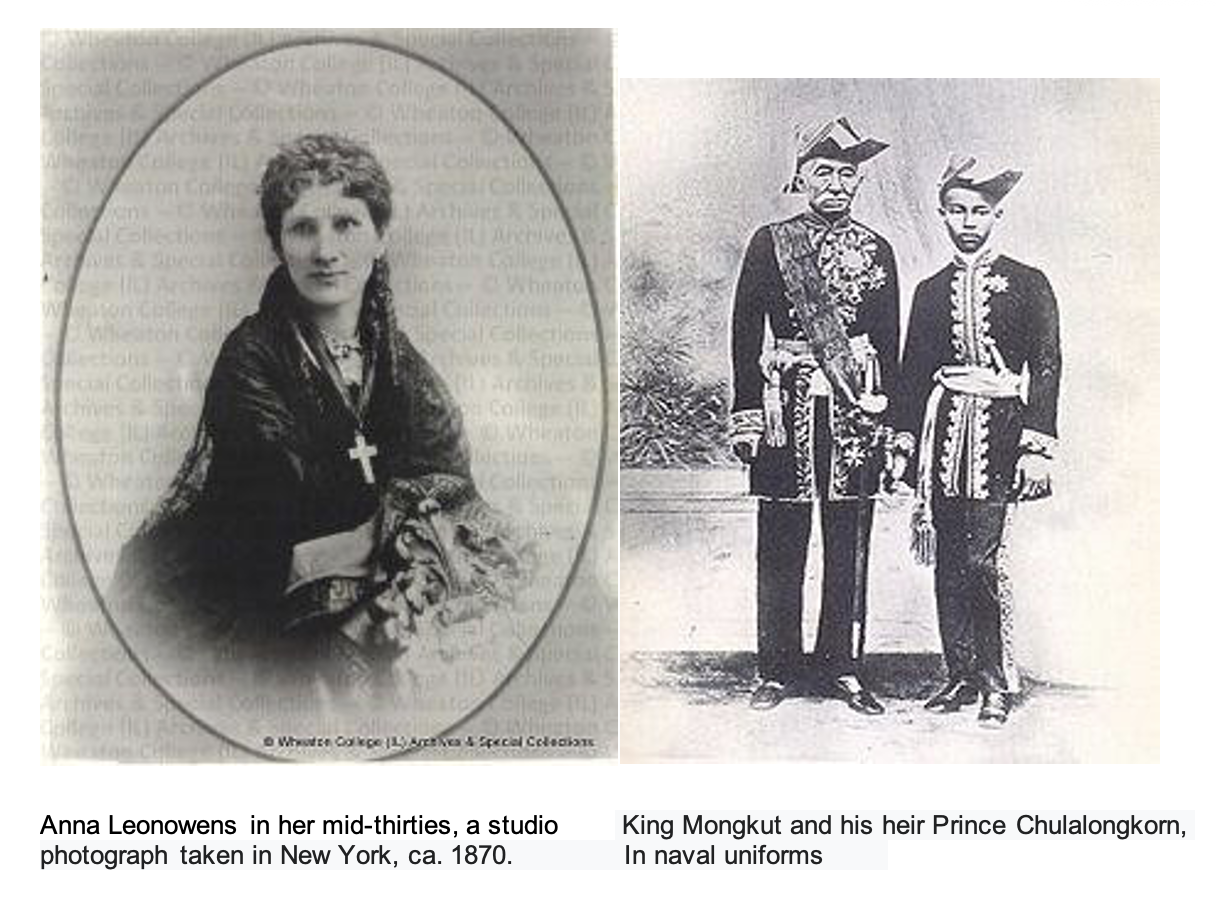
King Mongkut, now aged fifty-eight, had only been monarch for eleven years, his previous twenty-seven years having been spent as a celibate Buddhist monk. So he had a lot of catching up to do in his effort to create the largest royal family in Siamese history, eventually ending up with eighty-two children. Having started late, this meant that the oldest of the children were no more than ten or eleven years old, and prime amongst them was the heir apparent Prince Chulalongkorn, whom Anna found particularly biddable and prided herself on influencing, such that his reign saw the abolition of slavery in Siam for which Anna took some of the credit. Anna tells us that eventually twenty to twenty-five royal princes and princesses attended her lessons. She doesn’t give a figure for the number of wives and concubines who took up the king’s offer of a Western education. The impression Anna gives is that they attended sporadically and for social reasons, mainly to escape the supposed horrors of the harem or to bend Anna’s ear if they had some grievance to air in the hope that Anna would intercede on their behalf. The lonely and depressed would come along and Anna would often befriend these ‘sisters’ and arrange to see them on a one-to-one basis.
A luxurious consecrated temple with marble floors and gilded pillars within the women’s Inner Palace was made available as the schoolroom. The school was formally opened on a propitious Thursday with the king presenting each child in turn to Anna and then addressing the whole class: “Dear children, as this is to be an English school, you will have to learn and observe the English modes of salutation, conversation, and etiquette.”3 Notice that the king emphases orality and social appropriateness as the main goals of the English lessons, aims that would be at odds with Anna’s subsequent teaching methods which were literary and book-based – described by her as‘spell, read, and translate’.4 She was also a stickler for copperplate handwriting and an exercise might have to be copied out several times before she was happy with it. In this, as in many other matters, Anna knew best.
The king was quite an accomplished linguist and had firm ideas on language teaching based on his own experiences. Whilst a priest he had excelled as a scholar of Pali, the Sanskrit-based classical Indian language of Buddhist scripture. At the same time he had taken English and Latin lessons from both European Catholic and American Protestant missionaries, declaring that, in the case of English, his aim was to ‘communicate with English and American friends for knowledge of sciences & arts not for any least admiration or astonishment of vulgar religion’.5 The king prided himself on the correspondence in English he conducted with foreign dignitaries, in one instance even offering to provide the American president with pairs of breeding elephants to populate the Southern states, an offer politely turned down as impractical. As the reader will already have noted from his letter of appointment to Anna and his conversation with her, the king’s English was of a reasonably high standard, if somewhat eccentric. At all events, he had no trouble communicating his wants and his opinions. He was also a great linguistic pedant and quibbler, as Anna was often to complain:
More than once had we been aroused at dead of night by noisy female slaves, and dragged in hot haste and consternation to the Hall of Audience, only to find that his Majesty was, not at his last gasp, as we had feared, but simply bothered to find in Webster’s Dictionary some word that was to be found nowhere but in his own fertile brain […] Before my arrival in Bangkok it had been his not uncommon practice to send for a missionary at midnight, have him beguiled or abducted, and conveyed by boat to the palace, some miles up the river, to inquire if it would not be more elegant to write murky instead of obscure, or gloomily dark rather than not clearly apparent. And if the wretched man should venture his honest preference for the ordinary over the extraordinary form of expression, he was forthwith dismissed with irony, arrogance, or even insult, and without a word of apology for the rude invasion of his rest.6
The king had, says Anna, ‘Webster’s Unabridged on the brain - an exasperating form of king’s evil’. But the king’s fascination with and promotion of English was not a dilettante pursuit: it had a serious realpolitik edge to it, prompted by Western threats to Siamese independence. He was concerned about European imperialist designs in the region which had begun with British colonization of Burma and now manifested itself in French attempts to gain control of Cambodia, Siam’s client state. By showing himself to be an anglophile and a modernizing king, Mongkut was both assiduously courting English support against French excursions and forestalling the standard imperialist pretext for a take-over – that the kingdom was backward and corrupt. The king’s hiring of an English schoolmistress for his court was not a fashionable whim, but part of a grander design.7
Anna was not the first teacher of English the king had employed. Until shortly before Anna’s arrival the wives of American Protestant missionaries had been giving lessons in the palace, but the king had grown exasperated with their blatant proselytizing, hence his injunction to Anna in the letter of appointment that she is not to use her position ‘for conversion to Christianity; as the followers of Buddha are mostly ware of the powerfulness of truth and virtue, as well as the followers of Christ, and are desirous to have facility of English language and literature, more than new religions.’
Anna became aware of what her predecessors had been up to when, shortly after her arrival, she was given an audience with the king’s ‘child-wife’, who greeted her thus:
“I am very glad to see you. It is long time I not see. Why you come so late?” to all of which she evidently expected no reply. I tried baby-talk, in the hope of making my amiable sentiments intelligible to so infantile a creature, but in vain. Seeing me disappointed and embarrassed, she oddly sang a scrap of the Sunday-school hymn, “There is a Happy Land, far, far away”; and then said, “I think of you very often. In the beginning, God created the heavens and the earth.”8
It soon that the child-wife was mistaking Anna for her previous teacher, Mrs Mattoon.A pardonable error, since don’t all Western women look alike, especially if they are uniformly dressed in crinoline hooped skirts and bonnets? Later Anna was not averse to blatant Christian proselytizing of her own. We learn that women from the harem would bring their troubles to her, she would listen to their sad tales of sexual exploitation or neglect and console them with stories of Christian fortitude and with Bible readings. One, who had lost her position as the favourite of the harem came to Anna in a state of great depression and said she could not continue attending the English lessons. Anna comforted her and she was
persuaded gradually out of her grief. She learned in time to take pleasure in her English studies, and found comfort in the love of our Father in heaven. Without repining at her lot, hard as it was, or boasting of her knowledge, but with a loving, humble heart, she read and blessed the language that brought her nearer to a compassionate Saviour.9
Anna was clearly contravening one of the explicit conditions of her employment contract.
Anna taught ‘after the English manner’, i.e. as if she were teaching English as a first language to native speaker children, and her first lesson was a chanting of the English alphabet in unison. However, in time ‘the language of my pupils, its idioms and characteristic forms of expression, began to be familiar to me’ and she increasingly used Siamese for teacher talk and adopted double-translation (often of passages from the Bible) as one of her exercise-types – what she described as ‘our simple exercises of translating English into Siamese and Siamese into English’.10 Anna mentions only one set of textbooks that she used – ‘Webster’s far-famed spelling books’ – but subsequent study of some correspondence of the time reveals the order of twenty-four copies of McGuffey’s First Reader and twelve copies of Peter Parley’s Universal History, both American standards and probably recommended to Anna by her American missionary friends since the order was placed through the Presbyterians’ head office.11 There was also an order for thirty-six copies of Richard G. Parker’s Juvenile Philosophy, an introduction to scientific thinking. Alfred Habegger, Anna’s biographer, describes this book thus:
Intended to promote careful attention to the phenomena of daily life, the book consists of a series of Socratic mother-daughter conversations. Look in my eyes, Mother says, and tell me what you see. The child sees a large white part, a smaller blue circular part, and in the center “a little round place which looks very black.” Taking the girl to a dark corner, Mother asks if the black place looks any different. “It looks a little larger.” There are more questions and answers, followed by the aha moments. The iris has a color because it reflects light. The center is black because it doesn’t reflect light! Light bouncing off objects and entering the eye: that’s seeing! Other chapters consider color and light, evaporation and condensation, fire, heat, and wind. The book was a physics text without the math, prodding children to think in an abstract way about the physical processes they take for granted.12
As Habegger notes, given the king’s own scientific curiosity and the scientific teaching he had received from his missionary friends when he had been a monk, ‘Juvenile Philosophy was an excellent choice for Anna’s pupils’, but ‘regrettably, it isn’t known what use she made of her thirty-six copies’. The king, it should be noted, was a competent scientist in his own right: he had done the calculations which predicted a total solar eclipse for 18 August 1868 and had worked out the part of the Malay peninsula from which it could best be viewed:
Eager to show the world, the French especially, that his nation was as up-to-date as Europe, he set in motion a large expedition complete with elephants and royal wives and foreign scientists and a full complement of dignitaries, including his son Chulalongkorn and the kalahom [prime minister]. The latter hoped to convince his tradition-minded concubines that eclipses were not caused by some great beast swallowing the sun and that it wasn’t necessary to make a loud banging noise to ensure that the heavenly body would be safely disgorged.13
Anna devotes a chapter of The Romance of the Harem to her classroom activities and, in particular, to her efforts to overcome the superstitious and folkloristic explanations of the natural world which were entertained by her young pupils.14 She tells us that ‘the studies that took the most absolute possession of the fervid Eastern imaginations of my pupils were geography and astronomy’, and she describes her discussions with them on such topics as to whether Siam really was so much larger, relative to other countries, as their map showed it to be, or whether the earth was flat or square or round, or whether the moon was inhabited or not, or her attempts to convince them that there was such a thing as snow. There was one memorable lesson, however, in which Anna was almost persuaded of the force and beauty of Siamese superstition over the coldness of Western rationality. Here is Anna’s telling of the story of the serpent who dropped in for a lesson:
On another occasion, as we were all busily engaged in tracing the river Nile on an ancient map of Egypt, there fell suddenly from the vaulted roof above our heads, and upon the very centre of our chart on the table, a coil of something that looked at first like a beautiful thick silk cord neatly rolled up; in another instant, however, the coil unrolled itself, and began to move slowly away. I screamed, and fled to the extreme end of the temple. But what was my surprise to see all my pupils sitting calmly in their seats, with their hands folded in veneration and their eyes fixed in glowing admiration on the serpent as it moved in tortuous curves along the entire length of the table. With a blush of shame and a sense of inferiority I returned to my seat and watched with them the beautiful creature; a certain feeling of fascination dawned upon me as I looked into its clear, bright, penetrating eyes; the upper part was of a fine violet color, its sides covered with large scales of crimson edged with black; the abdominal parts were of a pale rose-color edged likewise with black; while the tail terminated in tints of a bluish ash of singular delicacy and beauty. As the snake slowly dragged itself to the end of the table I held my breath in terror, for it dropped on the arm of the chair on which the Prince Somdetch Choufa Chulalonkorn was seated, whence it fell on the floor, trailed itself along through the dim corridor and down the steps, and finally passed out of sight under the stone basement of the temple.
On the moment of its disappearance my pupils jumped up from their seats and clustered around me in the wildest joy, caressing me, and declaring that the gods loved me dearly, else they would not have sent me such an auspicious token in favor of my teaching. I was told that the gliding of the snake all over the table was full of happy omens, and that its dropping on the arm of the Prince's chair was an unmistakable sign that he would one day become famous in wisdom and knowledge. All the old and young women congratulated me, as did even the king himself, who, when he heard of the singular visitor we had had, caused the circumstance to be made known to the wise men and women of the court, and they all united in pronouncing it to be a wonderful and inspiring recognition of favor from on high. From this time I was treated with great consideration and respect by the simple-hearted women and mothers of the harem, but I nevertheless felt not a little uncomfortable for days after the sudden descent of the snake, and secretly hoped I might never again be so signally favored by the gods.
I afterwards learned that this snake has three names. In Sanskrit it is celebrated as the Sarpa Rakta, the red snake, who brings secret omens from the gods; in Pali, as the Naghalalvana, the crimson snake of the woods, who carries on his person in glowing letters the name of his great master; and in Siamese, Gnuthongdang, the crimson-bellied snake, who brings with its appearance all that is good and great to the beholder.
I leave it with my readers to decide which is the better, our inherited dread of and desire to destroy the serpent race, or the Siamese custom of idealizing, though with a certain superstitious reverence, the meanest of the works of nature.15
Lessons began immediately after Buddhist prayers in the school temple at nine in the morning. Anna had to be there in order to ‘muster my pupils together in good order’. Did some of them try to bunk off? We are told that attendance at class was irregular and that on some days only one pupil turned up.16 There were constant disruptions to teaching because of the frequent excursions, ceremonies and festivals the royal princes and princesses were required to participate in; one day, for example, lessons had to be cancelled for an exorcism. Then there were Anna’s frequent bouts of ill health – physical and emotional collapses sometimes lasting a month or more – brought on by the stress she felt herself under and the perils of her position.17 (She said that at times she was afraid for her life because of the malign influence she was said to have over the king, a fear which was completely unwarranted, but which was one of the factors precipitating her eventual departure from Siam.) After Anna had left Siam, Dan Bradley, a medical missionary who was close to the king and had earlier been one of his English teachers, wrote that because of ‘the almost daily breaks which the regal customs […] occasioned, in every plan and system of teaching she adopted, it was impossible for her to make really good scholars of any of her pupils’.18 In the summer of 1866, Anna’s health broke down again and she was obliged to apply for a leave of absence from which she never returned. Her account of her departure in July of the following year suggests it was almost a day of public mourning accompanied by a near riot. The king told her that ‘everyone is in affliction of your departure’ despite her being a ‘difficult woman, and more difficult than generality’. After the king had retired, ‘great was the uproar’:
What could I do, but stand still and submit to kisses, embraces, reproaches, from princesses and slaves? At last I rushed through the gate, the women screaming after me, “Come back!” and the children, “Don’t go!” I hurried to the residence of the heir apparent, to the most trying scene of all. His regret seemed too deep for words, and the few he did utter were very touching. Taking both my hands and laying his brow upon them, he said, after a long interval of silence, “Mam cha klap ma thort!” “Mam dear, come back, please!” “Keep a brave and true heart, my prince!” was all that I could say; and my last “God bless you!” was addressed to the royal palace of Siam.19
One might ask how successful a teacher Anna actually was. She came to Siam relatively untried, with less than two years’ teaching experience in Singapore and that with a handful of English-speaking children, not with foreign learners. It should be noted that Anna was far less experienced than the three missionary wives she replaced and had a far inferior education to them. One had graduated from Oberlin College and others, in addition to considerable experience in Siam, had worked as schoolteachers before marrying and coming to Siam.20 Anna takes all the credit for the excellence of her pupils’ English and for the changes in attitude wrought by their exposure, through her, to Western and Christian ideas, completely overlooking the work done by her predecessors and successors. Habegger is no great fan of Anna as a person, describing her as ‘mendacious to the bone’ and a character of ‘high-minded fraudulence’, but in his detailed and careful biography he had to concede that
all the evidence suggests that she was an effective teacher: authoritative, enthusiastic, affectionate, and remembered by pupils with real warmth. For Anna, guiding the young was not just a livelihood or path to fortune, it was an identity.21
And not just the children. ‘A central theme of her writing’, says Habegger, was her empathy with her older pupils, the pains she took with them, and ‘her pleasure in communing with Asian women across the barriers of language, culture, religion, ethnicity’.22 Clearly, Anna had a vocation for teaching and firm ideas on how to go about it based on an ambitious educational philosophy which saw the child as eminently malleable in the hands of a skilled teacher. Long after she had left Siam she gave a lecture in which she expressed some of these ideas:
The child is a bundle of potentialities, plastic as clay in the potter’s hand, ready to be moulded into whatever shape or form the parent, the teacher, the school and its environment may determine. […] From the moment a boy or girl begins to attend School, the powers, energies, and influence of the teacher will be strained at every point in order first to win the respect and confidence of the child and then to develop it in the right direction. […] Every act, every movement of the teacher is an object-lesson, the voice, the manner, the pronounciation [sic], the accent, the smile, the nod of the head, the wave of the hand, all these are distinct object-lessons which stamp themselves indelibly on the mental perceptions of the child.23
There is no doubt that Anna saw herself as some sort of mother-teacher, cared deeply for her pupils, and felt sincere and deep pity for ‘those ill-fated sisters of mine’, locked up in the harem and never to rejoice ‘in the freedom of the fields and woods’, and even more heart-felt grief for their children, brought up by unhappy mothers and taught, by the constraints and machinations of court life, to be cunning and duplicitous, having to grow up before their time in a corrupting environment from which are absent all
the endearments of childhood, – its merry laughter, its sparkling tears, its trustfulness, its artlessness, its engaging waywardness; and in their place instils silence, submission, self-constraint, suspicion, cunning, ever-vigilant fear. And the result is a spectacle of unnatural discipline simply appalling. The life of such a child is an egg-shell on an ocean; to its helpless speck of experience all horrors are possible. Its passing moment is its eternity; and that overwhelmed with terrors, real or imaginary, what is left but that poor little floating wreck, a child’s despair. 24
Fraudulent though Anna’s accounts are in many other respects, there is no denying the genuine anguish she expresses in choked, barely coherent passages such as this.
In addition to her star pupil, Prince Chulalongkorn, three of her other pupils stand out vividly in our memory, and Anna’s descriptions of them serve as a useful illustration of the slippery gradient extending from the verifiably true to the downright fictitious which characterizes her writing.
Firstly, seven-year-old Fa Ying, Anna’s ‘little angel’. She was the daughter of Mongkut’s queen, who had died in 1861 leaving four children, the eldest being heir-apparent Chulalongkorn. Fa Ying was ‘the king’s darling’, the favourite of the court, winsome, a charmer, and completely spoilt by everyone. One day, she settled herself on Anna’s lap:
“Will you teach me to draw?” said an irresistible young voice to me, as I sat at the school-room table, one bright afternoon. “It is so much more pleasant to sit by you than to go to my Sanskrit class. My Sanskrit teacher is not like my English teacher; she bends my hands back when I make mistakes. I don’t like Sanskrit. I like English. There are so many pretty pictures in your books. Will you take me to England with you, Mam cha? Pleaded the engaging little prattler.25
The king’s permission for this change of class having been given,
never did work seem more like pleasure than it did to me as I sat with this sweet, bright little princess, day after day, at the hour when all her brothers and sisters were at their Sanskrit, drawing herself, as the humour seized her, or watching me draw; but oftener listening, her large questioning eyes fixed upon my face, as step by step I led her out of the shadow-land of myth into the realm of the truth as it is in Christ Jesus. “The wisdom of this world is foolishness with God”; and I felt that this child of smiles and tears, all unbaptized and unblessed as she was, was nearer and dearer to her Father in heaven than to her father on earth.
The references to ‘unbaptized’ and ‘heaven’ give us a hint as to what is to follow. One day Anna receives an urgent summons to the palace from the king:
MY DEAR MAM,- Our well-beloved daughter, your favourite pupil, is attacked with cholera, and has earnest desire to see you, and is heard much to make frequent repetition of your name. I beg that you will favour her wish. I fear her illness is mortal, as there has been three deaths since morning. She is best beloved of my children. I am your afflicted friend,
S.S.P.P. MAHA MONGKUT
Anna rushes to the Palace but arrives too late. Fa Ying has gone the same way as those other young casualties of Victorian melodrama and had already ‘soared into the eternal, tender arms’ of Jesus, just as Little Nell had in The Old Curiosity Shop, or Little Eva in Uncle Tom’s Cabin, or Beth in Little Women. Anna can do no more than ‘imprint a parting kiss on the little face that had been so fair to me’, and then go to break the sad news to the king. The king’s reaction, as described by Anna, was curious: his tears were ‘strange and terrible’, welling up ‘from a heart from which all natural affections had seemed to be expelled, to make room for his own exacting, engrossing conceit of self’. There is a memorial ceremony in the schoolroom where Anna, in her white dress, has place of honour. She is required to sit on a red chair, freshly painted for the occasion (but not yet dry), whilst the king praises her for her ‘courage and conduct’ over Fa Ying’s death and confers a title of minor nobility on her – chao khun khruu yai (‘most noble high teacher’). Going with her title is a landed estate which, she later discovers, is in a far distant province and can only be reached ‘through a wild, dense jungle, on the back of an elephant’, so she was unable ever to take possession of it.26
A second pupil who stands out in Anna’s accounts is Son Klin, her closest friend and confidante in the palace. She is first encountered in The English Governess as ‘a pale, dejected woman, whose full name translated as “Hidden-Perfume”’. In some respects ‘child-like’, but ‘otherwise her expression and demeanour were anxious and aged’, Hidden-Perfume was one of the king’s concubines, but had long been out of favour. Anna had an ‘each-one-teach-one’ arrangement with her, whereby they met twice a week, Hidden-Perfume teaching Anna Siamese in exchange for Anna’s English lessons. Arriving for her lesson one day, Anna learns that Hidden-Perfume has been thrown into prison by the king. Anna contrives to visit her in the damp (‘slimy’) underground dungeon where she is languishing and learns the reason for her imprisonment. It appears there had been a misunderstanding: Hidden-Perfume had petitioned the king for an appointment for her brother without knowing that the post had already been granted to someone else; the king had been furious, accusing her of trying to undermine his power and had issued an order that she be chained and imprisoned, flogged, followed by the instruction to “beat her on the mouth for lying.” On hearing this, Anna immediately went to the Prime Minister to complain about the unjust punishment meted out to her pupil. The following week, as a result of Anna’s intercession, Hidden-Perfume was released and their lessons together continued as before. In The Romance of the Harem we encounter Hidden-Perfume again and we learn of the religious discussions the two have, especially their recognition of the common features of Buddhism and Christianity. Hidden-Perfume is much taken with the Sermon on the Mount and also with Uncle Tom’s Cabin, a copy of which Anna has gifted her. On the occasions when they couldn’t meet because of Anna’s illnesses (‘which confined me a month or more to my room’) she would receive affectionate letters from her friend signed ‘Harriet Beecher Stowe’. One day in early January 1867, not long before Anna’s final departure from Siam, she received an invitation to a formal dinner at Hidden-Perfume’s residence. After the dinner all Hidden-Perfume’s slave women and their children, a hundred and thirty-two of them, appeared in a group, ‘in nice new dresses, all looking particularly happy’, and Anna’s hostess announced to her assembled guests:
“I am wishful to be good like Harriet Beecher Stowe […] and never to buy human bodies again, but only to let go free once more, and so I have now no more slaves, but hired servants. I have given freedom to all of my slaves to go or to stay with me as they wish. If they go away to their homes, I am glad; if they stay with me, I am still more glad; and I will give them each four ticals every month after this day, with their food and clothes.”
Though Anna acknowledges that the credit for this wholesale manumission must go to the American writer, she nonetheless privately congratulates herself for the small part she herself has played in bringing it about.27
By far the most sensational of the episodes concerning her pupils is the story of Tuptim. Anna devotes three chapters of The Romance of the Harem to the telling of it,28 and it provides one of the climaxes to the filmed versions, being treated as the catalyst for Anna’s decision to leave Siam in complete disgust at the king’s barbarity and cruelty. Tuptim had been a simple worker on a building site when she had attracted the king’s attention and shortly afterwards had been kindly gifted to him as a concubine, quickly becoming the king’s favourite. She started attending the English classes:
She wanted to learn to write her name in English, she said, and she came to me once or twice a week until she had acquired that accomplishment, which seemed to give her immense satisfaction. After she had done this, she asked me if I would write the name “Khoon P’hra Bâlât” for her in English. I wrote it for her at once, without asking her why she wanted it or whose name it was. I did not even know if it was the name of a man or a woman, as the Siamese have no masculine and feminine terminations to their names and titles. She immediately began to trace the letters for herself, and I could see a world of tenderness in her large dreamy eyes as she copied and recopied the name in its English characters. I cannot rightly remember how often or how long she came to the school, for she was but one among many; but, whenever she found me engaged with the princes and princesses, she would sit for hours on the marble floor, and listen to our simple exercises of translating English into Siamese or Siamese into English, with increasing interest and delight expressed in her pure, guileless face.
Anna regretted the unwitting part that it turned out she had played in Tuptim’s subsequent tragedy and regretted that she never attempted to have a conversation with her or to learn anything about her history or her feelings: ‘If I had done this, I might have succeeded in winning her confidence and perhaps have been the means of reconciling her to her life in the palace. That I did not, will ever be a source of poignant regret to me.’
Tuptim stopped attending lessons and Anna forgot all about her. Some nine months later Anna was accosted by a young woman who said she was Tuptim’s slave-girl and that her mistress was imprisoned in one of the palace dungeons. Would Anna visit and see if she could help her? No one would say what crime she had committed, but when she went to the palace she saw Tuptim being escorted to her trial:
I was stupefied at the transformation that had been wrought in the Tuptim I had known. Her hair was cut close to her head, and her eyebrows had been shaved off. Her cheeks were hollow and sunken. Her eyes were cast down. Her hands were manacled, and her bare little feet could hardly drag along the heavy chains that were fastened to her ankles. […] The Amazons laid before the judges some priests’ garments and a small amulet attached to a piece of yellow cord. The vestments, such as are worn by a nain (young priest), were those in which Tuptim had been arrested, and in which she had probably escaped from the palace; the amulet, in appearance like those worn by all the natives of the country, had been taken from her neck. On opening the yellow silk which formed the envelope of the latter, a piece of paper was found stitched inside, with English letters written thereon. Khoon Thow App [the chief judge] was sufficiently versed in English to spell out and read aloud the name of “Khoon P’hra Bâlât.”
Tuptim admitted to dressing herself as a monk and tagging on to a group of monks who were leaving the palace after prayers. On arrival at the monastery she had begged to be admitted as a novice and, quite serendipitously, was put under the charge of the afore-mentioned P’hra Bâlât: “Then P’hra Bâlât took me to his cell; but he did not recognize in the young priest I seemed to be the Tuptim he had known in his boyhood, and who had once been his betrothed wife.” Tuptim stuck determinedly to this highly unlikely story and to her insistence on P’hra Bâlât’s complete innocence. At this point in Tuptim’s recital, the women, quite understandably, ‘held up their hands in profound astonishment, and the men judges grinned maliciously, displaying their hateful gums red with the juice of the betel nut.’ Unfortunately, one Sunday, having overslept and thinking she was alone in the cell, she was surprised by two priests coming in unexpectedly who were highly amused to see her ‘arranging her dress’. The game was up:
“Just then P’hra Bâlât and his other disciples returned from their morning ablutions. I crawled to his feet, and told him that I was Tuptim. He started back and recoiled to the end of the cell, as if the very earth had quaked beneath him, leaving me prostrate and overwhelmed with horror at what I had done. In a moment afterwards he came back to me, and, while weeping bitterly himself, begged me that I would cry no more. But the sight of his tears, and the grief in my heart, made me feel as if I were being swallowed up in a great black abyss, and I could not help crying more and more. Then he tried to soothe me, and said, ‘Alas, Tuptim, thou hast committed a great sin. But fear not. We are innocent; and for the sake of the great love thou hast shown to me, I am ready to suffer even unto death for thee.’ This is the whole truth. Indeed, indeed, it is!”
Tuptim sticks to her story, so the judge orders her to be stripped and given thirty lashes. P’hra Bâlât is now brought in on a stretcher, mutilated after prolonged torture, in the expectation that seeing Tuptim herself being tortured would induce him to confess his guilt. As the first blow falls on Tuptim’s ‘bare and delicate shoulders’, Anna leaps up and tells them that, if they fear for their lives, they should desist forthwith. She will go immediately and intercede with the king.
The king listens to her petition and agrees to commute the likely death sentence to one of hard labour; then duplicitously he goes back on his word. The pair are to be burnt alive and, to teach Anna a lesson for her interference, the execution is to take place directly outside her window. Anna describes the whole ceremony of the torture and preparation for the execution in great detail until she gets to Tuptim’s calm last words, and then she faints. When she awakens several hours later, the spectacle is over, the scaffolds removed and the crowd dispersed. It was prolonged, lurid and prurient descriptions such as these that induced the Scottish historian Ian Grimble, in an article in Time Magazine in 1970, to describe Anna as ‘one of those awful little English governesses, a sex-starved widow’ whose books were ‘pornographic […] rubbish […] the sort of books that Calvinists read beneath the bedcovers’.29
In her Preface to The English Governess, Anna insisted on the complete truthfulness of her stories: ‘In the following pages I have tried to give a full and faithful account of the scenes and the characters that were gradually unfolded to me as I began to understand the language, and by all other means to attain a clearer insight into the secret life of the court.’ However, in her Preface to The Romance of the Harem, she somewhat hedged this claim and admitted sometimes inhabiting the stories of others:
"Truth is often stranger than fiction," but so strange will some of the occurrences related in the following pages appear to Western readers, that I deem it necessary to state that they are also true. Most of the stories, incidents, and characters are known to me personally to be real, while of such narratives as I received from others I can say that "I tell the tale as it was told to me," and written down by me at the time. In some cases I have substituted fictitious for real names, in order to shield from what might be undesired publicity persons still living.
Charitably, one might refer to the early generic convention for the most outrageous stories (for example, Horace Walpole’s gothic novel The Castle of Otranto) to be prefaced by a protestation that what is to follow is completely truthful. The stories concerning her three students outlined above indeed have elements which are ‘stranger than fiction’ and we might consider some of the ways in which Anna embellished her descriptions, sensationalized them, and even indulged in brazen fraudulent inventions. The reader will immediately recognize the two parts of Fa Ying’s story as genre pieces, familiar from Victorian literature: firstly, the teacher as surrogate mother to an orphaned child who has an egotistical father lacking all ‘natural affection’, and then the heart-wrenching deathbed scene of a young child. However, the story does have a basis in fact. Fa Ying did die and the king wrote a lengthy memorial to her in English which was widely distributed amongst foreign dignitaries and published in the Straits Times, and which Anna quoted from extensively in her account. In this the king describes at some length Fa Ying’s education and her linguistic precocity, but there is no mention of drawing or Sanskrit, and one must assume that this part of the account is an embellishment or invention on Anna’s part. Another problem is that Anna wrote two accounts of the deathbed scene. A second version which she sold to the journal Youth’s Companion in 1881, eleven years after the publication of The English Governess, tells a different story; in this she describes her tender deathbed parting with the little princess:
With breaking heart and eyes overflowing with tears, I crept near to the little dying princess’ bed; she opened her eyes, put out her arms. I clasped her close to my breast; she nestled closer, then became very still. When I looked again my darling was dead.30
Which account, if either, are we to believe? Rather too often there are considerable disparities between Anna’s accounts of events in her books and her accounts of the same events in the long series of articles she later published in America. But the strangest part of the story is her description of the king’s reaction to Fa Ying’s death, suggesting that he shed crocodile tears ‘from a heart from which all natural affections had seemed to be expelled, to make room for his own exacting, engrossing conceit of self’. This is completely contrary to all contemporary accounts of the sincere affection the king had for all his children, his delight in their company, and, in Fa Ying’s case, the special treatment she had received from him. In his encomium for his daughter, Mongkut described how, before Fa Ying was weaned, he had himself fed her‘with milk obtained from her nurse, and sometimes with the milk of the cow, goat &c. poured in a teacup from which His Majesty fed her by means of a spoon, so this Royal daughter was as familiar with her father in her infancy as with her nurses.’
This is hardly the behaviour of a cold, distant and self-engrossed father. Habegger speculates that, in her harsh judgement, Anna was projecting her lack of natural affection towards her own family onto the king. She had not only lost her own first two children and had apparently quickly got over their loss, but she had broken with all members of her family, including, within a year of Fa Ying’s death, her sister Eliza. Habegger asks: ‘When she excoriated Mongkut for egotism and a lack of family feeling, was she writing about herself without knowing it?’31 There are other places in Anna’s accounts where psychological projection might be suspected, as in the case of Tuptim’s execution, where Tuptim’s fate can plausibly be interpreted as a metaphoric projection of Anna’s own. Of course, Anna had various reasons, some religious and doctrinal and others inspired by her Orientalism, for the generally unflattering picture she presents of King Mongkut and it is sometimes hard to disentangle all the possible motivations for her mendacity, and one can only speculate as to whether they are conscious and cynical distortions or unconscious and reflex, or a mixture of the two.
The story of Son Klin likewise has a basis in fact but it too is full of distortions and half-truths. There is still in existence a letter from the king to Anna indicating that Son Klin had displeased him and had been imprisoned but that Anna had interceded with the Prime Minister and obtained her release. However, Son Klin had certainly not been incarcerated in a slimy underground dungeon since these did not exist in the palace, nor could they because they would have been below the water level. It is more likely that Son Klin had been put under house arrest. A major flaw in Anna’s account of her friendship with Son Klin is her intimation that it was she who had taught Son Klin her English, beginning with the alphabet, and had then introduced her to Christian teaching and the solace that this provided. But the truth is that Son Klin had already been studying with Mrs Mattoon and the two other missionary wives for about ten years before Anna appeared on the scene, and had been one of those selected to welcome and entertain Anna on her arrival in Bangkok on account of the excellence of her English and her high status at court. She was far from being the subdued wretch grovelling on the marble floor as portrayed by Anna – a woman ‘so dejected and forlorn, so hopeless and timid’ that she took hold of Anna’s feet and ‘embraced them in a transport of delight’ when Anna promised to teach her English. Moreover, Son Klin’s familiarity with the Bible long preceded Anna’s arrival in Siam. It is true that some two dozen letters that Son Klin wrote to Anna signed ‘Harriet Beecher Stowe’ still exist which corroborate part of Anna’s account, but the operatic tableau of the wholesale manumission of over a hundred slaves is too much of a carefully constructed set-piece to be credible. Moreover, it is based on a complete misunderstanding of the Siamese system of slavery, to which Anna misleadingly gave some of the characteristics of the slavery system of the American Deep South, especially her portrayal of slaves as chattels over whom the master had power of life and death and who are bought and sold in the market place, the price for women dependant on their age and physical attraction.32
If Anna’s telling of the stories of Fa Ying and Son Klin involved a considerable degree of sensationalizing and bending of the truth, her account of the tragedy of Tuptim is a complete fabrication. The reader is probably suspicious of it anyway, given its literary ‘completeness’ and Anna’s total omniscience, being privy to every detail of the story and reproducing verbatim accounts of all dialogues and the court proceedings. There is also the sheer improbability of a woman disguising herself as a monk and escaping deception for so long within a monastery and in the company of a monk who had once been her fiancé, clearly a literary device borrowed from the Victorian ‘sensation novel’. Also, since Tuptim’s final torture and then her execution took place in public, one would expect that there would be some record of it amongst Siamese court records. One would also expect it to figure in newspaper stories, travellers’ accounts, and in the memoirs, reports and letters of Western missionaries and of other local residents. But there is absolutely no mention of any event even vaguely resembling that described by Anna. Habegger concludes that
it appears that the story of Tuptim was based on hearsay that was fleshed out by the author’s memory and imagination and the drama’s intrinsic demands. […] Essentially, she had three sources: a credible rumour that attractive Bangkok girls had formerly been snatched up by nobles; the execution of a royal concubine and her admirer during the Third Reign; and a bad translation of a purported Thai song about a philandering monk burned at the stake. […] Tellingly, all three dated from the Third Reign. None had anything to do with Mongkut.33
The ‘purported Thai song’ came from an English traveller’s narrative of a visit to Bangkok, one stanza of which he translated in comic-pathetic Gilbert and Sullivan style as
Behold the faggots blaze up high
The smoke is black and dense;
The sinews burst, and crack, and fly:
Oh suffering intense!34
Anna had turned a traditional folk song, jauntily translated into English by someone passing through Siam, into a solid contemporary fact.
Regarding the king’s supposed and uncharacteristic duplicity in going back on his undertaking to spare Tuptim’s life and Anna’s general portrayal of him as a shifty character, Habegger, following a study by Chu-Chueh Cheng,35 sees an unconscious projection of Anna’s true self onto the king: ‘The longer she worked for Mongkut, the more she made him the carrier of the shiftiness within herself that she could never acknowledge’.36 Alternatively, it might be seen as an example of the ‘good boy, bad boy’ dynamic as described by the psychologist Valeria Ugazio, whereby the king becomes more evil as Anna’s account progresses so that she can become more virtuous: ‘As he became more wicked, she became more pure, heroic, truthful and devoted to her sisters in subjection […] in stories that became less and less trustworthy’.37 It was a godsend to Anna that the king died shortly after her departure from Bangkok, so that her published accounts would not be challenged by him, as they certainly would have been; the king was very conscious of his international image and a great reader of the foreign press. Anna’s general presentation of him is of a hypocrite and a Jekyll and Hyde character whose true nature only she was aware of from her privileged position of access both to the women of the harem and access to the king in his private quarters where she would assist him with his international correspondence. In this, it is again plausible to see an unconscious projection of herself. According to Anna, to the outside world King Mongkut appeared
to rule with wisdom, to consult the welfare of his subjects, to be concerned for the integrity of justice and the purity of manners and conversation in his own court, and careful, by a prudent administration, to confirm his power at home and his prestige abroad. Considered apart from his domestic relations, he was, in many respects, an able and virtuous ruler. His foreign policy was liberal; he extended toleration to all religious sects; he expended a generous portion of his revenues in public improvements, - monasteries, temples, bazaars, canals, bridges, arose at his bidding on every side, and though he fell short of his early promise, he did much to improve the condition of his subjects. […] But as husband and kinsman his character assumes a most revolting aspect. Envious, revengeful, subtle, he was as fickle and petulant as he was suspicious and cruel. His brother, even the offspring of his brother, became to him objects of jealousy, if not of hatred. Their friends, must he thought, be his enemies, and applause bestowed upon them was odious to his soul. There were many horrid tragedies in his harem in which he enacted the part of a barbarian and a despot. Plainly, his conduct as the head of a great family to whom his will was a law of terror reflects abiding disgrace upon his name. Yet he had this redeeming feature, that he tenderly loved those of his children whose mothers had been agreeable to him.38
As we shall shortly see when we examine Anna’s CV, this dual nature that she perceived in the king mirrored her own, for the persona she presented to the outside world of being a lady, a member of the gentry and a distinguished Orientalist was far from being her true self, which had to be kept well hidden from view.
In my demonstration of Anna’s untrustworthiness as a narrator I have restricted myself to the stories which concern three of her pupils. To have picked out all the exaggerations, embellishments, half-truths, evasions, deceptions and frauds would have been an immense undertaking which not even Habegger’s lengthy and detailed study attempted. I have made no mention of some of the most egregious of these, for example her prurient tales of the sadistic treatment meted out to the runaway slave La-aw, or of Anna’s part in the fabulous escape of the Princess of Chiang Mai from her dungeon in the palace which ended with the princess’s slave loyally taking her place in the dungeon and then cutting out her tongue so as to remain mum as to how it had all been accomplished. Nor have I referred to such groundless assertions as the one that slaves were sacrificially executed to provide ‘guardian angels’ for new construction projects, or that
Siamese citizens of wealth and influence often bury treasure in the earth, to save it from arbitrary confiscation. In such cases a slave is generally immolated on the spot, to make a guardian genius.39
Another tall story, completely fictitious, involved Anna’s secretarial duties for the king. She relates how she had to deal with numerous applications from French demoiselles, offering themselves for membership into the king’s harem; concurrently, she tells us, the king had agents around the world in search of ‘an English woman of beauty and good parentage to crown [his] sensational collection’ - ‘but when I took my leave of Bangkok, in 1868 [sic], the coveted specimen had not yet appeared in the market’.40 Anna’s intention in these fraudulent assertions is transparent enough: to emphasize the king’s lasciviousness and to underline the superiority of English morals over the French. Fortunately, the king’s communications with his agents are open to inspection and reveal no such instructions, which anyway would have been completely out of character: the king was unusually uxorious and the great majority of his concubines were not purchased by him to satisfy the insatiable sexual appetite which Anna attributes to him, but were customary gifts from noble families of their daughters in the expectation of having some representation and influence at court; most of these gifts the king had received on the occasion of his accession to the throne, and life at court was considered by the young women as a privilege which carried considerable prestige. It is not improbable that the king viewed sexual intercourse with his concubines as a form of ‘king’s evil’, a distasteful royal obligation, rather like Queen Anne having to lay hands on the heads of queues of scrofulous petitioners. If Mongkut had any addiction it was bibliophilic rather than sexual.
Anna’s portrayal of life in the harem as one of loneliness, despair, sadistic and arbitrary punishments, and of general sexual depravity was completely wide of the mark: the so-called ‘harem’ was in fact a bustling ‘women’s city’ with some three thousand inhabitants in which the aristocratic ‘concubines’ had private residences where they lived surrounded by relatives and retinues of servants41 - a far cry indeed from the popular image of naked odalisques lounging in voluptuous nonchalance within the dimly lit and perfumed harem in expectation of the sultan’s arrival, as depicted in the popular genre paintings of Ingres. Far from being a sex prison in which the women were confined for life with any attempt at escape resulting in summary execution, Mongkut had decreed, six years before Anna’s arrival, that slaves such as concubines, chaperones, maids-in-waiting, and dancers were free to resign their positions and return to the outside world if they so wished, the only exception being for concubines who had royal children. Many chose not to leave as they preferred the privileged and safe world of the women’s city to the uncertainties and dangers of the outside world.42 But Anna failed to mention uncomfortable facts such as these, but instead exploited the clichés of popular imagination in her fabrications. These her American and European audiences lapped up, both because they had been conditioned to do so and knew no better, and because their prurience required it.
However, when the Western inhabitants of Bangkok first read Anna’s accounts of her experiences, they treated them with complete incredulity, even contempt. The country’s leading journalist, Samuel Jones Smith, said that he admired their ‘overwrought artistic colourings’ and speculated as to whether her accounts were meant to be ironic. When The Romance of the Harem followed, Smith wrote a review describing it as surpassing ‘its predecessor in sensationalism and incredibility’, and roundly stated that nothing in the book was believable, not even those parts ‘for which the authoress vouches on her own experiences’. The London and China Express, in its review, found ‘evidence of so much exaggeration – if not sheer invention – about these hearsay narratives’ and dismissed the book as a worthless confection, stating that it was ‘altogether inconceivable’ that ‘an Englishwoman could […] endure for any length of time the horrors of such a pandemonium’ as The Romance of the Harem described.43
So the question was raised as to what sort of Englishwoman would put up with the scandalous conditions Anna so sensationally described and what sort of woman could bring herself to write these two unpleasant and deeply disturbing books. We have already suggested possible psychological explanations for some aspects of Anna’s mendacity. It now remains to look more closely at who she really was. In a publicity hand-out provided by the agency which organized her lecture tours in America after she had left Siam, her potted biography states:
Anna Harriette Leonowens was born in Caernarvon in Wales, in the old homestead of an ancient Welsh family named Edwards. The youngest daughter of the house (mother of Mrs. Leonowens) accompanied her husband, Thomas Maxwell Crawford, to India, while their daughter was left in charge of an eminent Welsh lady (Mrs. Wallpole), to be educated in Wales.44
A recital of painful events followed: her father’s death in the ‘Sikh Rebellion’ and her widowed mother’s marriage to a domestic tyrant; then, at age 15, she had travelled out to India where she found her hostile stepfather implacably opposed to the British officer she loved; she had been sent on a long tour of the Middle East in the hope she would forget her sweetheart but, on her return, insisted on marrying him; this was followed by the death of two children and of her husband following a tiger hunt, and then the loss of family in the ‘heart-rending calamities’ of the Indian Mutiny; finally, her inheritance mysteriously disappeared, and she was forced to fend for herself, enduring ‘pain and torture’ in Siam.
In this biographical puff there is only one true fact – Anna did lose two children before the birth of Avis and Louis – but the rest is complete fabrication. Anna was not born in Caernarvon – much to the distress of that royal town when the truth finally came out, for they had long been celebrating her as its most famous citizen – but in India to a Eurasian mother and a father who was a sergeant in the army, not a captain as Anna claimed. The father had died before her birth, and her step-father was not an officer either, but a corporal, later demoted to a private. She had been educated, not by a governess in Wales, but in Bombay in a Protestant charity institution which took in mixed-race children whose white military fathers were either dead or absent and which trained its pupils for lives of humble Christian “usefulness”. Anna’s husband, Thomas Leon Owens, had been a paymaster sergeant in the army, not a major, and he had died, not as the result of heatstroke after a tiger hunt, but of apoplexy. There had never been an inheritance and none of Anna’s family had died in any of the Indian rebellions. It is very doubtful if the Middle Eastern trip, which formed the basis for her claim that she was a trained Orientalist, ever took place, or if it did it was of very short duration, perhaps only several months and not, as was claimed, three years.45
The fact that Anna had to resort to these porkies was, of course, an effect of the prejudices of the time. Governesses were supposed to be ladies. The British residents in Bangkok probably saw Anna for what she was since there is no talk of her socializing with them, only with the colour-blind American missionaries. And it was no accident, that on leaving Siam, she chose to settle in America, where she was less likely to be unmasked – Habegger’s study is deftly entitled Masked – rather than in England, where she would have had little chance of finding the kind of employment she was best suited to. Instead, Anna’s friendship with the Mattoons in Siam gave her entrance to a circle of patrician and idealistic New Englanders, staunch abolitionists, Quakers and evangelical Christians, who helped her find her feet in America and encouraged and aided her subsequent successful career as a teacher, lecturer and writer. This is when we see Anna in the only photograph we have of her (other than one taken in old age), ostentatiously wearing an outsize wooden crucifix around her neck.
When did Anna’s fabrications begin? Probably, like most successful frauds, over the years and bit by bit. She would probably have got her position in Siam without recourse to her bogus background, but once there she had an ambiguous and uneasy status – ‘a social inferior and a racial superior’, says Cheng46 – and so it was imperative to minimize any social inferiority and to hide any trace of a lack of racial superiority. She played the part of an English lady with aplomb, perfecting a superior peremptory manner. Anna had learnt from her first meetings with the prime minister and then with the king that the Siamese were inquisitive people: they had immediately quizzed her on her age, number of children, husband, and so on, an inquisition which figures prominently in the various film versions as a gross impertinence. But this was a Siamese form of politeness and a show of interest which Anna misinterpreted as unwarranted nosiness.So it early became apparent to Anna that it was necessary for her to have a convincing backstory and the posh one she had concocted which included a father and a husband who had been British army officers certainly did no great harm to her standing at court, her darker than normal complexion being plausibly attributed to life in the Tropics.
Anna’s fake biography was, in a way, understandable and attributable to the prejudices of the age and perhaps we shouldn’t make too much of it, but that still leaves unanswered the question as to why she indulged in the wholesale fabrications of much else in her two books. There are a number of possible explanations, not necessarily mutually exclusive. One is that she was a complete fantasist who lived in a different world to other people, perhaps even the sort of person who also unconsciously steals other people’s stories and memories and makes them her own (there is a wonderful short story by Tove Jansson about such a person47). I have some sympathy with this type of explanation since I have known people like this; they tend to flourish and to be tolerated in remote and unfashionable expatriate TEFLing settings, troubled souls who would find it hard to hold down a job anywhere else. But on reflection these people tend to be innocents and lacking in any malice. Anna’s deceptions were of a different order, being calculated and exuding bad faith. She had deep-rooted prejudices which she had to express, despite any evidence which might undermine them, and she had an audience to pander to who shared her prejudices. Prominent amongst these prejudices was a visceral distaste for polygamy and for the casual approach to sex of the Siamese.48 And so she concocted stories of cruelty, neglect, depression, arbitrary punishments and untrammelled sexual license to demonstrate the pervasiveness and wrongness of these habits. This was but one feature of the over-arching Orientalist image of Siamese life that she presented to her willing public.
So far, I have been using ‘Orientalist’ in two completely different senses and it is time to disambiguate the term. One sense, the neutral one, denotes a scholarly and scientific expert on Oriental peoples, cultures, and languages, usually a university- based academic who has devoted their life to writing books on the subject. This is the sense in which the term is used in, for example, Robert Irwin’s study of the great European Orientalists.49 Anna claimed to be one such on the basis of her three-year trip to the Middle East with the Reverend George Badger and his wife and as a result of her subsequent intensive study of Eastern languages. By the time she arrived in Siam, playing the part of the intrepid Victorian lady traveller, she claimed to be proficient in Arabic, Persian, Sanskrit and Hindi, and she brought along with her, so she tells us, a retainer called Monshee as her travelling informant on Persian and other languages. Margaret Landon, whose biography-cum-novel started the twentieth century craze for Anna, was the first to note that Anna’s three-year trip to the Middle East was an impossibility as there simply weren’t enough years in her biography to accommodate it. Accordingly, in her book Landon reduced the length of the trip to one year; some subsequent researchers allow only a few months for it, others doubt whether it took place at all. The Reverend George Badger and his wife certainly existed, made trips such as the one described, and they knew Anna well and were kind to her, but the probability is that she did no more than listen intently to their stories and steal them for her own. There is similar doubt about whether there was ever a ‘Monshee’ or if he is simply a device for some comic effects – he is forever getting into scrapes, being beaten up for failing to be sufficiently obsequious to Siamese worthies or for blundering into the harem. Regarding her mastery of exotic languages, Anna also tells us that she picked up Siamese fairly rapidly, thus making it possible to converse with the women of the harem and to use translation as one of her teaching tools. But readers of her books who know Siamese often find it hard to make sense of her frequent transliterations of Siamese words, phrases and sentences, and this casts some doubt on her claim that she was proficient in Siamese. For some reason Anna doesn’t mention Gujarati, the probable native tongue of her mother, as one of her many languages.
The loaded and partisan sense of the term, on the other hand, is that developed by Edward Said in his provocative study, Orientalism (1978). This sees Orientalism as a ‘structure of lies and myths’ by which the West seeks to ‘other’ the Orient in order to dominate, restructure and have authority over it. Amongst the attributes that the nineteenth century Orientalist characteristically ascribed to the East were, according to Said’s abundant quotations from contemporary sources, despotism, irrationality, gullibility, depravity, childlikeness, being much given to fulsome flattery, sexual excess, lack of energy and initiative, intrigue, cunning, cruelty, duplicity, and even – from the pens of such noted Orientalists as Nerval, Flaubert, Swinburne and Baudelaire – ‘the cultivation of sadomasochistic tastes’ anda ‘fascination with the macabre’. Writers and artists who simply luxuriated in and sated themselves and their willing audiences with the exoticism of the East probably did little actual harm but, in the hands of politicians and Empire builders, Orientalism was exploited as a vindication of Western colonization, which would rescue the Orient from backwardness and depravity. In its mildest forms, Orientalism provided Western audiences with settings and situations for imaginative escape and vicarious gratification for their somewhat questionable unconscious urges; at its most egregious, Orientalism was a pretext for meddling, exploitation and plunder. Said’s exposition portrays the ‘Orient’ as a Eurocentric mythic construct, representing the opposite of all the values the ‘West’ stood for, and one which ‘helped to define Europe (or the West) as its contrasting image, idea, personality, experience’.50
Said provides a telling quote, which one might, with equal justice, apply to Anna; Stendhal is excoriating Chateaubriand for his ‘stinking egotism’, which accounts for his complete failure to be a knowledgeable traveller:
He brought a heavy load of personal objectives and suppositions to the Orient, unloaded them there, and proceeded thereafter to push people, places, and ideas around in the Orient as if nothing could resist his imperious imagination.51
Said nowhere refers to Anna but he could well have taken her two books as classic expressions of nineteenth century Orientalism. Her descriptive writing is full of cultural misunderstandings and the experiences she relates, especially her dealings with the king, are one social blunder after another, of which she is blithely unaware. She is a great stereotyper; of the Siamese she says: ‘In common with most of the Asiatic races, they are apt to be indolent, improvident, greedy, intemperate, servile, cruel, vain, inquisitive, superstitious, and cowardly’, though sheis gracious enough to acknowledge that ‘individual variations from the more repulsive types are happily not rare’.52 Nor does she think much of the Siamese language, which lacks the idiomatic and metaphoric richness of English and, sin of all sins for an English teacher, it can be spelt however one wishes:
The language of this people advances but slowly in the direction of grammatical perfection. Like many other Oriental tongues, it was at first purely monosyllabic; but as the Pali or Sanskrit has been liberally engrafted on it, polysyllabic words have been formed. Its pronouns and particles are peculiar, its idioms few and simple, its metaphors very obvious. It is copious to redundancy in terms expressive of royalty, rank, dignity – in fact, a distinct phraseology is required in addressing personages of exalted station; repetitions of word and phrase are affected, rather than shunned. Sententious brevity and simplicity of expression belong to the pure spirit of the language, and when employed impart to it much dignity and beauty, but there is no standard of orthography, nor any grammar, and but few rules of universal application. Every Siamese writer spells to please himself, and the purism of one is the slang or gibberish of another.53
Denigration of Eastern languages, when compared with English or any of the other European languages, is one of the standard tropes of Orientalism. Anna seems to be equating ‘civilized’ languages with those which have polysyllabic lexicons and Siamese is not quite there yet. Anna is certainly an expert on these matters since her own writing is wonderfully involuted, polysyllabic, and replete with Virgilian tags and the felicitous insertion of the occasional French mot juste. For example, of King Mongkut she says:
He was more systematically educated, and a more capacious devourer of books and news, than perhaps any man of equal rank in our day. But much learning had made him morally mad; his extensive reading had engendered in his mind an extreme scepticism concerning all existing religious systems. In inborn integrity and steadfast principle he had no faith whatever. He sincerely believed that every man strove to compass his own ends, per fas et nefas. The mens sibi conscia recti was to him an hallucination, for which he entertained profound contempt; and he honestly pitied the delusion that pinned its faith on human truth and virtue. He was a provoking mélange of antiquarian attainments and modern scepticism. When, sometimes, I ventured to disabuse his mind of his darling scorn for motive and responsibility, I had the mortification to discover that I had but helped him to an argument against myself …54
Could this have been said in Siamese? Surely not. No wonder the English language, in the manner in which it was used by skilled writers such as Anna, was such a blessing for the East, providing it with a more advanced and civilized means of expression than their own primitive languages would allow. Luckily, there are still TEFLers around (I have worked alongside them) who resist the blandishments of those proponents of cultural and linguistic relativity and of political correctness and other modern fads and who follow Anna in upholding the superiority of English over all other languages. They delight in reminding their students of their good fortune at being initiated into its intricate wonders. “Gentlemen, I have come to cast my pearls,” regularly began one such colleague to his beginners’ class of Arabic speakers.
I find untenable the defence that Anna was a person of her age and only saw what she had been conditioned to see. Rather, her awareness of her own social and racial marginality led her to a defensive over-compensation in her vehement expressions of the distaste she felt for everything the Orient stood for. At the same time, what she wrote was clearly an attempt to please an audience with similar prejudices to her own and a cynical ploy to sell books. There is a big stylistic difference between her first and her second book as she became aware of a larger audience to pander to. The English Governess at the Court of Siam, written in the convoluted style illustrated above and with its many library-researched and stodgy factual chapters was obviously addressed to the high-minded, feminist, abolitionist, intellectual circle who took her up when she first arrived in New York. The Romance of the Harem, which followed three years later, was clearly aimed at the wider general audience she had built up with her lecture tours. The book’s title is racier, though it is true that there was already a certain sexual frisson, even in those days, in the ‘governess’ of the earlier book’s title, with its suggestion (to those in the know) of a dominatrix administering her spankings. But even here was another little deception: Anna was never a royal governess, but a mere schoolmistress. The vocabulary of The Romance of the Harem was simpler and its paragraphs shorter and more easily digestible, sometimes little more than a sentence or two, as opposed to the paragraphs in the earlier book which would go on for a page or more. Gone were all the constipated factual chapters, and in their place are sensational tales of torture, sadism and sexual exploitation. All these were calculated stylistic decisions. Anna had a career to build and mouths to feed.
This is not to say that Anna was not a troubled and unstable person and that this might account for some, though certainly not all, of the unreliable features of her narration. I have already alluded to elements of psychological projection, of paranoia and hysteria, and to her emotional breakdowns. Certainly, life in Siam was not easy for her. She lived under considerable stress, had constant worries about the upbringing of her two young children, and the king made increasingly onerous demands on her time and energy. He could call on her at any time of day or night for the translation of a French text or for help drafting letters or simply with some linguistic quibble. He was not appreciative and never gave her a raise. However, one must emphasize that there is no historical evidence of the king being guilty of any of the cruelties that Anna attributed to him; at his worst one would liken him to a querulous and irascible Oxbridge don, exasperating, but harmless. The strain Anna was under certainly coloured her writing, leading to heightened and exaggerated effects and an increasingly negative portrayal of the king and his behaviour. It is possible that Anna’s evocation of the wretched lives of the women of the harem was, in part, a projection of the king’s behaviour towards her. Habegger suggests that Anna’s fainting fit at the climax of Tuptim’s execution can be explained in these terms:
The reason Anna faints during Tuptim’s ordeal and doesn’t resume consciousness until it is over, a period of several hours, is that the concubine is herself. The scene has to take place in front of her house. The king has “to punish” the bad sleeping woman. She must not wake until her lovely other self and Asian scapegoat, her special ruby [a reference to Tuptim’s name which translates as ‘ruby’ or ‘pomegranate’], has been murdered. This is Anna’s punishing dream of suffering and suicide, presented as the historic truth about a nation’s actual monarch.55
At places in her writing, dream and reality seem to merge and one is sometimes not sure in which realm a particular piece of cruelty is taking place. There is a passage in The Romance of the Harem where Choy, one of the former favourites of the harem, describes her prolonged torture and then being condemned to death, her body to be quartered and thrown to the dogs (she is later spared because of the intervention of the British Consul), and it is unclear if she is relating a dream she has had or something which actually happened to her – the whole chapter is artfully ambiguous and can be read either way.56 In The English Governess Anna describes aparticularly pathetic scene when the dancing girls – pitiable ‘living puppets’ – are attempting to entertain their ‘scornful’ but ‘passionate’ king, and Anna has to ask herself, ‘Is it all maya, - delusion? I open wide my eyes, then close them, then open them again’, and we are not sure how to take the scene: Is it the imagining of a generic Orientalist tableau or the real thing?57 There are other passages in both books which might be similarly read as expressions of dissociative states. If Anna has, as Habegger notes, ‘a fondness for the sensational over the exact in her choice of words’,58 it could well be because there is a hysterical edge to her narration as a result of the continual stress she lived under.A further cause of stress which I suspect afflicted Anna in her last years in Siam is one that wandering TEFLers are frequently prone to and which, in the context of the denizens of Her Majesty’s prisons, is known as pre-release anxiety. Avis, at school in England, would soon be a grown woman; Louis’s education and future had to be thought of. Anna knew that she couldn’t stay for ever in Siam. Before long she would have to move on – but when, and where to, and how to survive when one was there?
But maybe there is a more straightforward explanation of Anna’s inventions and distortions. She was, above all, an entertainer par excellence: those who attended her lectures were spell-bound and entirely carried away by her performance, as were her grandchildren. But when the grandchildren noticed that
she “never seemed to tell anything the same way twice” and pointed out her inconsistencies, she refused to be corrected. Instead, she “put us in our places, telling us that she must tell her stories according to the mood she was in or she couldn’t tell them at all, and we gradually realized what she meant.” What she meant was that her stories were not just history but entertainment and that performance had its own exacting demands. […] [S]he became the modern Scheherazade, a mysterious female with a unique past and an endless supply of colourful Oriental tales.59
In the end I suspect that we will never know for sure what lay behind Anna’s mendacity: Was it a desire for revenge, or the work of a fantasist, or cynical crowd-pleasing for commercial and careerist reasons, or the result of unconscious impulses arising from all the insecurities and ambiguities of her life, or the work of a consummate entertainer who gets carried away with her own performance, or some combination of these? She was certainly a complex woman and one of many parts.60 Anna always insisted in both her writings and her lectures that ‘fact is stranger than fiction’. But as we have seen, her ‘facts’ were often monstrous fictions and the ‘real’ facts of her life and work at the Court of Siam were somewhat mundane and commonplace. That is how things usually are and, indeed, should be.
--------------
Notes
1.One of the latest being Alfred Habegger, Masked: The Life of Anna Leonowens, Schoolmistress at the Court of Siam, The University of Wisconsin Press, 2014.
2.From Anna Harriette Leonowens, The English Governess at the Siamese Court, Fields, Osgood & Co. (Boston) 1870, p. 59.
3.Ibid, p. 84.
4.Ibid, p. 112.
5.Cited by Habegger, op. cit., p. 186.
6.English Governess, pp. 251–252.
7.‘According to Prince Damrong Rajanubhab, a son of Mongkut who became a leading historian, “the most important event that influenced Siamese thought about Western Culture” was England’s humbling of China in the Opium War of 1839–42. One lesson for China’s traditional clients, such as Siam, was that it was time to start studying English. But the event that finally pushed Mongkut to arrange for lessons was the arrival of letters from Sri Lankan monks composed in this difficult Western tongue – conclusive evidence that there was a new “language of intercommunication among all the nations.”’ (Habegger, p. 151)
8.English Governess, p. 62.
9.Anna H. Leonowens, The Romance of the Harem, James B. Osgood & Co. (Boston), 1873,p. 144.
10.English Governess, chapter 12; Romance of the Harem, chapter 2.
11.Habegger, op. cit., p. 218.
12.Ibid., p. 219.
13.Ibid., p. 313.
14.Romance of the Harem, chapter 30.
15.Ibid.
16.English Governess, chapter 12; Romance of the Harem, chapter 15.
17.For example, in August 1866 she ‘remained prostrated with a sense of approaching danger’. The Romance of the Harem, p. 145.
18.Dan Beach Bradley, ‘Reminiscences of the Late Supreme Monarch of Siam’, Bangkok: American Missionary Association, 1869, p. 129; cited by Habegger, p. 220.
19.English Governess, chapter 27.
20.Habegger, p. 158.
21.Habegger, p.216.
22.Habegger, p. 162.
23.Notes for a lecture given by Anna in Halifax, Nova Scotia, (n.d.); cited by Habegger, p. 223.
24.English Governess, chapter 12. There is a similar passage in chapter 19 in which she discusses the character of the heir apparent, Prince Chulalonkorn, and then makes some more general comments:
A very stern thing is life to the children of royalty in Siam. To watch and be silent, when it has most need of confidence and freedom,– a horrible necessity for a child! The very babe in the cradle is taught mysterious and terrible things by the mother that bore it,– infantile experiences of distrust and terror, out of which a few come up noble, the many infamous. Here are baby heroes and heroines who do great deeds before our happier Western children have begun to think. There were actual, though unnoticed and unconscious, intrepidity and fortitude in the manoeuvres and the stands with which those little ones, on their own ground, flanked or checked that fatal enemy, their father. Angelic indeed were the spiritual triumphs that no eye noted, nor any smile rewarded, save the anxious eye and the prayerful smile of that sleepless maternity that misery had bound with them. But even misery becomes tolerable by first becoming familiar, and out of the depths these royal children laughed and prattled and frolicked and were glad.
25.English Governess, chapter 13.
26.The whole episode is described in chapter 13 of English Governess, ‘Fâ-Ying, The King’s Darling’.
27.The Hidden-Perfume episodes are to be found in English Governess, chapter 12, and Royal Harem, chapter 29.
28.Chapters 2–4.
29.Cited by Ruth Brandon, Other People’s Daughters: The Life and Times of the Governess, Weidenfeld & Nicolson, 2009, p. 186.
30.Anna Leonowens, ‘The Favorite’, Youth’s Companion, 7 April 1881, p. 126; cited by Habegger, p. 233.
31.Habegger, p. 233.
32.The Siamese word thaat is misleadingly translated as ‘slave’. According to a contemporary witness, one-third of the Siamese population were thaat, the majority being redeemable slaves, i.e. those who had mortgaged themselves or been mortgaged by a parent or spouse in order to borrow money. The debt could be paid off at any time. Habegger tells us that ‘unlike American slaves, redeemable thaat were not bought and sold in markets, did not belong to a race captured elsewhere, and were not imagined as less than human. Masters were legally obligated to provide them with rice and fish, and if the obligation wasn’t met, the thaat had legal remedies. […] A Thai authority on the sociology of old Siam, Akin Rabibhadana, has flatly said that “to carry over the idea of Western slavery and to apply it to thaat is to misunderstand thaat completely. The only way to understand thaat is in the context of Thai social organization,” which was (and is) based on “client and patron relationships.” As in feudal Europe, nearly everyone owed fealty or service to a superior.’ (pp. 239–240) Anna provided a very confusing chapter on ‘The Siamese System of Slavery’ towards the end of The Romance of the Harem which indicated that the thaat (bâtt, she calls them) was but one category of slave amongst many, rather than the predominant one. She also places a lot of emphasis on the buying and selling of thaat and the prices they can attract, making it sound like the market place of the American system, e.g. ‘Prices of slaves vary according to the appearance, color, strength, physical proportions, and parentage of the person sold, from one hundred and twenty ticals for men, and sixty to a hundred ticals for women. But if the woman be fair and pleasing in form and feature, she will bring as much as a thousand ticals for the harem of a great noble.
33.Habegger, p. 282.
34.Fred Arthur Neale, Narrative of a Residence at the Capital of the Kingdom of Siam; with a Description of the Manners, Customs, and Laws of the Modern Siamese, Office of the National Illustrated Library (London), 1852, cited by Habegger, p. 283.
35.Chu-Chueh Cheng, ‘Frances Trollope’s America and Anna Leonowens’ Siam: Questionable Travel and Problematic Writing’, in (ed.) Kristi Siegel, Gender, Genre, and Identity in Women’s Travel Writing, Peter Lang, 2004.
36.Habegger, p. 295
37.Ibid.
38.English Governess, chapter 26.
39.Ibid., chapter 24.
40.Ibid., chapter 11.
41.Habegger, p. 158, 203–6.
42.Ibid., pp. 204–8.
43.Ibid., pp. 177–9, 284–5.
44.Ibid., p. 7.
45.Brandon, op. cit., pp. 187–9; Habegger, pp. 7, 17–144.
46.Cheng, op. cit.; cited by Habegger, p. 164.
47.‘The Woman who Borrowed Memories’, in Tove Jansson, Travelling Light, trans. Silvester Mazzarella, Sort of Books, 2010, pp. 66–79.
48.In the Rodgers and Hammerstein musical, Anna makes her feelings on this matter known to the king in a wonderful patter song:
I do not like polygamy
Or even moderate bigamy
(I realise
That in your eyes
That clearly makes a prig o’ me)
But I am from a civilised land called Wales, Where men like you are kept in county gaols.
In your pursuit of pleasure, you
Have mistresses who treasure you
(They have no ken
Of other men
Beside whom they can measure you). A flock of sheep, and you the only ram – No wonder you’re the wonder of Siam!
49.Robert Irwin, For Lust of Knowing: Orientalists and their Enemies, Allen Lane, 2006.
50.Edward Said, Orientalism, Penguin Classics edition, 2003, pp. 1–3, 6, 32–3, 38–9, 180, 190.
51.Ibid., p. 171.
52.English Governess, chapter 2.
53.Ibid., chapter 9.
54.Ibid., chapter 11.
55.Habegger, pp. 279–280.
56.Romance of the Harem, chapter 15.
57.English Governess, chapter 4.
58.Habegger, p. 268.
59.Ibid., pp. 332–3.
60.As befits the great-aunt of Boris Karloff, famous for playing Frankenstein’s man of many parts.
About the author
David B. Wilson studied History at Cambridge and Applied Linguistics at Lancaster University. His 40-year TEFLing career is notable for its scope and variety – he has taught at every level from absolute beginners to very advanced (e.g. academic writing skills for post-graduate students). He has held university lectureships in Finland, Norway and Britain, and was Principal of a recognized language school in Brighton, UK. His ESP teaching and materials production have been primarily in aviation, working for a civil airline and two air forces, latterly training Finnish Air Force mechanics and pilots in how to use the technical manuals for the F18-Hornet. He has published extensively in both applied linguistics (child acquisition of language, discourse analysis, cultural differences in academic rhetoric, ethnomethodology, the Englishization of academe, and error analysis) and in literature (John Donne, William Empson, I. A. Richards, etc.). In addition, he co-authored many textbooks for Finnish schools and an ESP course for university students of economics. Prior to publishing The Experience of Expatriate English Language TeachingLink opens in a new window in 2025, his most recent publication was an annotated anthology of poems in English about Finland 1635–2000.