
News
'The McDonaldization of justice and the disappearance of fair trial?' Conference 19- 21 May 2022
From 19 - 21 May 2022 the 11th conference in the series The Future of Adversarial and Inquisitorial System, a collaboration between the Universities of Warwick, North Carolina, Bologna, Basel and Duke University will be hosted at Scarman House, University of Warwick.
The conference draws upon what Ritzer has described as a kind of McDonaldization of criminal justice. As the trial becomes increasingly rare, along with opportunities to challenge the reliability of evidence, the accused finds herself encouraged to make an admission at the earliest opportunity based on the information gathered during the police investigation. The presence of defence counsel at strategic points in the process lends some legitimacy, but the practices of law reflect little of the safeguards and values so celebrated in the rhetoric of both adversarial and inquisitorial-type systems. Processes are being ‘simplified’ – not in ways that make the process clear and easy to navigate – but through the removal of fundamental safeguards deemed too costly and time-consuming such as juries, judicial investigation, or any form of trial or contestation of charges. Added to this are new types of evidence, gathered in as yet unregulated ways, the nature and provenance of which require careful scrutiny if they are to form the basis of prosecution and conviction.
Several conference panels will be devoted to discussion of these themes drawing on Hodgson’s The Metamorphosis of Criminal Justice (2020, OUP). In this work, through a comparative analysis of the potentially radical and fundamental changes taking place across two contrasting jurisdictions (England and Wales, and France), she explores the ways that criminal justice traditions continue to be shaped in different ways by broader policy and political concerns, and the ways in which different systems adapt, change and distort when faced with (sometimes conflicting) pressures domestically and externally. This comparative lens also illuminates the ways that, in England and Wales and in France, different procedural values may serve to structure or limit reform, and so work to facilitate or resist change.
Thursday 19th May is devoted to presentations from Early Career Researchers. View the programme.
Attendance is free, but participants must register via email first to secure a place.
The main conference takes place on Friday 20th and the morning of Saturday 21st May. View the programmeLink opens in a new window.
All are welcome but you must register via email and there is a small charge for attendance (£35 Friday, including lunch; £25 Saturday). You are also welcome to join the conference dinner on the evening of Friday 20th May at a cost of £35.
More details including conference programmes and registration details can be found here.
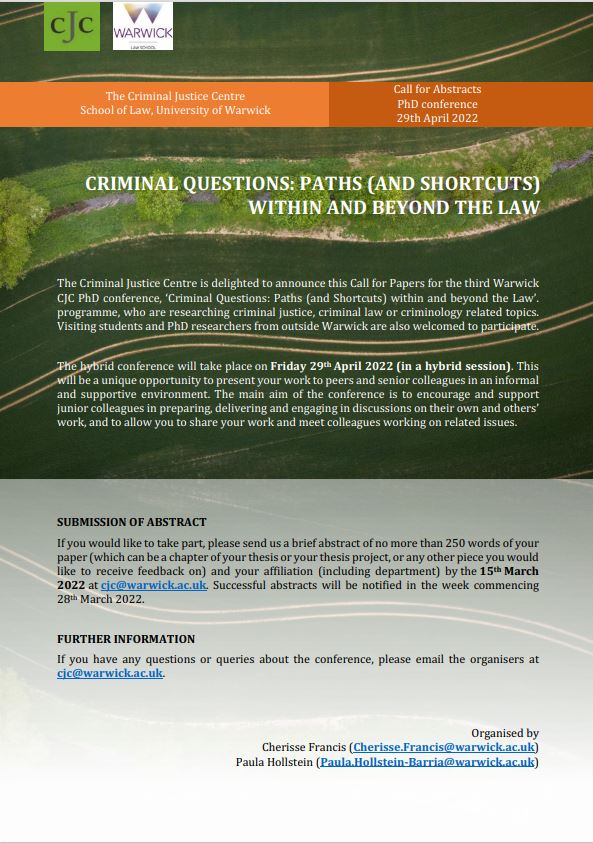
Call for papers : Third Annual CJC PhD Research Conference
The Criminal Justice Centre will be hosting its third annual PhD research conference on Friday 29th April 2022.
The theme for this year is: 'Criminal Questions: Paths (and Shortcuts) within and beyond the Law'.
This one-day conference seeks to bring together PhD researchers at any stage of their programme who are interested in topics related to criminal justice, criminal law or criminology.
Submission of Abstract:
If you are interested in participting please submit an abstract of no more than 250 words to cjc@warwick.ac.uk .
When submitting this abstract include your name, institutional affiliation and department.
The deadline for submission of abstracts is 15th March 2022.
Successful applicants will be notified in the week commencing 28th March 2022.
Valérie Hayaert awarded prestigeous Eutopia Science and Innovation Fellowship at the Universirty of Warwick (Criminal Justice Centre)
Call for Abstracts: Special Issue International Journal of Law, Crime and Justice
Call for abstracts for the special issue "The politics of (in)formality in criminal procedures"
International Journal of Law, Crime and Justice (peer-reviewed, open access possible)
The tension between formality and informality is intrinsic to the implementation of criminal law. Criminal procedures in fact always happen on a continuum between formality and informality, where the different actors involved (police officers and other street-level bureaucrats, prosecutors, judges, experts, defense lawyers, etc.) continuously perform and negotiate (in)formality. In this special issue, we aim to explore these “politics of (in)formality” in different criminal law settings and from different disciplinary perspectives.
To see the full Call: https://www.journals.elsevier.com/international-journal-of-law-crime-and-justice/call-for-papers/the-politics-of-in-formality-in-criminal-procedures
Please send your abstract (max. 300 words) to the guest editors Kei Hannah Brodersen (hannah.brodersen@unine.ch) and Damian Rosset (damian.rosset@unine.ch).
Deadline for submission of abstract: 1 November 2021 (24:00h CEST).
A selection will be made soon thereafter. The journal submission deadline is 31 March 2021.
Laura Lammasniemi announced as British Science Association (BSA) 2021 Award Lecturer
CJC Member Dr. Laura Lammasniemi was recently announced as a winner of the prestigious British Science Association (BSA) Lecture Award Series for 2021. Laura was recognised as the winner for social sciences based on her work 'Sexual Consent -Looking back at the law'. There were seven awardees across a number of disciplines who represent Early Career Researchers based in the UK who have displayed cutting edge work and committed public engagement.
The seven awardees will be present at a special Q + A event during the British Science Festival at the Chelmsford campus of Anglia Ruskin University in September where they will delve into their research and its real-world implications.
A short clip of Laura talking about her work can be found here on the BSA's Youtube channel.
Congratulations Laura!