
Law, Technology and Development Learning Circle

Photo by Conny Schneider
Background
The Law, Technology and Development Learning Circle is an initiative of the GLOBE Centre, Warwick Law School and the Centre for Interdisciplinary Methodologies (CIM). It brings together staff and students across the University of Warwick who are interested in the regulatory, governance, human rights, and political economy challenges of technology in/and on society.
The group aims to create a space for sharing and discussing research, legal and policy developments. Through reading groups, and policy conversations the group aims to develop cross-faculty collaboration that foreground Warwick’s law in context, and interdisciplinary research culture.
Researchers in the group work on a wide range of issues including data justice, digital rights, digital public infrastructures.
We are committed to building a critical, plural and contextual understanding of law and technology, that engages with dynamics of power, analyses continuities of coloniality in technology, studies effects across intersectional identities, and focuses on questions of epistemic justice, with an emphasis on studying developments in the global Majority.
The group is convened by Dr. Siddharth de Souza Link opens in a new windowand Dr. Serena NatileLink opens in a new window.
Activities
The group convenes twice a term and has organised discussions around questions of the coloniality of AI, and the empires that are emerging around the industry of Big Tech; conversations around the sustainability of computing and the implications of opening up spaces for thinking about justice in the technology industry; explorations of the implications that digitalization will have for vulnerable groups in criminal law systems and two further events in term 3 of this academic year which will discuss the governance of AI and the connections between data and the environment.
Through a series of meetings, the group has invited participation from researchers not just at WLS and CIM, but also at the School of Cross Faculty Studies, with students, at the taught and doctoral level also joining such conversations.
New directions
In the future, the group intends to develop resources for teaching across the university, as well as public resources such as a podcast that can connect to debates taking place in the group.
Upcoming Events:
Term 1, 2026-27:

AI in and beyond Work in the UK: Contesting New Forms of Exploitation and SurveillanceLink opens in a new window
Thursday, 29 October 2026, 12pm – 2pm
S2.09 and S2.12, Warwick Law School, Social Sciences Building
The use of Artificial Intelligence at work has become an issue for industrial disputes across many sectors in the UK. These issues include AI being used as an opportunity for layoffs and casualisation; deskilling; new forms of algorithmic management and surveillance; work intensification; and unpaid data extraction. Simultaneously, the UK government has pursued a pro-tech-sector AI policy – involving multiple new public sector contracts, data centres and nuclear power projects – while communities raise urgent questions about not only the environmental impact of data centres but also the governmental and corporate data extraction and use of AI to manage, predict, police and wage war. We will discuss the political and legal questions this conjuncture raises: the relationship between labour, data and value; state and corporate knowledge and power through new AI and data extraction infrastructures; the unequal distribution of harms, environmental implications and violence; and the possible relationships between labour and community forms of organising and resistance.
Speaker: Dimitra Kotouza, Labour Research Department
Past Events:
Term 3, 2025 - 26:

Theme: The Global South and Global and Local AI GovernanceLink opens in a new window
Thursday, 7 May 2026, 12pm – 2pm
S2.09, Warwick Law School, Social Sciences Building
We will discuss global and local aspects of AI Governance from the perspective of the Global South. We will be continuing from discussions in the previous two sessions. While the whole book provides a background on AI governance, suggest four specific chapters are suggested as our focus for a critical exploration.
Suggested Reading: The Oxford Handbook of AI Governance Link opens in a new windowby Justin B. Bullock (ed.) et al, especially Section 9.
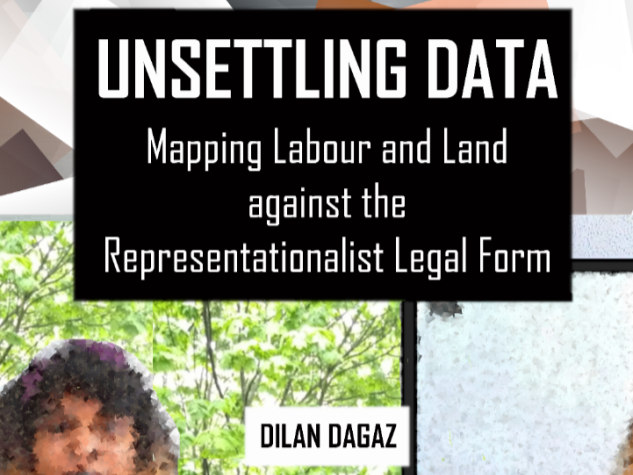
Book Discussion: Unsettling Data by Dilan DagazLink opens in a new window
Thursday, 11 June 2026, 12pm – 2pm
S.2.09, Warwick Law School, Social Sciences Building
What prevents data governance law from redressing the widespread exploitation of labour and land rampant across the data economies of our digital Earth? Unsettling Data answers this question by scrutinising the legal grammar of ‘data’ to expose the persistence of hierarchical power relations between the observer and the observed. The role of the modern legal form in fortifying and obscuring these power relations is elucidated. Proposing representationalism as the framework to map these hidden yet pervasive power relations, the book reveals how the representationalist legal form serves to delink the agency of the data subject from unjust labour and land exploitation in the digital political economy. Highlighting the importance of Indigenous/Adivasi perspectives for unsettling the philosophical core of Western(ised) data governance, Unsettling Data argues for the formal reconceptualisation of data as the entangled human and unhuman agencies implicated in its production; paving the way for a new legal grammar of data rooted in relational reciprocity.
Unsettling Data will be of interest to readers in critical legal theory, law and humanities, law and political economy, data protection, information law, AI governance, intellectual property as well as anyone seeking to understand the legal form or aesthetics of data from a critical lens.
Term 2, 2025 - 26:
Theme: Digital Vulnerability in Criminal JusticeLink opens in a new window
Thursday, 26 February 2026, 12pm – 2pm
R1.13, Ramphal Building
The discussion will be led by Dr Lorna Cameron, Visiting Research fellow at CIM, and will include a short presentation followed by reflections from participants. You are encouraged to read the book, or part of it, prior to the meeting.
Lorna Cameron is a recent PhD graduate and Visiting Fellow at the Centre for Interdisciplinary Methodologies at Warwick, with an original disciplinary background in architecture and design research.
Suggested Reading: Digital Vulnerability in Criminal Justice: Vulnerable People and Communication Technologies (2026)Link opens in a new window Palgrave Macmillan by Carolyn Mackay.
Term 1, 2025 - 26:
Theme: Sustainability and Technology
Thursday, 4 December 2025, 12pm – 2pm
S2.09, Warwick Law School, Social Sciences Building
In this session, we will meet to discuss the book Insolvent: How to Reorient Computing for Just Sustainability by Christoph Becker. The discussion will be led by Dr Siddharth de Souza and will include a short presentation followed by reflections from participants. You are encouraged to read the book, or part of it, prior to the meeting.
Theme: AI and Global MaldistributionLink opens in a new window
Thursday, 7 November 2025, 12pm – 2pm
S2.09, Warwick Law School, Social Sciences Building
Contact
For more information on the group, please contact Dr Siddharth De Souza (Siddharth.De-Souza@warwick.ac.uk) or Dr Serena Natile (Serena.Natile@warwick.ac.uk).
For logistical information about the events, please contact globe@warwick.ac.uk