
Lessons from First FINDEM Project Workshop
By Resya KaniaLink opens in a new window and Kofi GunuLink opens in a new window
The FINDEM project adopts the conceptual lens of “the politics of financial citizenship” to explore how the growing middle classes in emerging market democracies access, participate in, and mobilize around the governance of the financial system, and how these processes shape political life more broadly.
Over two days, from 29-30 September 2025, the FINDEM team brought together twenty-five scholars from Southeast Asia, Sub-Saharan Africa, North America, Europe, and the UK interested in the democracy-finance nexus to explore the project theme and discuss its animating questions.
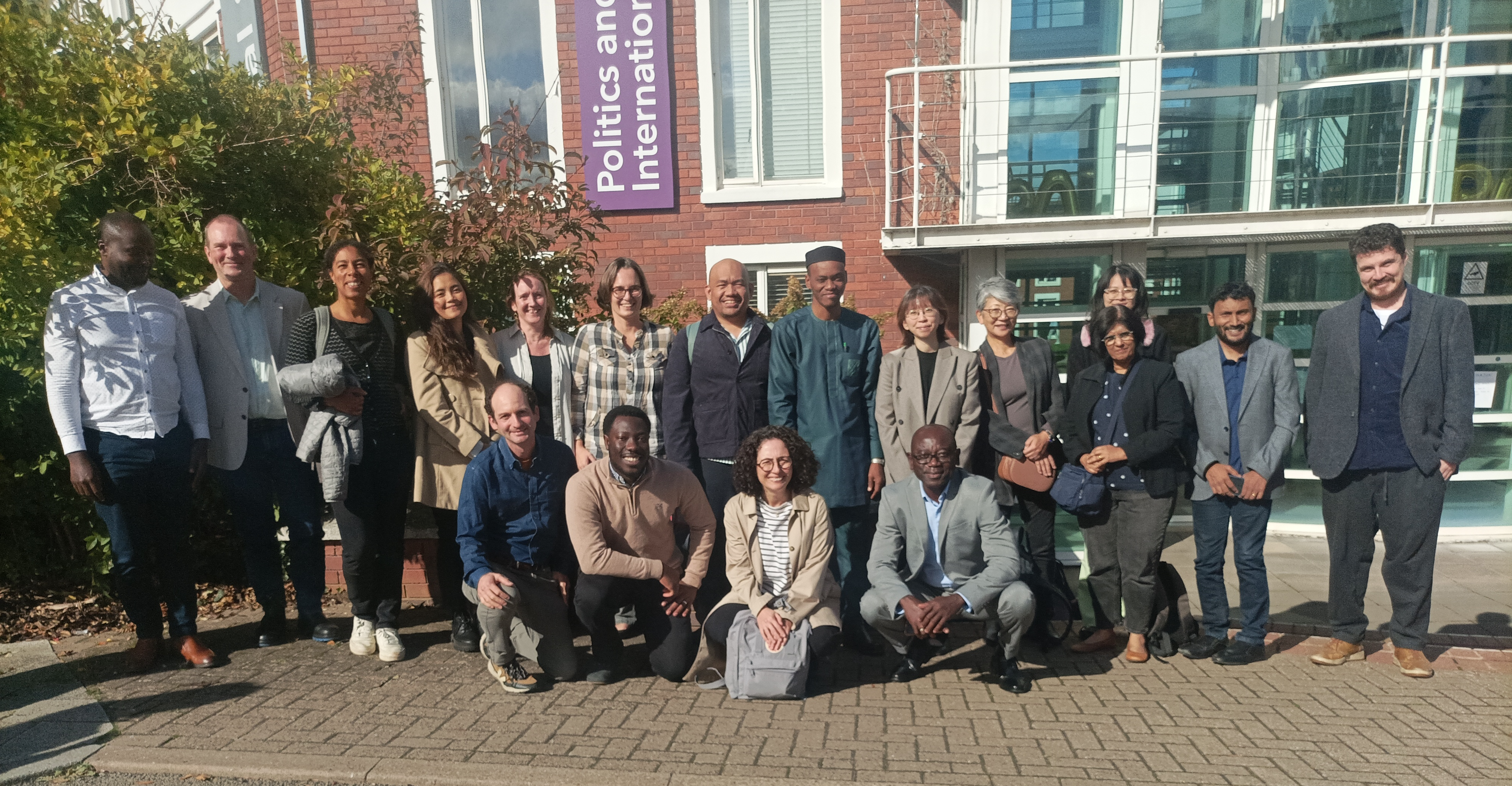
Here is a summary of the discussions and our key takeaways.
On the first day, five scholars presented their work on the emerging middle class, democracy, and financialization. The workshop started with Jeffrey PallerLink opens in a new window showing how urbanization in Ghana has led to the phenomenon of “patchwork cities,” where wealthy residential areas coexist cheek by jowl with poor informal settlements. However, rather than fostering diversity and tolerance, this coexistence deepens segregation and patronage systems. Within his concept of “patchwork cities,” Jeffrey also demonstrated how informality shapes citizenship and democracy.
Then Lena RethelLink opens in a new window explained how the middle class in emerging economies is a fragmented and vulnerable group. In the current era of financialization, the growth and stability of the middle class is increasingly tied to the financial sector, for example, through mortgages, pensions, and other forms of debt. Lena illustrated this more deeply through the context of Indonesia and Malaysia. She argued that the middle class is not a unified democratic force, but a heterogeneous category that depends on finance (debt) to maintain its status.
Fulya ApaydinLink opens in a new window shared an analysis on her 2022 survey of 1,289 individuals in Malaysia which showed that the type of household debt shapes political attitudes. Her work argues that household debt plays a significant role in politics; debt can be a source of stability for political regimes when manageable, but when repayments become onerous, especially during crises, debt could fuel dissatisfaction and negative reactions against the incumbent government.
Juliet JohnsonLink opens in a new window proposed the concept of “financial nationalism” to capture a distinct alternative to the liberal international order that has emerged since the 2008 financial crisis. Contemporary financial nationalism is where governments frame interventions such as debt regulation, capital controls, and the promotion of domestic investors as efforts to achieve political legitimacy and national sovereignty. She argues that this “financial nationalism” strategy faces a number of limitations. For one, dependence on volatile global capital flows and external crises (e.g., COVID-19 or the war in Ukraine) can undermine economic and political stability, even pushing governments toward authoritarian control.
Finally, Michael Saward’sLink opens in a new window key-note address sought to challenge static understandings of democracy. He argued that democracy should not be seen as a fixed model, but as a dynamic and context-dependent concept. He invited the workshop participants to reflect on some fundamental questions: democracy for whom, for what purposes, and under what conditions? Saward introduced alternative perspectives on democracy that FINDEM could incorporate, notably “fugitive democracy,” where democratic action emerges from grassroots mobilisation.

Day two of the FINDEM workshop opened with a pair of presentations on how financialization is driving social inequality and uneven public goods provision across Indonesia. Louis O’SullivanLink opens in a new window showed that in Indonesia, state-led interventions to advance financial deepening primarily benefit metropolitan areas, particularly the greater Jakarta region. But even within these better-served core regions, the distinct growth regime pursued by the government has entrenched class disparities: while middle-class households use credit access to build wealth, lower-income groups use debt mainly for consumption. Soomin OhLink opens in a new window presented work on how electoral competition shapes patterns of public service provision in Indonesia. Politicians facing tighter races invest in more universal and visible goods such as schools and clinics to appeal to both core and swing voters. Together, the papers underscore the utility of bringing the analysis to the sub-national level, which reveals how financial and political incentives jointly reproduce spatial and socioeconomic inequalities.
The next set of presentations, by Francis Boateng FrimpongLink opens in a new window and Moch Faisal KarimLink opens in a new window, examined how financial inclusion initiatives are reshaping state-citizen relations in the Global South. Frimpong traced the shift from welfare-based social provision to market-oriented financial inclusion in Sub-Saharan Africa, showing how governments and international institutions have reframed social protection around individual financial participation. Karim analysed Indonesia’s peer-to-peer lending boom, arguing that digital platforms promoted as tools of empowerment have instead entrenched “predatory financialization,” deepening indebtedness and dependency.
The presentations revealed striking parallels between Southeast Asia and Sub-Saharan Africa, where private financial actors increasingly mediate access to welfare and credit. In both regions, digital platforms such as mobile money and P2P lending have expanded financial access while increasing exposure to unregulated intermediaries. Speakers emphasised that narratives of empowerment surrounding financial inclusion often obscure how constrained individual agency remains. The trend toward the “responsibilisation” of citizens transfers social risk from the state to the vulnerable, particularly women and low-income households.
The afternoon’s discussions turned to the middle-class politics of sovereign debt, with presentations from Umesh MoramudaliLink opens in a new window and Kofi GunuLink opens in a new window. Moramudali discussed how the rising expectations and consumption patterns of the Sri Lankan middle class deepened the government’s reliance on global capital markets and ultimately contributed to the country’s sovereign default in 2022. Gunu shared a case study from Ghana, where pensioner bondholders mobilised effectively during the country’s 2023 domestic debt exchange program, leveraging public protest and their extensive networks to secure an exemption from haircuts.
The presentations and subsequent conversation highlighted how state dependency, geography, and context shape whether and how the middle class participates in political struggles. Participants pointed to the need for further research to better understand the vulnerabilities and political attitudes of different middle-class segments—retirees, professionals, informal workers, and bondholders, etc.
The workshop was a thought-provoking exploration of different aspects of the politics of financial citizenship, bringing together insights from fields of study that are not normally in conversation with one another, ably assisted by the project’s international advisory board. The two days of catalytic conversations spotlighted five key points that will guide the FINDEM project in the years to come:
- First, the concept of the financial middle class is multi-dimensional. It encompasses material, socio-economic, spatial, psychological, and other expressions that the project would do well to tease out.
- Second, financial practices such as debt, saving, and investment are not simply survival strategies but an arena of everyday politics, enabling the middle class to articulate their interests and make claims as rights-bearing citizens.
- Third, the workshop highlighted how financialization has a dual effect: some individuals use credit to pursue education, housing, or migration, while others face debt traps that impede their upward mobility.
- Fourth, we also identified migration, both within and across countries, as a form of political agency. Emigration is often a response to limited opportunities for advancement at home, and the diaspora influences politics and markets through remittances and investments.
- Finally, our discussions emphasised how financialization produces a fragmented middle class, comprising both the empowered and the precariat but also divided by factors such as age, gender, and ethnicity.
We should expect these diverse experiences to shape financial subjectivities and affect struggles over debt, welfare, and citizenship in emerging economies.