
Departmental news
Winners announced - HRC Doctoral Fellowship Competition
Congratulations to the winners of the HRC Doctoral Fellowship Competition.
We look forward to their conferences next year (24/25)
Airelle Amédro (SMLC) & Enrica Leydi (SMLC) - ‘Irresistible Decay: Aestheticization of death and life imbrications from the 18th Century to today’
Lu Feng (English) & Chun-Wai (Wayne) Kwong (English) - ‘After Postcolonialism: Global Theory, Local Transformations’
Julián Harruch-Morales (Hispanic) - ‘Uses and Abuses of the Decolonial’
Anna Pravdica, Himesh Mehta & Mia Edwards (all History) - ‘Individualism, Human Nature, & the Self: From the Early Modern Era to the Modern Western World’
Professor Sandra Chapman attended the European Geosciences Union (EGU) meeting to receive her Hannes Alfvén Medal.
On Tuesday 16th April, Professor Chapman was presented her award at the annual EGU meeting in Vienna with over 15,000 people in attendance. Sandra also gave a lecture titled ‘Multiscale matters: when coupling across multiple scales drives the dynamics of solar system plasmas.’
Top of the class!
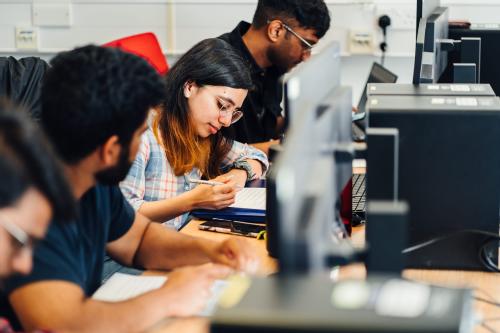 WMG at the University of Warwick has seen five of its courses ranked number one in the UK by the Eduniversal Best Masters 2024.
Eduniversal ranks the quality of Master’s both in the UK and worldwide. This year a total of five WMG programmes have been recognised in their respective categories, with MSc Cyber Security Management being ranked number one in the world.
Accompanying MSc Cyber Security Management in the rankings were the MSc e-Business Management; MSc Supply Chain and Logistics Management; MSc Innovation and Entrepreneurship and MSc Engineering Business Management programmes.
The rankings were as follows:
· MSc Cyber Security Management –number one in the world for Cybersecurity, Systems Security and Data Protection programmes
· MSc Innovation and Entrepreneurship – number one in the UK and number 22 globally for Entrepreneurship – up three places on the 2022 rankings
· MSc Supply Chain and Logistics Management - number one in the UK and 28th globally for Supply Chain and Logistics - up one place from 2022
· MSc Engineering Business Management - number one in the UK and number three in Western Europe for Industrial and Operations Management.
· MSc e-Business Management - number one in the UK and fifth in Western Europe for E-business and Digital Marketing.
Professor Dan Nunan, Associate Dean (Postgraduate Education) at WMG at the University of Warwick, explained: “I am thrilled to see WMGs specialist courses in applied engineering, management and technology once again recognised as a leading choice for students seeking to develop their careers. These rankings are testament to the hard work and dedication of all our teaching team at WMG.”
Harjinder Lallie, Discipline Group Lead for Cyber Security at WMG, and Director of the Academic Centre of Excellence in Cyber Security Education at the University of Warwick, said: “I am absolutely delighted that our MSc Cyber Security Management degree continues to receive recognition both nationally and globally. The course has an international reputation for excellent teaching, hands on practical experiences and superb post-study employment opportunities. To be ranked number one in the world is an outstanding achievement.”
Eduniversal Group is a global leader in higher education information, providing students worldwide with the tools to find the best education opportunities. Eduniversal publishes annual rankings of the best Master's programmes in 50 fields of study, covering 154 different countries within nine geographic zones. The ranked programmes come from more than 1,800 universities and schools.
WMG offers 14 applied Master’s courses across technology, engineering and management all designed to meet the needs of global industry. Find out more here: https://warwick.ac.uk/fac/sci/wmg/study/masters-degrees
New trial launches to explore environmentally-sustainable shopping choices
A new research project launched today by a partnership including the University of Warwick will explore how shoppers can be encouraged to make more sustainable food choices while they do their online shopping.
The online shopping project is part of the SALIENT food trials, a consortium of eight universities and two research institutes looking at ways to support healthier eating and reduce the impact of food on the planet, funded by the UK government through the ESRC.
The trial is facilitated by a web browser extension for the online grocery platform of a major UK supermarket, which will pull information from a database of over 14,000 ‘life cycle assessments’ for the available products compiled by food sustainability experts Sustained.
Up to 2750 UK shoppers will be recruited to take part in up to five waves. They will be invited to download a plug-in for their internet browser which will provide two sorts of nudges to help guide their purchases:-
- Eco-labelling: these will inform online shoppers about the environmental footprint of their food choices, using an A (least impact) to G (most impact) rating system.
- Product Swaps: shoppers may be shown products with a lower environmental impact and equal or better nutritional profile, in place of their initial choices. These may also be made available at a discount to test the effect of lower prices on purchase decisions.
The researchers will evaluate the impact of these interventions on the environmental rating of consumers’ shopping baskets, to understand whether either intervention results in more sustainable shopping habits and by how much.
Professor Thijs van Rens, co-lead of the Sustained trial, said: “Offering swaps and price discounts are promising ways to get people to buy more sustainable foods, which are often better for their health too. But we have very little evidence for how effective these interventions are, particularly for online grocery shopping.
“Previous research has mostly focused on physical supermarkets or on simulated online supermarkets. But we know that people often make quite different choices in real life than in simulated environments.
“Our collaboration with Sustained will provide a great opportunity to generate real life data which we can analyse in order to recommend policies with the best chance of changing behaviour in a positive way.”
Professor Oyinlola Oyebode, also co-lead of the research trial, said: “Climate change and environmental degradation are important and serious challenges for human health. Changing the food we produce, buy and eat can help to address this, and more sustainable food often offers direct benefits for health too.”
Carl Oliver, Sustained CEO, said: “Empowering more sustainable purchasing choices is part of the journey to reducing the massive impact the global food system has on the environment.
“This trial is also about understanding how industry and policy makers can utilise technology partners like Sustained to shape a food system that supports the health of us and our planet.
“This is an exciting partnership for Sustained as we work towards our vision of helping consumers and businesses reduce their environmental impact through actionable intelligence and collaboration.”
About SALIENT: SALIENT is a team of researchers working with the public, partners from local and national government, food charities, community support teams, and the food industry, with the goal of designing interventions to support healthier eating and reduce the impact of food on the planet. The SALIENT consortium is drawn from eight universities (Oxford, Cambridge, Warwick, Birmingham, Hertfordshire, Liverpool, London School of Hygiene and Tropical Medicine, and Queen Mary University of London) and two research institutes (Nesta and the Behavioural Insights Team). https://www.salientfoodtrials.uk/
Visiting Speaker - Professor Yannis Hamilakis - Report
Humanities Research Centre – Visiting Speaker’s Fund – Professor Yannis Hamilakis
Outputs Supported Through the Visiting Speaker’s Fund
1) Keynote lecture for the Classical Association Annual Conference, the field-leading conference in Classics in the UK.
2) Research and Career-Development Seminar for Postgraduate Students in the Department of Classics and Ancient History at Warwick.
Description Of Outputs
Funds from the HRC Visiting Speaker’s Fund in combination with a contribution from the Department of Classics and Ancient History supported the travel and accommodation of Professor Yannis Hamilakis, a world-leading scholar, to deliver the keynote lecture at the UK field-leading Classical Association (CA) conference which Warwick hosted during May 22-24, 2024.
Professor Yannis Hamilakis is an extremely high profile archaeologist and scholar in the area of the socio-politics of the past (Greece especially) and is currently the Joukowsky Family Professor of Archaeology and Professor of Modern Greek Studies at Brown University.
Professor Hamilakis’ keynote lecture, entitled, Undoing Monumental Racecraft: The Acropolis Otherwise was delivered on the afternoon of Friday March 22, 2024 on Oculus 1.05 to an international audience of approximately 270 Classicists. Professor Hamilakis’ talk presented a dissection of the Athenian Acropolis as it is traditionally presented – a monument to Classical Athens. He presented how and why the acropolis was ‘cleansed’ of its non-Classical past during the 19th century in order to present very specific messages about these monuments that were heavily informed by European nationalisms of the time. The lecture then presented would-be 19th century plans for the Acropolis that were proposed by a Bavarian architect who was employed by the newly established Greek monarchy. These plans included locating a royal palace, and even a horse-racing track on top of the hill.
Professor Hamilakis then presented evidence from the traditionally overlooked Medieval and the Ottoman periods, and presented a very strong case for why we need to re-consider these traditions as valuable stakeholders in the history of this monument. Two of the particularly fascinating case studies presented related to the largely discarded remains of Ottoman-era headstones from a cemetery at the entrance to the Acropolis, as well as evidence for a community of enslaved people of African origin who lived at the base of the Acropolis in the 18th century. Both communities have been more-orless completely written out of the history of the Acropolis in favour of the traditional presentation of a ‘pure’ Classical Greek monument which has been heavily informed by 19th century nationalism which has its origins in a different part of Europe. This lecture calls for a reassessment and a considered decolonisation of the Acropolis by those of us who teach using its monuments. Presenting a longer-term and diverse history/archaeology of the Acropolis enables a more careful contextualisation of the monuments, and enables us to question the historiography around, and the reception of, what is all-too-often framed as an iconic feature of ‘western’ culture.
The keynote lecture did not have a question session, but The Classical Association (CA) run a promotional campaign for this conference, part of this strategy includes Twitter/X. On Jan 30, 2024, as requested, I sent the @HRCWarwick to the organising committee to pass along to the CA communications team for use in promotions regarding the keynote lecture. the CA conference held a drinks event in the Agora of the Faculty of Arts Building during which Professor Hamilakis fielded a range of questions about the lecture from colleagues across our discipline.
On the morning of March 23, Professor Hamilakis held a hybrid-seminar in the Faculty of Arts Building for Postgraduate Researchers in the Department of Classics and Ancient History. This even was attended by seven postgraduate (PG herein) researchers, Professor Hamilakis and the author. The seminar discussion began with questions from the postgraduate community about the keynote lecture that took place on the previous night. That particular discussion focused on the would-be 19th century development plans for the Acropolis as well as the active process of prioritising specific archaeological and historical phases of a site for presentation. On Professor Hamilakis’ direction, the seminar discussion then moved on to cover more practical topics that were of specific interest to the postgraduate community in Classics and Ancient History.
These topics included:
• Developing an academic career.
• Strategic publishing.
• Navigating disciplinary boundaries in research.
• Developing PhD projects.
The seminar discussion was lively, and lasted slightly beyond the scheduled 1-hour time slot. Online participation was facilitated using Microsoft Teams and a ‘Meeting Owl’, which proved to be an excellent tool for ensuring both audio and visual participation by the online attendees. The postgraduate students from Classics and Ancient History were happy to ask questions and to listen to advice/suggestions from Professor Hamilakis. Oral feedback provided to me from the participants indicated that this was a helpful and engaging session.
The original aims of this application were to secure financial support from the Visiting Speaker’s Fund in order to bring a field-leading scholar to the University of Warwick. This speaker, Professor Hamilakis, was to deliver a keynote address at the largest annual UK conference in our discipline (the Classical Association Conference) and to lead a seminar discussion with postgraduate students from the Department of Classics and Ancient History. These aims were all met, and the number of attendees and engagement at both the keynote lecture and the seminar exceeded our initial aims.
Stonebreakers: Film Screening and Roundtable Discussion - Report
Stonebreakers: Film Screening and Roundtable Discussion
Wednesday 13 March 2024
HRC report – Joanne Lee
Internal webpage: Stonebreakers (warwick.ac.uk)
Coventry Cathedral webpage: Stonebreakers - Film Screening - Coventry Cathedral
On Wednesday 13th March, Valerio Ciriaci (director) and Isaak J. Liptzin (producer) visited Warwick as part of their UK tour to present their documentary film Stonebreakers (Awen Films, 2022). Thanks to the generous support from the HRC Visting Speaker’s Fund and from the Warwick Institute of Engagement, along with contributions from departments of History, PAIS, SCAPVC and the SMLC, we were able to stage two separate events: an afternoon on-campus event open to staff and students, and an evening event in the Chapter House theatre of Coventry Cathedral open to members of the public.
Valerio Ciriaci and Isaak J. Liptzin co-founded Awen Films in 2012 and Stonebreakers is their third documentary feature film. The documentary chronicles the fight around historical memory in the US that exploded in 2020 during the George Floyd protests and the presidential election. It interrogates understandings of national narratives and foundational myths (in particular Columbus and the Founding Fathers) and explores debates around contested monuments, statues and landmarks. The film premiered in 2022 at the Festival dei Popoli in Florence, where it won three awards.
The afternoon screening and roundtable panel discussion took place in the Cinema Room of the Faculty of Arts Building with an audience of around 40 staff and students and was followed by a drinks reception.In the evening, a similar free event took place in the Chapter House theatre of Coventry Cathedral with around 30 in attendance. Although scheduled on a busy day in the last week of term, the film drew in a varied audience with interests in US politics, racial justice, decolonising movements, historical memory and documentary filmmaking.
The film-screenings (70 minutes) were followed by a roundtable panel discussion – the aim of which was not only to allow the filmmakers to explain the ideas behind the making of the film and respond to questions from the audience, but also to bring them into dialogue with researchers and cultural activists who specialise in different aspects of US history and politics, questions of memory and memorialisation, and cultural policy and inclusion.
Afternoon panelists included:
Jess Eastland-Underwood: a final year PhD Student from PAIS whose research looks at how everyday understandings of the concept of ‘the economy’ in the USA mobilised the anti-lockdown and George Floyd protests during the Covid-19 pandemic. Her published work has looked at interpretations of the economic ideology of the Founding Fathers in the Tea Party movement as well as the way popular conceptions of ‘the market’ reproduce white supremacy.
Alison Cooley: Professor in Classics at Warwick, Deputy Head of Classics, and Director of the Humanities Research Centre. Her interest in contemporary debates surrounding statues and memorials stems from her research into the cultural and political aspects of the Roman world. She has a forthcoming chapter on the destruction of ancient monuments from Pharaonic Egypt to Imperial Rome: 'Control: The destruction of monuments', in D. Agri and S. Lewis (eds.) Cultural History of Media: Antiquity (Bloomsbury)
Lara Ratnaraja: an independent cultural consultant who specialises in diversity, innovation, leadership, collaboration and cultural policy within the cultural, the HE and digital sectors. She co-produces a series of cultural leadership programmes for people from diverse backgrounds linked to geographical place and also curates a digital Conference called Hello Culture. Her projects include working with the 8 Welsh National Arts Companies to develop a cultural framework for diversity co-designed with creative stakeholders and residents.Lara is on the board of Compton Verney and is Co-Chair of the Coventry Biennial. She is also on the UK Council for Creative UK and the Equality Monitoring Group for Arts Council Wales.
Evening panelists included:
David Wright: David teaches and writes about cultural policy and the creative industries in the Centre for Cultural and Media Policy Studies at Warwick. His recent work has concerned campaigns for statues and memorials to figures from twentieth-century popular culture. He is currently writing a book for Liverpool University Press: Celebrity and Public Art: Memorialising Popular Culture and his recent open access article in the European Journal of Cultural Studies concerned nostalgia and statues to comedians in the North of England.
Ras Emmanuelle Henry Cottrell: founder of I&I Collective – an international collective of promoters, producers, performers, DJs, artists & activists. One of his recent projects at St Mary’s Guildhall in Coventry involved exploring the history of the American civil rights activist Frederick Douglass who visited the city in 1847 where he delivered three lectures as part of his anti-slavery campaigns.
Lydia Plath: Associate Professor of US History at Warwick, where she specialises in the history of racism and racial violence. Her research projects have investigated the representation of slavery in twentieth and twenty-first century American cinema. Her teaching centres on African American history and her module ‘America in Black and White’ won the inaugural Historians of the Twentieth Century United States Inclusive Curricula Prize. Lydia is one of the facilitators of the Tackling Racial Inequality at Warwick Staff Development Programme.
Both afternoon and evening screenings led to lively and insightful panel discussions in which participants debated the quest for representation within the film: was the struggle really about whether a statue or monument should stand, or was the struggle for territorial rights and political space more important? Why do certain stories become central to the national narrative while other stories and voices are marginalised? How can we incorporate activism into our teaching and research? Questions to the director and producer also explored cinematography and considered how much of the intensity and beauty of the film derives from the choice to avoid a didactic voice-over, the use of music to build tension and the powerful juxtaposition of imagery. At both events, we really needed an extra hour to fully explore these aspects!
The events were successful in bringing filmmakers together with researchers at Warwick and external collaborators while the subject of racial justice and political representation clearly resonated with both audiences. We hope to purchase the documentary for the library so that other members of the university can watch a film which makes a vital contribution to political debates about monuments, memorialisation and constructions of national narratives. We extend our thanks and appreciation to Valerio and Isaak for coming to Warwick and sharing their film with us – we eagerly await their next film project!
Dr Hyo Yoon Kang awarded the British Academy Mid-Career Fellowship
We are thrilled to share that Dr Hyo Yoon Kang, Reader/Associate Professor at Warwick Law School has been awarded the British Academy Mid-Career Fellowship for the next academic year.
Natural disasters and local government finance - new insights from the Philippines
Delegating tax-and-spend powers to local government risks limiting the ability of local authorities to respond to environmental disasters, according to new research published in the Journal of Economic Behavior and Organization.
Dr Jose Rowell Corpuz (University of Warwick), Professor Joseph Capuno (University of the Philippines Diliman) and Dr Samuel Lordemus (University of Lucerne) looked at 10 years of public finance data from the Philippines both before and after a national emergency in 2013, when Typhoon Haiyan struck the islands with 200mph winds, to explore how local public finances respond to natural disasters.
The researchers also looked for evidence of how central government disaster relief funds and international aid affected local revenue raising and spending on essential services – did the external aid compensate for lower local revenues, or was it genuinely additional to existing resources?
While these questions have been studied in better-off countries, it is believed that this study substantially adds to the analysis of the local fiscal response to natural disasters in a country with more limited financial resources.
The Philippines is in a high-risk typhoon area, and Typhoon Haiyan was one of the strongest ever recorded and caused unprecedented damage as it crossed the country. Official government sources estimate that about 6,300 people died, more than 28,000 were injured and 4 million left homeless.
It displaced communities and affected the regions' infrastructure, roads, hospitals, schools, and public services. The severity of the impact on the areas it ravaged was unanticipated and unprecedented, with its effects felt during and after the disaster.
Using data on local government revenue and spending from before and after Typhoon Haiyan, Dr Corpuz and his co-authors found:
- The typhoon had a small impact on local government revenue raising. In the short term there was a fall in income from taxes and charges on local businesses but these recovered after around two years. This effect was more severe in less-well-off municipalities and highlights the importance of flexible central government support to address economic inequality.
- The typhoon had a small but measurable impact on spending. Local governments spent slightly less on all areas of responsibility except health, housing and labour. They also reduced their debt repayments.
- Local governments which received external aid did not diminish their tax collection efforts and spent more on public services, education, social and economic services, and debt repayments. This result shows that foreign aid has a vital role to play in supporting local government to help citizens in the aftermath of disasters.
Commenting on his research Dr Corpuz said:
“The effects of natural disasters can have a huge impact on a local economy and under decentralisation, local governments are limited in the resources they can mobilise in the aftermath.
“Ordinarily, local tax revenue collection provides a higher rate of local government spending over and above central government transfers. This changes after a natural disaster when there are significant losses in revenues particularly from local businesses and economic enterprise.
“When a typhoon as powerful as Haiyan affects the generating revenue capacity of local governments, central government transfers and foreign aid are crucial to maintaining public expenditures that benefit its people.”
Specifically, the research evidence suggests:
- Local governments exposed to common nationwide shocks such as Typhoon Haiyan have limited capacity to reallocate or provide additional resources that would address the increased demand for local public spending.
- Lack of strong and responsive financial support from central government leaves local governments to fend for themselves. This situation only escalates the impact of external shocks.
- Central government needs to step in with additional sources of funding for disaster relief and ensure a coordinated effort with other funding sources (such as foreign aid) to effectively target the most vulnerable communities.
Dr Corpuz concludes:
“Although we cannot generalize, the Philippine case is a reminder of natural disasters’ debilitating effect on local governments and vulnerable communities. We hope that our study will inspire many in ensuring a well-coordinated disaster risk management by central and local governments, particularly in settings of decentralised local government finance.”
Read the full research paper: Natural disasters and local government finance: Evidence from Typhoon Haiyan
Warwick Economics student August Küenburg releases new podcast Econ Bites
August Küenburg (BSc Economics, Year 2) has released an exciting new podcast Econ Bites, exploring economic public policymaking and its key figures and institutions. In his impressive first episode, August interviews Jonathan Haskel, member of the Monetary Policy Committee of the Bank of England, to discuss central bank independence and inflation targeting. We caught up with August about his fascinating new project.
Hi August! Why did you decide to start creating and publishing your own podcast?
Having my own podcast gives me the opportunity to talk to inspiring people in the field of economics about all kinds of interesting topics and share these conversations with other interested people. Preparing a podcast episode is a fun learning experience and an excellent way to deepen my own understanding about certain topics that we begin to cover as undergraduate economics students.
Your first episode has a very exciting guest – Jonathan Haskel. Can you explain who he is and why you’ve chosen to interview him?
Jonathan Haskel is a Professor of Economics at Imperial College Business School and is currently serving his second term as a member of the Monetary Policy Committee (MPC) at the Bank of England. Jonathan holds one of the nine votes to decide the future of the UK monetary policy. His experience as a central banker and ability to explain complex matters with often simple analogies makes him the perfect guest for my podcast episode.
Why should people listen to this episode with Jonathan?
Listeners will hopefully gain a better understanding of how the MPC operates and why inflation targeting and central bank independence are essential to ensure effective and credible monetary policy. Jonathan makes an excellent point about how economists have too long held a machine-like view of the economy and that a major intellectual breakthrough was needed to start treating the economy much more systematically.
For this episode you’ve done a lot of research into the history of the Bank of England and its policymaking on matters such as inflation. How has your degree in economics equipped you with the skills to complete this research?
One of my optional models, Money and Banking, discusses monetary policy and central bank independence in more detail and this motivated me to do further research into central banks. Most of my preparation goes into reading the literature and gaining a solid understanding of the topic.
Your podcast demonstrates a keen interest in policymaking – are you planning to pursue a career path in this area?
At the moment I want to pursue a career in public policy, being as a central banker or maybe as an economist at the International Monetary Fund or World Bank.
Talking to people in those fields is an exciting opportunity for me to learn more about their jobs and why they matter so much. Policymaking has a real impact on people’s lives, and I believe that coming up with new insights and solutions to various economic issues could be a very interesting and fulfilling career prospect.
I hope to have more central bankers, academics and economists working on public policy on my podcast in the future.
August Küenburg (BSc Economics, year 2)
You can listen to August’s first episode of his podcast Econ Bites on Spotify here.
Divine Disasters - Conference Report
Divine Disasters: Exploring Distressed Landscapes in Literature and Theology
What happens when belief, the sacred and the divine collide with ecological crises? How do such distressed landscapes alter our ideas of the ecological and theological? The one-day interdisciplinary conference, Divine Disasters: Exploring Distressed Landscapes in Literature and Theology, set out to explore these questions at the University of Warwick on 24th February 2024.
This conference asked how art and literature depicted the role of the divine in disasters. During times of ecological crisis, some turn to religion for solace, while others feel their faith shaken. These dilemmas are unsurprising as the distressed landscapes of disasters are often places of multitudinous emotions, including fear, sadness, anxiety, anger, and hope, foregrounding theological queries of evil, doubt, and suffering. Literature and creative art often act as a site for exploring intersections between theological enquiries and ecological disasters. “Divine disasters” offers a new lens for examining the interrelationship between theology, ecology, and literature, questioning human vulnerability and theology’s big questions within narratives of distressed landscapes.
The conference welcomed 77 delegates, with 43 in-person attendees and a further 35 joining us online. The hybrid conference format made the event more accessible, facilitating a range of scholars from international institutions that enhanced the cross-discipline implications of Divine Disasters. In turn, the conference programme boasted presentations across diverse fields, including cultural studies, history, sociology, film, and media studies, to explore the conference theme in both imaged landscapes and real-world terms.
Sadly, our keynote speaker, Prof. Patricia Murrieta-Flores, could not present her research on “Nepantla, between indigenous time and colonial space: Reflections about the end of the world in Central Mexico” due to illness. However, this schedule change allowed all delegates to participate in the two workshops initially planned to run concurrently. “Workshop A: Reading Ecopoetics in Divine Disasters”, facilitated by PhD candidates Ambika Raja, Nicola Hamer, and Lizzie Smith, opened the conference and invited discussions on poetry by Will Giles alongside visual art by Kaili Chun and Hongtao Zhou. In the afternoon, Catherine Greenwood from the University of Sheffield facilitated “Workshop B: Creating Responses to Divine Disasters” with Ruth-Anne Walbank, allowing delegates to write their responses to the conference theme through a series of free writing exercises and prompts from writing, including Catherine’s poetry, the Sura Qari’ah, and the Hopi Prophecies. While unexpected, the renewed focus on these interactive workshops rather than a single keynote decentred the conference’s didactic mode to refocus the event around discourse, exchange, and creativity, building a stronger feeling of academic community across the day.
The remainder of the conference encompassed six parallel panels from 17 researchers. In Room A, panels explored fictional representations of divine disasters, including ‘Dark Ecologies and Gothic Disasters’, ‘Deluge, Disaster, and Divine Deep Ecologies’, and ‘Remembering Disaster in Art and Culture’. The interdisciplinary scope of such fictional accounts enabled fresh comparisons between the mediums for imagining divine disasters, ranging from children’s animated films to Shakespeare’s plays. Meanwhile, the panels in Room B contemplated narratives from real-world disasters and the philosophical questions they raised, such as ‘Hope and Morality in the Face of Disaster’, ‘Divine Disasters and Religious Practice’, and ‘Extractions, Wastelands, and Human-made Disasters’. Papers on recent events such as the Chornobyl disaster and current topics like climate anxiety emphasised the relevance of “Divine Disasters” as an important critical lens for interpreting historic and contemporary distressed landscapes.
We would like to thank the Humanities Research Centre at the University of Warwick for their support in funding the conference. Thanks to the high-quality papers from the 2024 conference, we hope to submit a book proposal to the Warwick Series in the Humanities to develop and share ‘Divine Disasters’ with wider academic communities.
Report by Ruth-Anne Walbank and Ambika Raja
March 2024