
Departmental news
Dr Elizabeth Sharp attends the Global Young Scientists Summit in Singapore
Dr Elizabeth Sharp was shortlisted to represent the department at the Global Young Scientists Summit in January, in Singapore.
WLS Staff Spotlight: Dr Maggie O'Brien
For our second Warwick Law School Staff Spotlight interview, we caught up with Dr Maggie O'Brien, Director of Undergraduate Studies.
WMG students tackle industry challenges through Company Collaboration Projects
The MSc International Trade, Strategy and Operations (ITSO) course, at WMG, University of Warwick, is collaborating with a series of key industrial partners to offer students the opportunity to work on Company Collaboration Projects (CCP) again this academic year.
Company Collaboration Projects are collaborative dissertations that give students the opportunity to work on real-life challenges facing industry. The projects provides another option for students when selecting their dissertation, and in turn help to develop key skills and employment capabilities, whilst helping organisations to resolve their challenges via systematic research.
The CCP dissertation option was presented to students, at a special launch event for 23/24, by WMG’s ITSO Course Director, Dr Di Li. At the event, WMG’s Associate Dean (Postgraduate Education), Professor Dan Nunan highlighted the values of knowledge study and the practical impacts.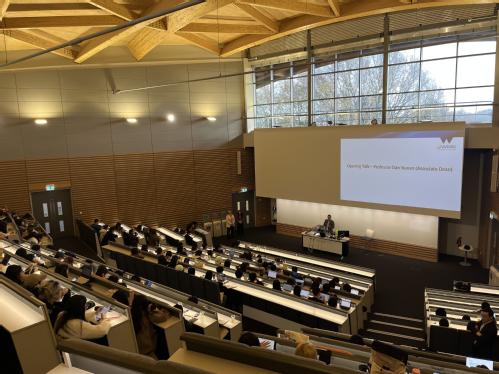
The students also heard from senior executives at industrial partners, including Dr Filomeno Martina, CEO and co-founder at WAAM3D, and Ms Shu Jia, Assistant CEO at Rexville Solutions, who shared more details about the projects available this year.
Ms Shu Jia explains: “The Company Collaboration Projects have brought great impacts to our business by helping us save costs of several millions. We are so happy to continue the collaborations on this with the ITSO programme at WMG.”
Dr Filomeno Martina comments: “WAAM3D is delighted to work together with WMG on the Company Collaboration Projects, which are a key aspect of our academic engagement. WMG’s projects are well organised and deliver highly valuable outputs. We feel honoured to support the WMG students with both their academic studies and professional development.”
ITSO student course representative, Rong Fu, says: “This event not only helps ITSO students to have a clearer understanding of the type of projects available, but also provides the opportunity to communicate with corporate staff and supervisors face-to-face. The CCP allow us the opportunity to apply what we have learnt in solving real-world problems which is extremely attractive and helpful for our future career development.”
Find out more about WMG’s International Trade, Strategy and Operations Master’s Programme here: MSc International Trade, Strategy and Operations | University of Warwick
If you represent a company who is interested in finding out more about CCP please email WMG’s Assistant Professor and ITSO Course Director, Dr Di Li, here: D.Li@warwick.ac.uk.
Life Sciences Research with Impact
The recently published BBSRC Impact Showcase 2023 presents a collection of impact stories arising from BBSRC investments. The showcase highlights the vital role bioscience has in addressing key strategic global challenges and features research by Professor Eric Holub to develop new varieties of beans compatible with the British Climate.
Find out more (Scroll down the homepage to find 'Homegrown production of designer dry beans').
Professor Andrew Oswald appointed chair of IZA Network Advisory Panel
Andrew Oswald, Professor of Economics and Behavioural Science in the Department of Economics at the University of Warwick has been appointed Chair of a new Network Advisory Panel of the IZA Institute of Labour Economics.
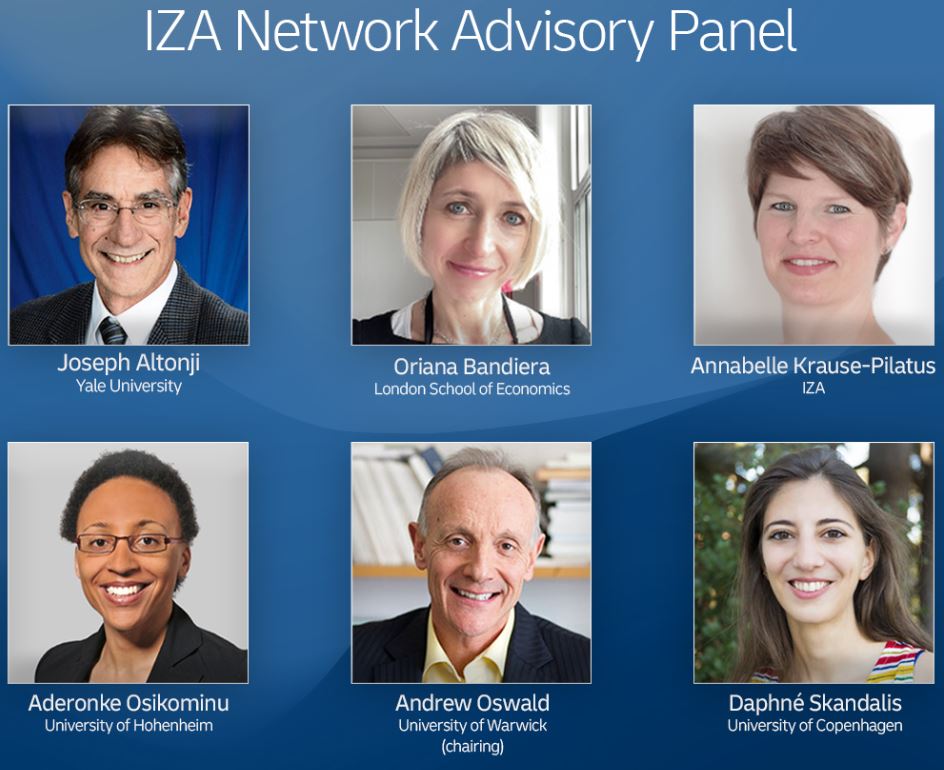
The new IZA Network Advisory PanelLink opens in a new window, chaired by Professor Oswald, will discuss, and make suggestions for, the future direction of the IZA research institute.
IZA Institute of Labour EconomicsLink opens in a new window, based in Bonn, is a research institute and the leading international network in labour economics, with around 2,000 scholars from over 60 countries. The institute also now covers behavioural economics. IZA members are dedicated to high-quality research on labour markets, inequality, and behaviour. To date, IZA has published over 16,750 discussion papers which are free for anybody in the world to download and read. It also publishes policy papers and has a substantial history of influencing economic policy in Germany and many other nations.
Last week the major newspapers in Germany, including Der Spiegel and Frankfurt Algemeine Zeitung, ran stories on the formation of the new Panel and its members.
IZA Network Advisory Panel:
- Joseph Altonji, Yale University
- Oriana Bandiera, London School of Economics
- Annabelle Kraus-Pilatus, IZA
- Andrew Oswald, University of Warwick
- Aderonke Osikominu, University of Hohenheim
- Daphne Skandalis, University of Copenhagen
Professor Oswald has been an active member of IZA since 1999 when he joined it as a Research Fellow and working as Acting Director of Research at IZA between 2011 and 2012. His research lies at the borders of economics, psychology, epidemiology and medicine and he worked on trade unions, labour contracts, the wage curve, entrepreneurship, job satisfaction, and the economics of happiness and mental health. He has also published papers on climate change and gives regular talks on climate emergency and policy action.
Professor Andrew Oswald said about his appointment:
"IZA is thought to be the largest network of research economists in the world. It seems to me an honour to be asked to chair this kind of distinguished Panel (it wouldn't greatly surprise me if it contains one or two future Nobel prize winners). It would be especially nice to think that the appointment might, in some small way, reflect Warwick's reputation in European and world economics.”
Relevant links
Professor Andrew OswaldLink opens in a new window – staff profile with a link to his personal website.
‘Financial Crime Across Disciplines: Global South Perspectives’ Symposium hosted at Warwick Law School.
The Global South Dialogue on Economic Crime Network, in collaboration with the Warwick Law School, hosted a 3-day symposium Centre on campus last week.
Digital pathology cleared for use in cancer screening programmes
New research supported by our Clinical Trials Unit has led to the UK government approving the use of digital pathology to help speed up analysis of cancer screening samples.
New paper published in Nature Physics
Dr Wei Peng, lead author with colleagues Professor Ana Sanchez, Professor David Walker and Steven Hindmarsh have worked collaboratively with other institutions to publish their paper titled Flexoelectric polarizing and control of a ferromagnetic metalLink opens in a new window in Nature Physics on Jan. 17, 2024.
Personalized Chronomodulated 5-Fluorouracil Treatment: A Physiologically Based Pharmacokinetic Precision Dosing Approach for Optimizing Cancer Therapy
This work is based on the discovery of diurnal variations impacting cancer therapy. Especially, use of chronomodulated treatment with 5-fluorouracil (5-FU) has gained significance. Studies indicate high inter-individual variability in diurnal variations in dihydropyrimidine dehydrogenase (DPD) activity – a key enzyme for 5-FU metabolism. However, the influence of individual chronotypes on chronomodulated therapy was unclear but is needed to optimize precision dosing of chronomodulated 5‑FU. Lead by the Thorsten Lehr's PKPD group at the University of Saarland, this collaborative paper is taking a treasure trove of patient 5-FU PK data amalgamated with DPD enzyme activity data from health people to establish a novel PKPD model of 5-FU that captures the extent of diurnal variations in DPD activity and can help investigate individualized chronomodulated 5-FU therapy through testing alternative personalized dosing strategies. Read the paper here.