
Departmental news
Lacuna Magazine publishes student story on the impact of Black role models and Black creative spaces
Xaymaca Awoyungbo, a final year undergraduate student studying History at the University of Warwick, has written an article for our Lacuna magazine titled: "If you can see it, you can be it: The impact of Black role models and Black creative spaces." Xaymaca speaks with author Sandra A Agard and explores Britain’s young Black creative networks.
Professor Celine Tan contributes to consultation on JET-IP
Professor Celine Tan from Warwick Law School contributed to the South Africa Presidential Climate Commission (PCC) Consultation on the Just Energy Transition Plan (JET-IP). The JET-IP is part of a multi-country funding initiative, the Just Economic Transition Partnership (JETP), by a coalition of developed countries to support a number of developing countries' transition away from dependence on coal and other fossil fuels.
The European World 1500-1800: An Introduction to Early Modern History Fourth Edition
Drawing on Warwick’s longstanding core module for the period, numerous early modernists have collaborated on a textbook which first appeared in 2009. Now in its fourth edition, The European World 1500-1800: An Introduction to Early Modern History (London: Routledge, 2023) has been adopted by many universities and used by generations of students across the globe.
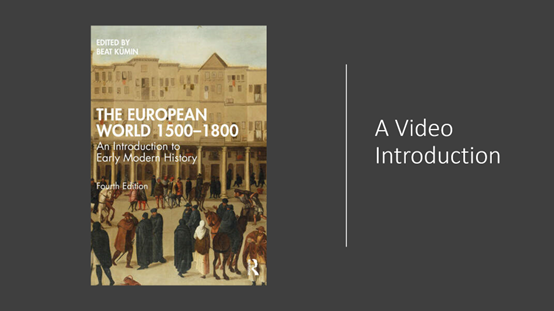
To mark the latest updates, which include two new chapters – on ‘Environments’ and ‘Food & Drink Cultures’, a fresh ‘all colour’ look and additional print as well as online features, Beat Kümin (editor) and William Rupp (assistant / website editor) have recorded a teaser & full video introduction at the historic church of Berkswell just a few miles from campus.
We hope that it will whet your appetite to find out more about The European World on the Routledge homepage and our companion website!
Thursday 4th May 2023 - Public Lecture "Three Puzzles about Pricing and Geometry"
Renato Paes Leme, Google Research New York
Thursday 4th May 2023 - MS.01 Zeeman building, at 18:15
As the famous Graham-Buffet quote says “price is what you pay; value is what you get" and every business success or failure is driven by the match or mismatch of the two. We will discuss a simple question in pricing algorithms: how to adjust prices over time to learn a buyer's valuation while minimizing revenue loss. This is a nice puzzle with a surprising solution. We will discuss the Kleinberg-Leighton algorithm and how to generalize it to multi-dimensional settings. There, we will do a detour to convex geometry and the theory of intrinsic volumes. We will also discuss how to measure the length of a potato.
Free attendance
There will be a reception after the lecture
Main contact point: K.G.Latuszynski@warwick.ac.uk
HRC Doctoral Fellowship Competition - Winners
We are pleased to announce the winners of the HRC Doctoral Fellowship Competition as follows:
Gennaro Ambrosino & Kerry Gibbons (SMLC) - ‘Archaeology, Psychoanalysis and Colonialism: The Return of the Repressed in European Culture in the Modern Age’
Ambika Raja & Ruth-Anne Walbank (English) - ‘Divine disasters: Exploring distressed landscapes in literature and theology’
Yue Su (Film & TV Studies) - ‘Forms and Feelings of Kinship in the Contemporary World’
GibsonGroup discover material to prevent phage infection
Bacteriophage (phage) are present wherever their bacteria hosts are. Phage have huge biotechnological potential, but lytic phages can also cause complete loss of bacterial cultures. For example in the food industry, or in every research laboratory, where rigorous sterile handing is the primary containment strategy. For industrial biotechnology using microorganisms to enable sustainable of chemicals, materials and drugs, phage infection must be addressed. In our latest (patent pending) work, in collaboration with the SagonaLab at Warwick, and Cytiva, we discovered that a simple polymer can prevent phage infection of bacteria when applied to the growth media. This process is simple, requires no change to working practises and prevents phage infections. We are still investigating the mechanistic aspects, but this is virustatic (inhibitory) rather than virucidal.
Read the press release here.
Read the paper here.
Genetically encoded imaging tools for investigating cell dynamics at a glance
The biology of a cell is the sum of many highly dynamic processes, each orchestrated by a plethora of proteins and other molecules.
Microscopy is an invaluable approach to spatially and temporally dissect the molecular details of these processes. Hundreds of genetically encoded imaging tools have been developed that allow cell scientists to determine the function of a protein of interest in the context of these dynamic processes. Broadly, these tools fall into three strategies: observation, inhibition and activation. Using examples for each strategy, in this Cell Science at a Glance and the accompanying poster, we provide a guide to using these tools to dissect protein function in a given cellular process. Our focus here is on tools that allow rapid modification of proteins of interest and how observing the resulting changes in cell states is key to unlocking dynamic cell processes. The aim is to inspire the reader's next set of imaging experiments.
Read the paper here.
The chemistry of global warming outreach style!
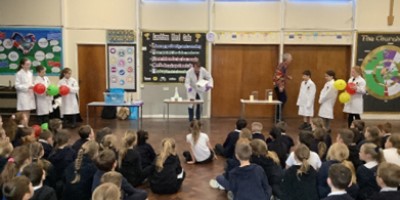
PhD student, Edward Lant, and Prof. Peter Sadler put on their lab coats (and matching multicoloured colour shirts!) to demonstrate the chemistry of global warming to St Nicholas Primary School childrenLink opens in a new window ,Alcester.
Funding awarded from Science and Technology Facilities Council
Congratulations to Dr Karolos Potamianos who has been awarded £287,845 from Science and Technology Facilities Council (STFC) for a research project titled 'Expanding the timing frontier: precision timing for particle tracking and identification.'
The funding will permit the procurement of a 12 GHz signal generator, a fast oscilloscope (<8ps per sample), and a logic analyser. These will enable the proper characterisation of ultra-fast silicon detectors and associated readout at realistic operating conditions, in particular enabling precise measurements of their (ultra-fast) response signals.
The research will be led by Dr Karolos Potamianos. He said,
"The use of fast silicon in collider detectors offers many new opportunities, as high-precision timing information enables distinguish between collisions occurring very close in space but well-separated in time. This will greatly help mitigate the effect of overlapping proton-proton interactions (pileup) at the High-Luminosity LHC. It is thus essential that we can properly characterise these detectors, which the procured equipment will enable. However, challenges such as ensuring proper operation of the detectors in a tough radiation environment and that sufficient bandwidth is available to transfer data out of the detector remain to make these detectors a reality at the LHC.”
RSC Dalton Conference comes to Warwick for 2023.
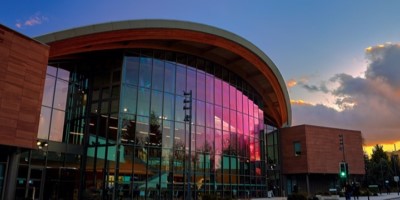
The RSC Dalton Conference came to Warwick for 2023, with 420 attendees and 130+ sessions highlighting the strength and depth of Inorganic Chemistry in the UK.