
Departmental news
Professor Penny Roberts New Book Release
Huguenot Networks - Truth and Secrecy in Sixteenth-Century Europe is the latest publication from Professor Penny Roberts, Professor of Early Modern European History, published by Cambridge University Press.
How did Huguenots stay connected in the 16th-century? And how did they maintain clandestine religious and political networks across Europe? Beginning with the chance discovery of an intriguing interrogation document, concerning correspondence to be smuggled from France to England hidden in a basket of cheese, this study explores the importance of truth and secrecy within Huguenot information networks.
Penny Roberts provides new insights into the transnational operation of agents: fanning out from confessional conflicts in Normandy to incorporate exiles in England, scholars and diplomats in Germany, the Swiss cantons and the Netherlands, and spy networks operating between France and Scotland.
Information Asymmetry and Cryptography
In a recent work, visiting undergraduate student Yahel Manor and Warwick DCS researchers Jinqiao Hu and Igor Oliveira addressed a fundamental question relevant to the security of cryptographic protocols.
The symmetry of information principle says that the amount of information that a sequence x of bits reveals about another sequence y is essentially the same in either direction. This is known to hold in an idealised world where computations can take an arbitrarily long time, as demonstrated by A. Kolmogorov and L. Levin in the 1970s. In contrast, modern cryptography is built around deliberate asymmetry—for example, functions of the form y = f(x) that are easy to compute but hard to invert (one-way functions).
The new work shows that, once one moves from the idealised setting of time-unbounded computations to the more realistic world of efficient, randomised computations (algorithms that must run quickly and may use randomness), this symmetry can fail in a strong and unconditional way. In other words, computational constraints can yield information asymmetry. In practical terms, this supports the intuition that information may not be extracted efficiently: knowing y = f(x) may not make x efficiently recoverable to the extent that an (ineffective) symmetry principle would suggest, even when x and y are closely related.
Earlier work formally tied an average-case form of this symmetry failure to the existence of one-way functions, the central primitive in cryptography. By proving new failures of symmetry of information, the authors provide concrete progress towards the computational asymmetry that underpins encryption, digital signatures, and many other cryptographic protocols.
This work will be presented at the 58th Annual ACM Symposium on Theory of Computing (STOC) in June 2026 in Salt Lake City, Utah, USA.
Failure of Symmetry of Information for Randomised Computations
Jinqiao Hu (University of Warwick); Yahel Manor (University of Haifa); Igor C. Oliveira (University of Warwick)
The paper describing this research is available here.
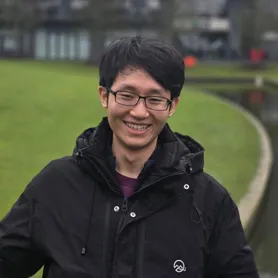
Jinqiao Hu, PhD student in the Department of Computer Science at the University of Warwick, and co-author of the new result.
Warwick Computer Science Celebrates Athena Swan Silver Award
The Department of Computer Science is delighted to announce that it has been awarded the Athena Swan Silver Award, recognising our commitment to advancing gender equality for staff and students.
Athena Swan is a UK-wide framework to improve gender equality in higher education. A Silver Award is given to departments that can demonstrate evidence of meaningful progress and impact over a 5-year period – and with a clear and ambitious plan for future action.
In their review, the assessment panel described our submission as "a strong Silver application which addresses all criteria very well."
Warwick Law Society is nominated for LawCareers.Net Award
Warwick Law Society has been nominated in the LawCareers.Net (LCN) Student Law Society Awards 2026 in not one, but four categories.
Martin Costa successfully defends his PhD thesis
Many congratulations to Martin Costa for passing his PhD viva, with Prof Long Tran-Thanh (Warwick) and Dr Christian Konrad (Bristol) as examiners. Martin has worked on two different fundamental topics in algorithms - clustering and edge coloring. His work on clustering led to a Google PhD fellowship, and his work on edge coloring (the topic of his thesis) led to a best paper award at STOC. During his PhD spanning 3 years, Martin published 7 papers in STOC/FOCS/SODA, 2 papers in ICML/NeurIPS, and 1 paper in ICALP. We wish him all the very best for the next stage of his career.
Warwick celebrates CenTax anniversary with Vice-Chancellor and University Council
University of Warwick Vice-Chancellor and President Professor Stuart Croft hosted members of the University Council and guests from across the University at an event to celebrate one of the university’s newest research centres, the Centre for the Analysis of Taxation (CenTax).
Founded by Warwick’s Professor Arun Advani and Dr Andy Summers of LSE, CenTax made its public debut during the 2024 party conference season and was formally launched with a Parliamentary reception that autumn.
The Vice Chancellor explained why the event was a slightly belated anniversary celebration: “We were planning on having the Warwick launch in November last year – but we couldn’t because the Chancellor of the Exchequer decided to have the budget on that same day and Arun and his team were rather busy.”
Describing the event as a “fireside chat,” the Vice Chancellor put questions to Professor Advani before inviting questions and comments from the floor.
Arun explained how CenTax grew from his working partnership with Dr Andy Summers at LSE: “I’ve been working with administrative tax data since it became available to researchers about thirteen years ago. Eight years ago I teamed up with Andy, who is a lawyer by background. And one of the great things about this interdisciplinary partnership is that while I have a good understanding of the numbers and how to use the data, I don’t always know where to look in terms of the tax system to explore some of the really niche issues.”
As the team grew, their research developed and their work gained public attention it made sense to formalise the partnership into a research centre to benefit from a more unified voice and additional resources.
According to Arun, an unexpected benefit of adopting a more formal identity has been greater engagement with the machinery of government - an organisation seems easier to bring into the government’s consultation structures than individual researchers.
Arun explained how engagement can include taking the CenTax team to the new Darlington Economic Campus for a day of presentations and workshops – “walking them through what we know, how we know it, how we can feel confident about it and how they can use that information in – say – submissions to the Office for Budget Responsibility (OBR) on spending proposals.”
“Given how much the fiscal numbers have ended up being a block on policy changes in the last few years, I think that’s the most powerful thing we can be doing at the moment.”
Invited to reflect further on how CenTax engages with government, Arun said: “The first thing to stress is that we are completely non-partisan. Before the last election we engaged with five of the major parties – in the main, they get in touch with us to ask for analysis. But often we do our own prospective work, on areas we think are important but others might not yet be considering. We also engage heavily with the civil service, which is where institutional knowledge is held in a way that outlasts the vagaries of the UK political system!”
“We engage carefully and thoughtfully with all of the different parties. We know the different interests that they have and what parts of our research they will engage over.
“It’s not always the easiest balance to manage. The first thing we do is help them understand where we as academics come from. They are used to a classic think tank that can be neatly put in a box – that’s a left think tank, that’s a right think tank. And we’re a kind of hybrid – a think tank in a university? And you’re a professor? What does that mean? It’s an interesting way into the conversation and a good way for us to explain that we are here to try and provide the best evidence."
“We try to start by listening a lot. What are they interested in? Why? The thing that we want to help any party with is not ‘tackling the problems we think the country has’ – it’s ‘tackling the problems they think the country has’. Finding the best evidenced solutions for their tax priorities.”
Reflecting on the experience of being in the eye of the political storm over inheritance tax changes, Arun said: “We don’t get to tell the government what to do. We say, ‘here is the current state of policy, here is what the effects of alternatives would be’ – and I think that is the proper role for us as academics and experts.
“The right place for us as experts is to give people – including the public, though the media –information, and then for MPs to debate in Parliament whether any policy trade-offs are worthwhile.”
Questions from the guests covered topics from public attitudes to tax levels, to whether there are any limits on political groups which academics could or should engage with, and what tax decisions were the best and worst in history.
- Visit the CenTax website to find out more about the Centre’s research and policy work.
Physics to host Sutton Trust Summer School
We are pleased to share that the Department of Physics will be hosting a 2026 Sutton Trust Physics and Astronomy Summer School, led by Dr Lauren Doyle.