
Departmental news
University of Warwick to lead clean energy storage revolution with £10 million gift
University of Warwick has received a transformational £10 million philanthropic gift from alumnus Tim Hartnoll to establish a pioneering new research centre dedicated to sustainable electrical chemistry research for new forms of batteries.
Pollution solution co-developed by Professor Anant Sudarshan reaches finals of 2025 Earthshot Prize
The world’s first cap-and-trade market for particulate matter, implemented in the Indian state of Gujarat through a pioneering partnership between the Gujarat Pollution Board and a team of researchers including Professor Anant Sudarshan, was one of the three finalists in the Clean Our Air category of this year’s Earthshot PrizeLink opens in a new window.
The four researchers who collaborated with the Gujarat authorities to design, launch and evaluate the project are Professor Michael Greenstone (University of Chicago), Professor Rohini Pande and Dr Nicholas Ryan, (both Yale) and Professor Sudarshan.
Earlier this year the impact of this pilot formed the subject of an article in Quarterly Journal of EconomicsLink opens in a new window finding high compliance, over 20 percent reductions in industrial emissions, and no increase in costs.
Commenting on the Earthshot nomination, Professor Sudarshan said:
“The Earthshot Awards are an opportunity to engage with some of the most exciting and important work on protecting our planet from across the world.
“We were the only academic research nominated, providing a wonderful opportunity to catalyse real world impact. Our team has already begun engaging with Brazil on their planned nation-wide carbon market in addition to scaling up the market in other parts of India.”
The Earthshot Prize was founded in 2020 as the personal initiative of HRH Prince William to discover and support the best examples of climate and environment leadership and problem-solving around the world. Each year 15 finalists are chosen from thousands of nominations, across 5 Earthshot themes. All 15 finalists each year become members of The Earthshot Fellowship programme.
The 2025 Clean Our Air finalists were the State of GujaratLink opens in a new window, for pioneering the world’s first trading scheme for particulate emissions; the City of GuangzhouLink opens in a new window, for its rapid transition to electric buses and taxis; and this year’s winner, the City of BogotaLink opens in a new window, for coordinated action across transport, freight, and green infrastructure to improve urban air quality.
Commending the Gujarat scheme, the Earthshot organisers said:
“the scheme is now regarded as gold-standard evidence that emissions trading is not only environmentally and economically beneficial, but it can succeed in tackling the severe pollution challenges faced by rapidly developing economies in the Global South.”
Opening the Rio awards ceremony, Prince William said:
“Our finalists are a shining example of how we can build stronger economies, design healthier cities, and create better jobs for the next generation. When we unite, our momentum is unstoppable – the momentum to achieve truly astonishing impact, faster than imagined.”
Building on the momentum from the successful Gujarat scheme, the research team has launched an Emissions Market Accelerator partnership to work with governments across the Global South who are interested in exploring whether a similar market approach will work for them.
6 November 2025
- Read about the emissions trading market project on the Earthshot website: The State of Gujarat - The Earthshot Prize 2025 Finalist
- Read our news reportLink opens in a new window about the emissions trading market .
- The research team was awarded funding to scale the market by the University of Chicago, J-PAL’s King Climate Action Initiative (K-CAI), and J-PAL South Asia's Solutions and Advancements through Research for Water, and Air (SARWA) and Alliance for Scaling Policy Impact through Research and Evidence (ASPIRE).
CenTax key part of new coalition calling for tax reform
The Centre for the Analysis of Taxation (CenTaxLink opens in a new window), jointly founded and led by Warwick Economics Professor Arun Advani, is a key member of a coalition of think-tanks from across the political spectrum which has today launched a call for fairer, pro-growth reform – without raising overall levels of taxation.
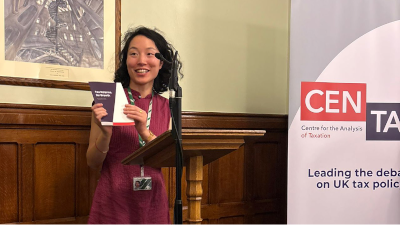
Tax Reforms for Growth, co-authored by experts from think tanks including the Centre for the Analysis of Taxation (CenTax), the Centre for Policy Studies (CPS), the IPPR, the Adam Smith Institute, the New Economics Foundation, Bright Blue and the Joseph Rowntree Foundation (JRF), outlines seven revenue-neutral reforms that they argue would make the UK’s tax system fairer, more effective and more pro-growth.
The team of authors spans the political spectrum but share a view that the UK’s tax rules are outdated and distortionary, that they are holding back investment and productivity – and that change is possible whatever the overall tax take.
The report highlights seven key areas for reform:
- Replace outdated property taxes with a modern system based on current values. This would involve abolishing Stamp Duty and reforming Council Tax and Business Rates.
- Lower VAT while broadening the base. Compensate lower income groups for higher costs on basic goods.
- Address marginal income tax rates that punish work. This includes reducing the marginal rate that applies to the removal of childcare subsidies.
- Tax income from work equally. Merge Income Tax and National Insurance to remove distortions.
- Tax landlords on profits as other income. Allow a full deduction for mortgage interest costs, or equivalent allowance for the cost of borrowing.
- Reform Capital Gains Tax. Introduce an ‘investment allowance’ while tackling exemptions.
- Reform Corporation Tax. Give upfront tax relief for all business expenditure and end the capital/income distinction in tax law.
The joint report was launched on Wednesday 5th November at a Parliamentary reception attended by MPs from all parties.
Professor Arun Advani, Director of CenTax, said:
The UK’s tax code is riddled with inconsistencies and distortions that discourage investment, penalise work and hold back productivity. There is widespread agreement on the need for proper reform. The upcoming Budget is an opportunity for the Chancellor to look at the taxsystem as a whole, and ensure that whatever the total tax take, any changes are also serving her growth mission.
Robert Colvile, Director of the Centre for Policy Studies, said:
There are all kinds of disagreements among think tanks about the ideal level of taxation, but a surprising level of consensus about the problems with the current system. Whatever your political position, it’s hard to argue that we have a tax system that’s clear, consistent and pro-growth. Hopefully, politicians will be inspired by the broad support for tax simplification across both left and right.
5 November 2025
Photo: Yuan Yang MP speaks at the report's Parliamentary launch.
- Tax Reforms for UK Growth is a joint publication by Andy Summers – Director, Centax; Arun Advani – Director, CenTax; Carsten Jung - Associate Director for economic policy and AI, the IPPR; Chris Belfield – Principal Policy Adviser, JRF; Dan Neidle – Founder, Tax Policy Associates ; Robert Colvile – Director, Centre for Policy Studies; Hannah Peaker – Deputy CEO, New Economics Foundation; James Howat – Chief Economist, Labour Together; James Lawson – Chairman, Adam Smith Institute; Ryan Shorthouse – CEO, Bright Blue
- All proposals are revenue neutral and reflect areas of consensus among economists and policy experts across the political spectrum.
- Read the full report on the CenTax website hereLink opens in a new window.
£2.3M boost to revolutionize optical and mechanical metamaterials
Researchers from the University of Cambridge and the University of Warwick have secured £2.3M in UKRI funding to create materials with radically new optical and mechanical properties, that can be produced at scale and low cost.
Landmark reform of weddings law linked to weddings study
The Government has announced plans to reform weddings law in England and Wales in a move set to completely overhaul how and where couples can marry. This is the biggest change to weddings law in over two hundred years.
Cutting-Edge Semiconductor Innovation on Display at This Year’s REWIRE IKC Showcase
Leaders from academia, industry, and government gather to spotlight next-generation power electronics driving the UK’s net zero transition.
New antibiotic for drug-resistant bacteria found hiding in plain sight
Prof Chris Corre, Prof Greg Challis and Dr. Lona Alkhalaf from the University of Warwick and Professor David Lupton rfrom Monash University have discovered a promising new antibiotic that shows activity against drug-resistant bacterial pathogens, including MRSA and VRE.
In a new study published in the Journal of the American Chemical Society (JACS), researchers from the Monash Warwick Alliance Combatting Emerging Superbug Threats Initiative have discovered a promising new antibiotic - pre-methylenomycin C lactone. The new antibiotic was found ‘hiding in plain sight’ as an intermediate chemical in the natural process that produces the well-known antibiotic methylenomycin A. When tested for antimicrobial activity, one of the intermediates, pre-methylenomycin C lactone, was shown to be over 100 times more active against diverse Gram-positive bacteria than the original antibiotic methylenomycin A. Specifically, it was shown to be effective against S. aureus and E. faecium, the bacterial species behind Methicillin-resistant Staphylococcus aureus (MRSA) and Vancomycin-resistant Enterococcus (VRE) respectively.
Importantly, the researchers could not detect any emergence of resistance to pre-methylenomycin C lactone in Enterococcus bacteria under conditions where vancomycin resistance is observed. Vancomycin is a “last line” treatment for Enterococcus infection, so this finding is especially promising for VRE, a WHO High Priority Pathogen.
With its simple structure, potent activity, difficult to resist profile, and scalable synthesis, pre-methylenomycin C lactone represents a promising new candidate that could potentially help to save some of the 1.1 million people who are the victims of AMR every year.
StayRose: a photostable StayGold derivative red-shifted by genetic code expansion
StayRose: a photostable StayGold derivative red-shifted by genetic code expansion was published in the Journal of Biological Chemistry last week by a team of scientists from the groups of Mohan Balasubramanian (WMS), Masanori Mishima (WMS), Allister Crow (SLS), Falk Schneider (WMS), Abhishek Kumar (Marine Biological Laboratory) and Lijiang Song (Warwick Chemistry), funded by a collaborative Wellcome Trust bioimaging grant.
This work was led by first author Dr Will Smith, who completed his PhD as part of the MRC DTP.
The work presents a new fluorescent protein named StayRose, which is the first red version of the photobleaching-resistant green protein StayGold. These photostable proteins can be tagged to proteins of interest for microscopy and overcome the previous issue of fluorescence loss during prolonged imaging. StayRose contains an unnatural amino acid, 3-aminotyrosine, which underpins its red colour. Tests showed that StayRose maintains the extreme photostability of StayGold. The work presents a StayRose crystal structure, the first of a 3-aminotyrosine-incorporating fluorescent protein, and demonstrates use of StayRose in bacteria and zebrafish embryos.
Read the paper here.Link opens in a new window
Cyclic Peptide–Polymer Conjugate Nanotubes for Delivery of SN-38 in Treatment of Colorectal Cancer Model
A recent publication in Advanced Healthcare Materials led by PhD student Sophie Hill is the result of a collaboration between Sébastien Perrier and Robert Dallmann. Together they show the potential of cyclic peptide-polymer conjugate nanotubes as powerful drug delivery vectors in a mammalian model of human disease.
The Perrier lab has already shown that these nanotubes are great drug delivery tools due to their propensity for dynamic self-assembly, high aspect ratio morphology and structural interchangeability, and demonstrated the shielding abilities of the polymeric corona of nanotubes to enhance pro-drug bond stabilities and modulate hydrolysis.
Here, they have used a hydrophobic core with multiple drug units attached to improve drug loading capacity and overall efficiency of the nanotube carriers. They show in vitro efficacy and in vivo pharmacokinetic and anti-tumour pharmacodynamics of these nanotubes in colorectal cancer models, comparing the potent topoisomerase inhibitor SN-38 with its clinically-used parent pro-drug irinotecan.
This work highlights the potential of SN-38 nanotubes as well-tolerated therapeutic option for colorectal cancer, with implications for future clinical translation and improved patient outcomes.
Read the paper here.Link opens in a new window