
Departmental news
Warwick welcomes first cohort to pioneering Economics and Management degree
If the new BSc in Economics and Management degree traced the geographic diversity of its first intake, it would be taking a journey across the world – from the Gothic spires of Europe and the vast steppes of central Asia to the innovation hubs of India.
And then it would proceed through China, maritime Southeast Asia and Australia, before looping back through the dramatic terrains of Mauritius and Nigeria.
Over 100 students representing more than 20 nationalities have joined the inaugural year of this joint degree offered by the Department of Economics in partnership with Warwick Business School.
Over the next three or four years they will be taking their own journeys through a programme that combines theoretical economics with the practical skills needed for management in businesses and organisations.
Dr Isleide Zissimos, Director of Joint Degrees in the Department of Economics said:
“Economics sharpens the mind; Management drives action. Together, they equip future leaders to make a difference in the world.”
Dr Matie Toma, Assistant Professor of Behavioural Science and WBS Course Director of the BSc Economics and Management added:
“It’s inspiring to see such a diverse cohort of students, embarking on a programme that itself thrives on the integration of diverse perspectives. “This degree is not just about acquiring knowledge – it’s about preparing students to become agile thinkers and responsible leaders in a complex world. In today’s rapidly changing business environment, it is becoming increasingly important for managers to be equipped with the ability to perform economic policy analysis and to integrate broader economic issues into their general management thinking."
The BSc programme will enable participants to develop a solid understanding of fundamental concepts of micro and macroeconomic analysis and provide them with a strong foundation in basic data analysis techniques and concepts of statistical analysis.
The interdisciplinary nature of the course will prepare students for a wide range of careers, including consulting, policy analysis, data analytics, business management, finance, technology, and civil service.
Professor Jeremy Smith, Head of Department of Economics commented:
“We are proud to welcome students from across the world to a programme that not only builds analytical and managerial expertise but also fosters the kind of cross-cultural understanding essential for leadership in a globalised economy.”
Mark Johnson, Professor of Operations Management and Associate Dean of Undergraduate Programmes at Warwick Business School, said:
“Our ongoing dialogue with employers has revealed a real need from businesses and organisations for graduates who can combine management skills with an understanding of economics and some of the tools needed to navigate the economic landscape.”
The BSc Economics and Management course draws on the research excellence of the University of Warwick’s renowned Department of Economics with that of the BSc Management degree at Warwick Business School, which are ranked respectively number one and number two in the UK in their fields by The Times and Sunday Times Good University Guide 2026.
The Department of Economics has been ranked second in the UK by the most recent Research Excellence Framework (REF) while the REF has rated 93 per cent of Warwick Business School's research 'world-leading' or 'internationally excellent'.
Teaching at Warwick has also earned the UK Government's highest gold standard in the Teaching Excellence Framework (TEF).
While students on the joint degree course will develop the analytic rigour of classic economics and core management competencies such as leadership, adaptability and critical thinking, the curriculum also offers flexibility though optional modules such as Behavioural Economics and Entrepreneurial Finance.
In the third year, students may opt for a work placement applying their skills and knowledge in a real work setting before returning to Warwick for their final year.
Graduates from WBS and the Department of Economics have gone on to work for global names like Goldman Sachs, Unilever, Amazon, Google, PwC and UK Government bodies such as the Department for Business and Trade.
Professor Johnson said:
“At Warwick Business School we are for the Change Makers, those restless to change the world for the better. This course will enable students to gain the skills and knowledge to have a positive impact with any career they choose to build.”
Alex Trickey, one of the students on the programme has told us about their hopes and aspirations for the next 3 years at Warwick:
"I chose to study economics and management because I’ve always had an interest in knowing how people get what they want, and that is vaguely what economics is. Studying at A level, I realised I could pursue this interest further, and so threw myself in to local economics competitions and my studies. Management interested me because I, having been apart of the air training corps for 4-5 years, have been exposed to not only management styles of schools, casual workplaces, but also a vaguely military style. This highlighted the existence of differences in management to me, which inspired me to do some extra curricular reading, where I realised management would be something I would love to study, too.
"For the next few years of this course I hope to improve my course related skills significantly, learn to live independently, make use of as many opportunities as possible, improve my health and fitness, and all together have an awesome time! "
For more information about this undergraduate degree, please visit the study page: BSc Economics and Management or get in touch with us if you have a query at economics.admissions@warwick.ac.uk.
New study highlights equity gap in accessing menopause care
Warwick Medical School research has explored how women experience menopause and access care within the NHS, focusing on inequalities shaped by ethnicity, socioeconomic status, and cultural norms.
WLS students share their Thrive experience
Finalist LLB student Naveera Abhayawickrama and third year Law and Sociology student Virginia Choi have shared their experience of the Warwick Thrive programme and why they believe it is an excellent opportunity for our students.
Warwick Horizon Europe Seed Fund 2025-26
We are hereby launching the Warwick Horizon Europe Seed FundLink opens in a new window for the academic year 2025-26. The fund aims to support Warwick academics and researchers to engage with the Horizon Europe programme.
The Seed Fund provides funding between £3 K- £7.5 K/ award for projects made under one of the three routes:
- Route 1: Collaborations (max. £7.5K/ award)
- Route 2: Brokerage Events (max. £3K/ award)
- Route 3: Consultancy Services (max. £7.5K/ award)
Further details on the Routes can be found on the Warwick Horizon Europe Seed FundLink opens in a new window webpage.
Applications consist of one summary CV per proposal (including details of all relevant collaborators/ consultancy services where applicable) and the completed Application Form (download from ‘How do I apply?’ on the call pageLink opens in a new window). Submit applications to the call manager, Lelia Buretia lelia.buretia@warwick.ac.uk.
The next deadline is: Wed 3 December 2025 at 5pm (GMT). Decisions are to be communicated by the end of w/c 15 December. Projects may start immediately but no later than 2 months after receiving the outcome notification. If sufficient funds remain after the December panel, a second deadline will be available in March (Wed 4 March 2026 at 5pm), with decisions from the March panel to be communicated by the end of w/c 16 March 2026. Please note that the March panel is not guaranteed and is dependent on the remaining availability of funds at that point, therefore earlier applications, i.e. to the December deadline, are encouraged.
All projects and all project expenditure must be finalised by 31st July 2026. No project extensions are possible past this date. Any funds unspent by 31st July 2026 will need to be returned.
Prof Swaran Singh named in list of top 50 most influential BAME health leaders
Professor Swaran Singh has been named in Health Service Journal’s (HSJ) list of the top 50 most influential Black, Asian and Minority Ethnic people in English health and care.
Medherant announces positive initial Phase 1 clinical trial results for testosterone patch for women
Warwick spin-out Medherant has reported positive results from its initial first-stage clinical trial at Hammersmith Medicines Research (HMR); London. The announcement comes as Menopause Awareness Month is celebrated, which focuses us on this major change in women’s lives.
Professor Sascha Becker formally inducted as Fellow of the Econometric Society
Professor Sascha Becker was formally inducted as a Fellow of the Econometric Society at its 2025 World Congress by Society President Larry Samuelson.
The Econometric Society World Congress takes place every five years and is attended by members from around the world. The 2025 World Congress was held in Seoul, Korea.
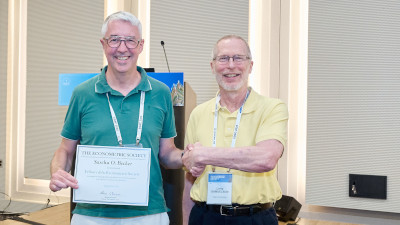
Alongside a programme of scientific discussion, social and cultural events, the Congress hosts a New Fellows Awards Ceremony to welcome all fellows elected since the previous meeting. Sascha was elected in 2024 in recognition of his contribution to the discipline
Sascha said: “I was deeply honoured to be elected as a Fellow of the Econometric Society in 2024.”
“It was great to meet many of the other newly elected Fellows at the New Fellows Awards Ceremony in Seoul this August, and to receive the award certificate from President Larry Samuelson.
“I look forward to continuing to contribute to the field and to supporting the next generation of economists in their research endeavours."
ENDS
- The Econometric Society is an international society for the advancement of economic theory in its relation to statistics and mathematics. It publishes important economic journals: Econometrica, Quantitative Economics, Theoretical Economics as well as the Monograph Series. It also organises annual scientific meetings in six regions of the world and a World Congress once every five years.
New Policy Brief on Body Image and Trade Mark Law
The Law School’s Dr Luminita Olteanu has co-authored a new Policy Brief with Professor Ilanah Fhima from UCL Laws. The Policy Brief titled ‘Body Image and Trade Mark Law: A Policy Proposal’ is the result of the Strategic Brand Signalling Roundtable held on 16 June 2025 at Bentham House, with support from IBIL and Warwick Law School.